

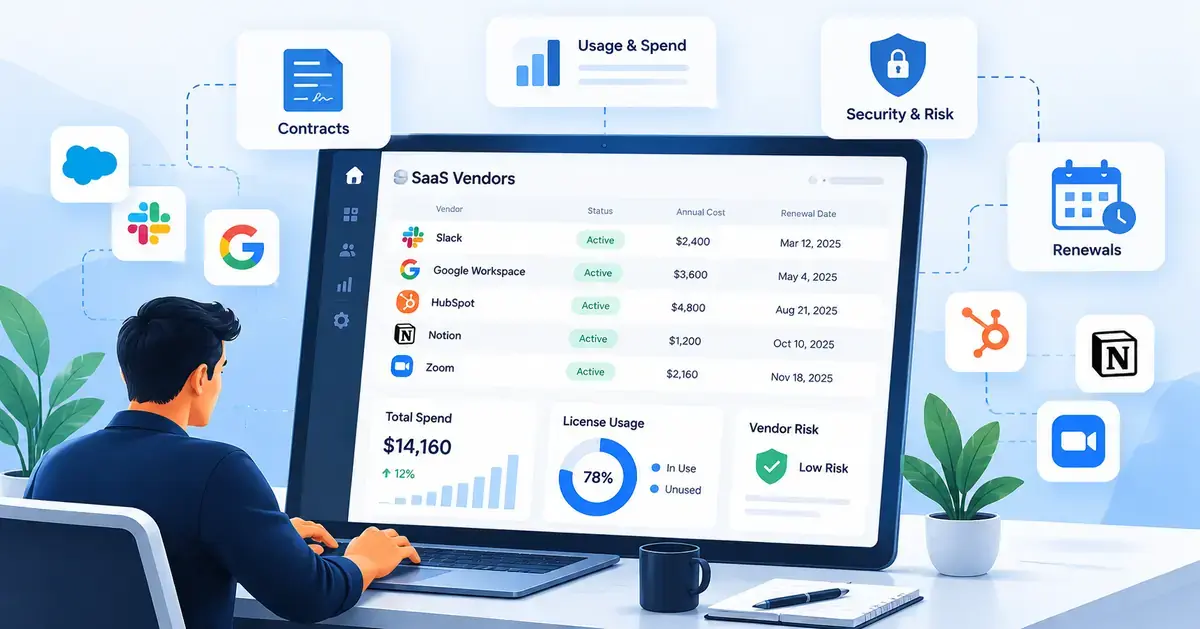
Managing SaaS vendors involves more than selecting software and paying subscription bills. Businesses also need to keep contracts organized, monitor performance, control spending, assess security risks, and ensure each tool continues to deliver value.
Without a clear process, teams can miss renewal deadlines, pay for unused licenses, or continue working with vendors that no longer meet their needs. As a company adds more applications and departments, keeping track of everything becomes increasingly challenging.
This guide explains how to manage SaaS vendors effectively, which metrics to monitor, how to prepare for renewals, and when dedicated management tools are worth considering.
What Is SaaS Vendor Management?
SaaS vendor management is the ongoing process of selecting, monitoring, and maintaining relationships with software as a service providers. It covers the financial, commercial, operational, and security aspects of those relationships throughout the vendor lifecycle.
Consider a startup that uses separate platforms for customer relationship management (CRM), email marketing, accounting, customer support, and project management. Each subscription comes with its own pricing, contract terms, access permissions, and renewal deadlines.
SaaS vendor management brings these details together, giving teams a clearer picture of their software commitments and helping them make informed decisions.
SaaS Vendor Management vs. Procurement vs. Vendor Evaluation
Although these activities are closely related, each serves a different purpose.
- SaaS procurement involves identifying business needs, comparing solutions, obtaining approvals, and purchasing software.
- SaaS vendor evaluation determines whether a provider meets the company’s business, technical, financial, and security requirements.
- SaaS vendor management continues after the purchase, covering costs, performance, contracts, risk reviews, renewals, and offboarding.
For a closer look at the purchasing process, read SaaSyntic’s guide to the SaaS procurement process.
Why SaaS Vendor Management Matters
A structured approach gives businesses better visibility into their software relationships and helps prevent avoidable operational problems.
The main benefits include:
- Better cost control: Identify unused licenses, overlapping tools, and unexpected charges.
- Stronger risk management: Track security requirements, vendor incidents, and unresolved compliance concerns.
- Clear accountability: Assign responsibility for each vendor, contract, and renewal.
- Improved performance: Check whether software meets agreed service levels and business requirements.
- Greater flexibility: Understand data export options and switching costs before becoming too dependent on a provider.
For example, a marketing team might pay for two platforms with overlapping email automation capabilities. Reviewing actual usage could reveal that one subscription is no longer necessary. The potential savings come from understanding what the team needs, rather than relying solely on price negotiations.
The SaaS Vendor Management Lifecycle
An effective SaaS vendor lifecycle management process covers seven stages. Smaller businesses can manage them with a spreadsheet and calendar reminders, while larger organizations may need more formal workflows.
Step 1: Build a Centralized Vendor Inventory
Start by listing every SaaS application the business uses, including subscriptions purchased directly by individual departments.
Your vendor register should include:
- Vendor and product name
- Business purpose and internal owner
- Subscription cost and billing frequency
- Contract start and end dates
- Renewal notice period
- Licensed users and usage information
- Data access and security classification
- Cancellation and data export requirements
This inventory provides the foundation for future decisions. Review invoices, payment records, and departmental software lists to uncover subscriptions that might otherwise go unnoticed.
Step 2: Assign Owners and Classify Risk
Every important vendor should have a designated internal owner. That person coordinates reviews, tracks issues, and checks whether the software continues to meet business needs.
Not all vendors require the same level of oversight. A platform that handles sensitive customer information or supports a critical business process deserves more attention than a low risk application used occasionally by a small team.
For higher risk vendors, review access controls, data handling practices, incident notification commitments, and relevant security documentation. SaaSyntic’s guide to a SaaS vendor security assessment offers further guidance on evaluating vendor security.
Step 3: Establish Contract and Approval Controls
Keep contracts, order forms, pricing schedules, service level agreements (SLAs), and renewal terms in one accessible location.
Before signing or renewing a contract, check:
- Automatic renewal provisions and notice deadlines
- Price increases and minimum user commitments
- Usage based fees and overage charges
- Support commitments and service credits
- Data ownership, export, and deletion terms
- Termination rights and migration requirements
An attractive introductory price doesn’t necessarily reflect the long term cost. Understand the full commercial commitment and how expenses could change as your team grows.
Step 4: Track Spending, Licenses, and Usage
Subscription costs tell only part of the story. A tool might appear affordable on a per user basis but still offer poor value if employees rarely use it.
Compare active users with purchased licenses, look for overlapping capabilities, and investigate charges that differ from the expected budget.
Suppose a company pays for 40 licenses, but only 24 employees regularly use the application. The vendor owner should investigate whether the remaining licenses are necessary. Some might be reserved for seasonal demand or upcoming hires, so check operational requirements before removing them.
Step 5: Monitor Vendor Performance
Set clear expectations for each important vendor and review whether those expectations are being met.
Useful indicators include service availability, support response times, unresolved incidents, user adoption, integration reliability, and business outcomes.
The right metrics depend on the software. A customer support platform might be assessed on reliability and workflow efficiency, while an analytics tool may be judged on data accuracy and reporting usefulness.
Keep records of recurring problems and agree on corrective actions with the vendor. If performance doesn’t improve, consider renegotiating the contract, changing the service arrangement, or switching providers.
Step 6: Prepare for Renewals Early
Create a renewal calendar based on the notice periods specified in your contracts. Start reviewing important renewals well before their deadlines so there’s enough time to negotiate terms or evaluate alternatives.
Before renewing, ask:
- Does the team still need the software?
- Are employees using the available licenses?
- Has the vendor met its service and support commitments?
- Is the pricing competitive for the capabilities required?
- Would switching providers cause significant disruption?
A renewal should reflect the software’s current value and the cost of switching, not simply the convenience of continuing the subscription.
Step 7: Renew, Replace, or Offboard
If a vendor continues to meet your needs, renew under terms that reflect current usage and expected growth. If it falls short, compare the options for resolving problems, renegotiating the agreement, or finding another provider.
Offboarding requires careful planning. Account for data exports, migration, account deactivation, integration removal, and confirmation of data deletion where applicable. Assign responsibilities before cancelling the service to avoid losing important information or disrupting essential operations.
SaaS Vendor Management Best Practices
Good vendor management depends on consistent processes, not necessarily expensive software. A few practical habits can make the work easier as your business grows.
- Maintain a single source of truth. Keep vendor details, costs, contracts, owners, and renewal dates together.
- Review actual usage. Compare license assignments and activity with business needs before increasing or renewing commitments.
- Set clear responsibilities. Coordinate finance, IT, procurement, security, and business owners according to the size and risk of each purchase.
- Automate reminders where possible. Use calendar alerts or workflows to flag renewal deadlines, contract reviews, and usage thresholds.
- Document important decisions. Record performance issues, agreed improvements, security reviews, and the reasons for renewing or switching.
The FinOps Foundation also recommends bringing SaaS spending, usage, licensing, and renewal information together to support better informed decisions. Its FinOps guidance for SaaS provides additional detail.
SaaS Vendor Management Checklist
Use this checklist during regular reviews and before major renewals.
- Every active subscription has an owner and a documented business purpose.
- Costs, license counts, and usage are reviewed.
- Contract terms and renewal notice periods are recorded.
- Security and privacy requirements reflect the vendor’s risk level.
- Performance issues and corrective actions are documented.
- Renewal decisions consider business value, alternatives, and switching costs.
- Offboarding procedures cover data export, access removal, and deletion requirements.
How to Measure SaaS Vendor Performance
Choose metrics that help you make decisions rather than collecting numbers that have little practical value.
| Metric | What it tells you |
| SLA compliance | Whether agreed service commitments are being met |
| License utilization | Whether purchased licenses are being used effectively |
| Support resolution time | How quickly reported issues are resolved |
| Subscription cost trend | Whether spending is increasing as expected |
| Business outcome | Whether the tool supports its intended purpose |
License utilization, for example, can be calculated as follows:
License utilization = (Licenses in use ÷ Licenses purchased) × 100
If 24 of 30 purchased licenses are in use, utilization is 80%. That figure is a reason to investigate, not an automatic instruction to cancel six licenses. Check upcoming hiring plans, seasonal demand, and contractual restrictions before making changes.
SaaS Vendor Management Tools: What Should You Use?
The right approach depends on how many subscriptions you manage, how complex your contracts are, and the risks involved.
| Approach | Advantages | Limitations | Best for |
| Spreadsheet and calendar | Low cost and easy to customize | Manual updates and limited automation | Small businesses |
| Contract management software | Centralized agreements and contract workflows | May not provide detailed license usage data | Teams managing many contracts |
| SaaS management platform | Can consolidate application, license, spending, and renewal information | Additional cost and implementation effort | Businesses with complex SaaS portfolios |
A spreadsheet is a practical starting point if you manage relatively few subscriptions and can keep the records accurate. Dedicated software becomes worth considering when manual tracking becomes unreliable, renewal deadlines are difficult to monitor, or license and spending reviews take too much time.
Before investing in another platform, check whether your existing finance, identity management, or IT systems already cover some of these needs. The aim is to improve oversight without adding unnecessary software costs.
Common SaaS Vendor Management Mistakes
Even a well organized process can fall short if teams overlook a few important details.
- Tracking contracts but ignoring usage: Knowing when a contract expires doesn’t tell you whether the software still delivers value.
- Waiting until renewal week: Last minute reviews leave little time to negotiate or evaluate alternatives.
- Treating every vendor equally: Critical systems and vendors handling sensitive information may need more oversight than low risk tools.
- Ignoring exit requirements: Difficult data exports and poorly planned migrations can make switching expensive.
- Automating a broken process: Reminders help, but they can’t compensate for inaccurate records, unclear ownership, or poor decisions.
FAQ’s
What is the difference between SaaS vendor management and SaaS procurement?
SaaS procurement focuses on identifying, evaluating, approving, and purchasing software. SaaS vendor management covers the ongoing relationship, including spending, performance, contracts, risk reviews, renewals, and offboarding.
How can small businesses manage SaaS vendors?
Start with a centralized spreadsheet containing vendor names, subscription costs, owners, contract dates, renewal deadlines, and usage information. Assign responsibility for each subscription and schedule regular reviews. Introduce dedicated software when manual tracking becomes difficult to maintain.
How often should SaaS vendors be reviewed?
Review spending, usage, and upcoming renewals regularly, such as monthly or quarterly, depending on the business. Security and performance reviews should reflect vendor risk, contractual commitments, and significant changes. Critical vendors may require more frequent monitoring.
When should a business switch SaaS vendors?
Consider switching when a provider repeatedly fails important service commitments, costs no longer justify the value, essential requirements remain unmet, or significant risks go unresolved. Before deciding, compare alternatives and account for migration expenses, data portability, implementation time, and potential business disruption.
Conclusion
Effective SaaS vendor management gives businesses control over their software relationships long after the initial purchase. By maintaining accurate vendor records, assigning clear ownership, monitoring usage and performance, and preparing for renewals early, teams can make more informed decisions about their software investments.
Start with a simple vendor register and renewal calendar. Review them consistently, address risks according to their impact, and introduce automation or dedicated management tools when your needs justify the investment.
The goal isn’t to manage more software. It’s to ensure every SaaS relationship continues to support the business at an acceptable cost and level of risk.