
Have you ever felt like your marketing team ends up spending more time managing campaigns than actually growing the business? One day you are welcoming new trial users, the next day you are chasing inactive leads, sending follow up emails, and trying to understand why those promising prospects never convert. And as your SaaS business keeps getting bigger, all those repeating tasks start stacking up fast.
That’s exactly why SaaS marketing automation tools have become a kind of must-have for basically every successful software company’s growth plan.
Modern automation platforms don’t just schedule emails anymore. They let teams interpret customer behavior, tailor messaging, nurture leads on autopilot, and craft a smoother kind of customer journey across the whole buying path. Instead of depending on manual follow ups, your marketing keeps moving, working 24/7.
But since there are dozens of platforms all saying they are the best, picking the right one can feel messy at first.
In this guide, we’ll walk through the best SaaS marketing automation tools available today, explain what makes each platform different, and show you how to select one that truly fits your business goals.
Why are SaaS marketing automation tools becoming a necessity?
When you grow a SaaS business, you end up dealing with thousands of customer conversations every month. New users sign up for free trials, current customers check out those new features, and interested buyers download little guides or register for webinars. Each of those moments, even the small ones, is a chance to build up a stronger connection, kinda directly and kinda indirectly too.
Trying to handle all of that by hand just doesn’t scale, not even close.
This is where marketing automation software really kicks in and changes the whole game.
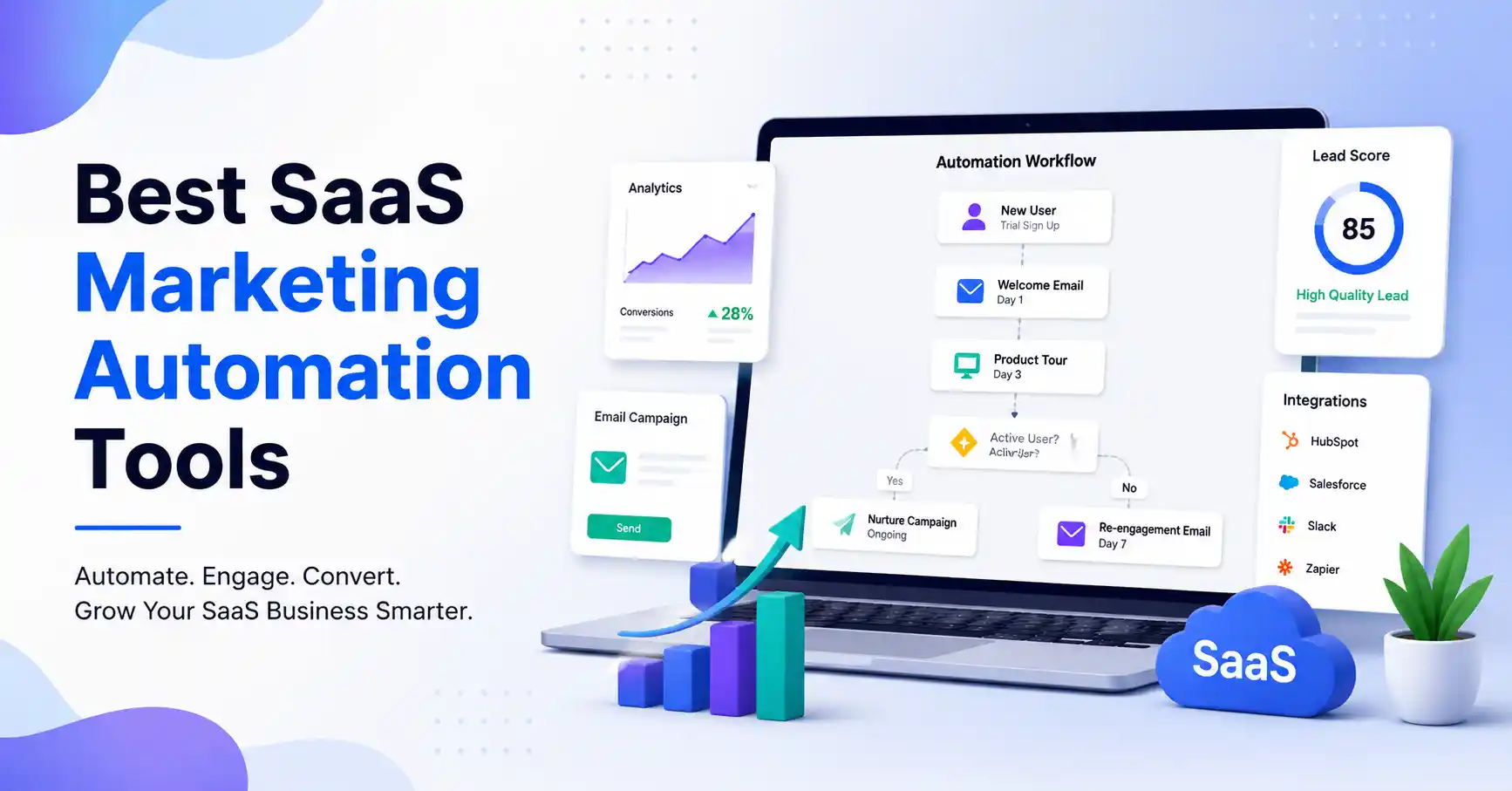
Instead of blasting the same message to every single person, automation platforms launch tailored communication that’s based on what the customer actually does. A fresh trial signup might get a sequence of onboarding emails, someone who hasn’t logged in lately gets re-engagement assets, and a user actively poking around premium features will see upgrade suggestions, on time and in context.
So you get a smoother customer experience without stacking even more tasks on your marketing team’s plate.
Marketing strategist Daniel Reeves puts it pretty well, more or less:
“The goal of automation isn’t sending more emails. It’s delivering better experiences at exactly the right moment.”
And yeah, that straightforward idea is also why automation keeps showing up as one of the best, highest-return investments for SaaS companies.
Which SaaS marketing automation tools are worth considering?
There are like dozens of automation platforms around these days, but only a few really keep popping up, mostly due to their capabilities, the way they scale, and how simple they feel day to day.
HubSpot Marketing Hub
HubSpot has kinda become one of the industry’s most complete marketing automation platforms, in practice. It bundles CRM, workflow automation, landing pages, email campaigns, analytics, lead scoring, and reporting into one unified solution, so teams don’t have to stitch everything together manually.
Its biggest edge? the simplicity of the whole setup. Marketing and sales teams are essentially working from the same customer data, which makes collaboration way easier, especially as the business keeps growing. You get a smoother handoff, less “who owns this” friction, and more shared context.
For medium-sized, and also enterprise SaaS companies, HubSpot often turns into the central platform for managing customer relationships.
ActiveCampaign
ActiveCampaign still ends up being one of the more solid options, for companies that really value email marketing automation.
Between the smart segmentation, the predictive sending, the ever-changing content, and the visual automation builder, marketers can put together highly tailored campaigns with very little hands-on work.
If you’re still comparing email platforms before choosing a complete marketing automation solution, our guide on Best Email Marketing Tools for SaaS Businesses provides a detailed comparison of the leading options available for startups, growing SaaS companies, and enterprise teams.
Customer.io
Customer.io really leans into customer behavior, not those rigid time tables, or fixed schedules, you know. Instead of firing off emails purely on calendar dates, it just sort of responds to what people actually do in your application. Like if someone finishes onboarding, or keeps poking around a new feature , or maybe quietly abandons a workflow , Customer.io will automatically send the right message at the right time.
That approach is especially useful for product-led SaaS teams who want better activation and longer retention, without relying on generic sequences or guesswork.
Brevo
Before, it was called Sendinblue, and now Brevo kind of comes in with this solid set of automation options… while still not carrying the premium pricing you usually see with enterprise software. It blends email marketing, SMS outreach, landing pages, audience segmentation, plus workflow automation all together which makes it a pretty good fit for startups and those small SaaS teams that are moving fast.
Ortto
Ortto pulls together customer data, journey mapping, and automation, in one platform. Honestly businesses that focus on customer journey automation tend to go with Ortto, because it gives really deep insights into how customers interact with their products, while still making it simple to craft personalized experiences across multiple channels.
How does customer journey automation improve customer retention?
Imagine someone signs up for your software today, and then like, within minutes, they get a welcome email. After that, the next day they receive onboarding tips, pretty simple. Then a few days later they’re shown a feature they haven’t even tried yet, like lightly nudged. And if they stop using the product , there’s an automated workflow that nudges them back with useful resources instead of another generic sales email. None of these steps ask for manual effort, which is kinda the point.
That’s the power of customer journey automation. Instead of depending on scheduled campaigns, modern automation platforms react in a smarter way to customer behavior. Each message feels right on time, because it’s triggered by what people actually do, not just by when they joined your mailing list.
If you’re interested in learning how successful automation workflows are structured, the HubSpot Marketing Automation Guide is an excellent resource for understanding lifecycle marketing, behavioral triggers, and customer engagement strategies.
This personalized approach not only improves engagement but also reduces churn by helping users discover value before they lose interest.
What features should you look for in SaaS marketing automation tools?
Every automation platform says it has powerful things, but not all of those features will actually matter for your business.
Rather than getting stuck on long, almost like endless comparison tables, start by figuring out which abilities really make a difference to marketing performance.
Workflow Builder
A visual workflow builder lets marketers put together involved customer journeys without having to write code. And the more easily you can build and update those workflows, the quicker your team can try out new campaigns, tweak customer experiences too and still move with some kind of rhythm.
Email Marketing Automation
Email still stays one of the top digital marketing channels, no doubt. The best platforms or tooling usually, includes audience segmentation, tailored messaging, trigger based campaigns, A/B testing, dynamic content, and deeper analytics that allow marketers to keep refining results over time .
Lead Nurturing Software
Good lead nurturing software slowly guides prospects along the way, rather then just pushing them toward a quick sale.
By sharing helpful content across the entire buying path, businesses earn steadier trust, address customer questions and objections, and boost conversion rates in a more natural , gradual manner.
CRM Marketing Automation
Marketing automation gets way more effective once it is linked up with a CRM, basically. When sales and marketing folks work from the same customer info , it helps with personalization, better lead triage , and smoother communication all the way through the sales funnel.
If you’re still evaluating CRM platforms, our guide on Best CRM for SaaS Startups in 2026 explains which solutions integrate best with modern marketing automation software while supporting long-term business growth.
Analytics and Reporting
One of the biggest advantages of using SaaS marketing automation tools is the ability to measure, literally everything. Without analytics it’s kind of hard to tell if your campaigns are actually helping your business grow, or if they’re just adding more messages to your customers inboxes.
A good automation platform should give you visibility that is more than plain open rates and clicks. It should help you figure out how people travel through your marketing funnel, which promotions generate real leads that are qualified, and which touchpoints end up nudging revenue.
Some of the most valuable reports include:
- Email open and click-through rates
- Lead conversion rates
- Customer lifetime value (CLV)
- Campaign ROI
- Revenue attribution
- Funnel drop-off analysis
- User engagement metrics
These insights allow marketing teams to improve campaigns continuously instead of relying on guesswork.
How is AI making marketing automation software smarter?
Artificial intelligence is changing marketing automation, faster than ever now, it kind of seems. Modern platforms don’t only automate the same old repetitive tasks, they also help marketers make better choices in a more clever way. With AI, you can analyze customer behavior, forecast future moves, suggest the most fitting moment to send emails, and even spot the users who might cancel their subscriptions, before it happens.
Today, AI-powered automation helps SaaS companies:
- Predict which leads are most likely to convert.
- Personalize email content automatically.
- Recommend products or features based on user behavior.
- Optimize campaign timing.
- Improve lead scoring.
- Detect customers at risk of churning.
Instead of replacing marketers, AI helps them zero in on strategy, while automation takes care of repetitive work. As digital marketing strategist Melissa Carter puts it:
“The companies succeeding with AI aren’t automating everything they’re automating the right things, while keeping the customer experience personal”
Which marketing automation platform is right for your business?
Picking the best platform really depends on where your business is at right now, not just grabbing the tool with the most features and calling it a day. It’s kinda more about timing and fit than raw capability.
For startups
When you’re launching a SaaS product, affordability plus simple setup matter the most. Brevo has solid automation features too, and it doesn’t force you into a big spend, which can be a real relief.
For growing SaaS companies
If your team is already pulling in steady leads, ActiveCampaign is often a good match. It gives you a workflow builder that goes pretty far, along with email automation that’s strong and flexible.
For scaling businesses
HubSpot Marketing Hub works well for organizations that want marketing, sales, and CRM together in one connected ecosystem. It’s the sort of all in one setup that helps teams avoid the usual handoff mess.
For product-led SaaS
If your business depends a lot on product usage data, then Customer.io and Ortto tend to fit nicely. They both focus on behavioral automation, so you can improve onboarding and nudge customer retention without guessing as much.
In the end the right platform should address today’s pressure points while still backing tomorrow’s expansion.
Common mistakes businesses make with marketing automation
Even the best marketing automation software wont turn into great outcomes if you handle it the wrong way, and you know people do that all the time.
Automating way too much, way too soon
A lot of businesses want to trigger everything immediately. Instead, start with welcome emails, onboarding sequences, and lead nurturing, then expand into more complex workflows later.
Ignoring customer segmentation, like really ignoring it
If you send the same email to every subscriber, engagement drops. Segment your audience by behavior, interests, lifecycle stage, and even product usage, so your messaging stays more relevant than just “generic”
Forgetting to refresh the workflows
Customer expectations shift, sometimes quickly. Go back and review your automation regularly, so emails, offers, and the overall tone stay aligned.
Only focusing on email
Marketing automation is not only email. Most modern platforms can cover SMS, push notifications, in-app messaging, webinars, and even customer success initiatives, depending on what you are running.
Tracking the wrong metrics
Open rates can be nice, but they dont explain the full picture. Aim for performance measures that actually drive business growth, like qualified leads, trial to paid conversions, retention, and customer lifetime value.
What should you consider before investing in a marketing automation platform?
Before choosing any automation solution, ask yourself a few practical questions:
- Does it integrate with your CRM and existing tools?
- Can it scale as your business grows?
- Is the workflow builder easy for your team to use?
- Does it provide detailed reporting and analytics?
- Does it support personalization and behavioral automation?
- Will it improve your customer experience instead of making it feel robotic?
Answering these questions will help you sort of narrow down your options, and you can invest in a platform that delivers steady, long term value over time, and yeah it really matters.
Final Thoughts
Honestly the best SaaS marketing automation tools do way more than just automate repetitive marketing chores. They kind of help companies form better customer relationships, ramp up engagement, guide prospects along more smoothly, and expand marketing efforts without adding manual work, every single week.
Whether you’re a startup trying to grow that first real customer base , or an established SaaS team fine-tuning complicated customer journeys, picking the right marketing automation software can really move the needle on your overall marketing results.
The next chapter of SaaS marketing is not mostly about blasting more emails or stitching together extra workflows. It’s more about delivering a stronger customer experience at every step. The orgs that lean into personalization, customer worth, and ongoing adjustments tend to keep separating themselves as AI powered marketing keeps rolling forward.
If you’ve already kicked off with marketing automation, we’d love to know how it’s been going for you. What platform worked best for your business? Drop your thoughts in the comments, and please join in the discussion.
FAQ’s
What are SaaS marketing automation tools?
SaaS marketing automation tools are software platforms that kinda automate marketing activities like email campaigns, lead nurturing, customer onboarding, customer segmentation, and lifecycle marketing, so businesses can grow more efficiently, kind of without the constant manual work.
Which marketing automation platform is best for startups?
Brevo and ActiveCampaign are really solid picks for startups. They come with strong automation features, easy-to-use interfaces, and pricing that feels more affordable. So yeah, it’s a practical combo not just theory.
Why is customer journey automation important?
Because customer journey automation provides tailored messaging based on user behavior. It helps businesses boost engagement, increase retention, and improve conversion rates. More specifically it keeps the whole experience more relevant, less random.
How does CRM marketing automation improve sales?
CRM marketing automation helps sales by keeping marketing and sales teams in sync. It does this by sharing customer data, tracking interactions, and supporting more personalized communication during the entire buying journey. Basically it reduces guesswork.
Is marketing automation still important with AI?
Absolutely. AI makes marketing automation even more effective by forecasting customer behavior, tuning campaigns, personalizing communication,and helping companies deliver smoother customer experiences. It’s like automation plus smarter decisions, not replace-and-forget.