
Ever feel like your startup is generating leads, signing up trial users, and collecting customer data, but somehow it all still feels scattered , like it never quite lines up?
That is exactly when a CRM starts to matter. As SaaS businesses grow, managing customer relationships with manual effort becomes close to impossible. Sales chats get buried, follow up tasks are missed, and promising opportunities slip through the cracks anyway.
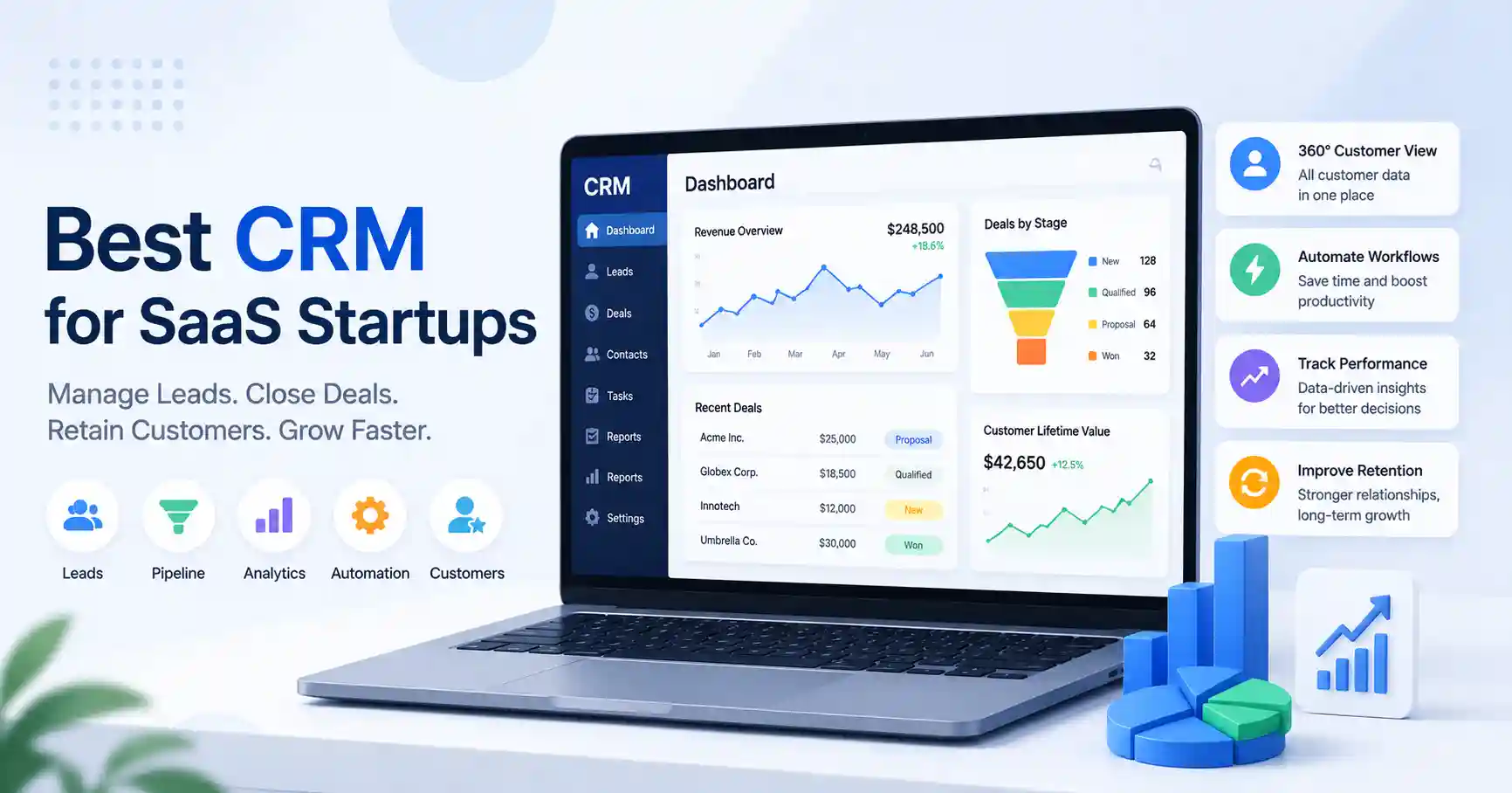
The best CRM for SaaS startups helps you organize customer interactions, automate repetitive workflows, surface revenue opportunities , and strengthen retention. More importantly, it gives you a clean, complete view of the full customer journey, from the first touch.
In this guide, you will learn what makes a great SaaS CRM, which platforms are standing out in 2026, and how to choose the right solution for your specific business.
What Makes the Best CRM for SaaS Different From Traditional CRMs?
Not every CRM is designed for SaaS companies.
Historically, CRMs aimed at customers with complex sales processes or requiring extensive account management. But now that the world is overwhelmingly digital, and clients mostly interact with companies over the internet, we need a new type of CRM- software as a service based ones..onActivityResult(requestCode, resultCode, data);It is designed to bring in new customers and cater to them effectively, converting (partially) their requests into generated revenue.
The best CRM for SaaS should help teams:
- Track customer lifecycle stages
- Monitor subscription revenue
- Manage sales pipelines
- Automate onboarding workflows
- Improve customer retention
- Connect with marketing and support tools
CRM in the Cloud implies a convenient workstation where all information regarding a client can be obtained without an effort by any department of a company: sales, marketing, and customer service.
Why Are SaaS Startups Investing More in CRM Software Than Ever?
Every year, customer acquisition expenses are growing higher. At the same time, SaaS competition within categories is becoming more brutal and excruciating.
In effect, this means that it’s not enough for startups to concentrate solely on bringing in leads. What they have to do, is to ensure that each customer interaction is of the highest quality.
Benefits of using a CRM include:
- Better lead management
- Faster sales cycles
- Improved trial-to-paid conversion rates
- Stronger customer retention
- Increased revenue visibility
- Better forecasting
It is not a new discovery that many businesses need to enhance their level of Customer Relationship Management than acquire even more customers. It is very challenging that systems such as CRM should be reinforced with SaaS conversion optimization strategies of SaaS for more effective and better development.
Blake Morgan, the customer service expert, has very rightfully stated that,
“People forget what they spent their money on but they don’t forget how bad they had felt when buying it.”
Which Features Should You Look for in the Best CRM for SaaS?
Choosing a CRM becomes easier when you focus on features that directly impact growth.
Subscription Management
Economic stability remains the basic principle of any business plan in the field of software and e-commerce; your CRM software solution also should have organized subscription plan management, renewals, up-sell to more premium plans or cross-sell to other products/upgrades and downgrades or cancellations of such plans.
Sales Pipeline Management
A visual sales pipeline helps teams understand where every prospect stands in the buying journey.
Customer Segmentation
Communication becomes more effective when customers are divided into groups based on their behavior, the industry they belong to, the size of the company, or the use of a particular product.
Workflow Automation
Automation saves time and reduces human error.
Common automation examples include:
- Lead assignment
- Follow-up reminders
- Trial expiration emails
- Renewal notifications
- Customer onboarding sequences
Reporting and Analytics
Data-driven decisions require accurate reporting.
Look for dashboards that show:
- Monthly recurring revenue
- Customer lifetime value
- Churn rate
- Conversion rate
- Sales performance
What Are the Best CRM Platforms for SaaS Startups in 2026?
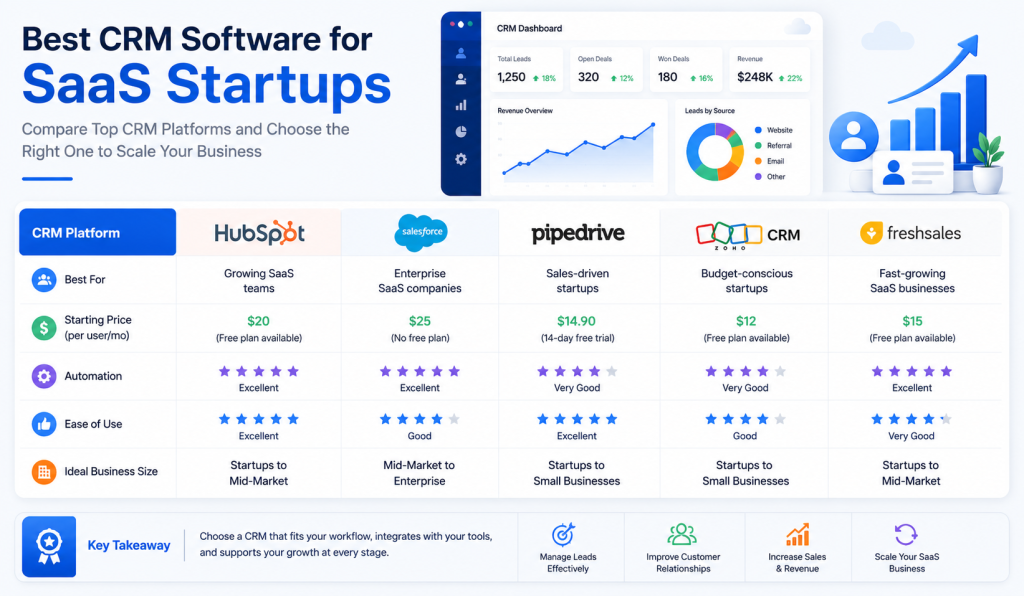
Below is a comparison of some of the most popular CRM solutions for SaaS companies.
| CRM Platform | Best For | Key Strength | Pricing Level |
| HubSpot CRM | Growing SaaS teams | Ease of use and automation | Medium |
| Salesforce | Enterprise SaaS | Advanced customization | High |
| Pipedrive | Startup sales teams | Simple pipeline management | Medium |
| Zoho CRM | Budget-conscious startups | Value for money | Low |
| Freshsales | SaaS growth teams | AI-powered sales features | Medium |
| Close CRM | Inside sales teams | Communication tracking | Medium |
Key takeaway: HubSpot, Pipedrive, and Freshsales are commonly considered the three most cost-effective tools that help SaaS startups meet the correct combination of functionality and scalability inside their platforms.
HubSpot CRM
HubSpot remains one of the most popular choices for SaaS businesses.
Advantages include:
- User-friendly interface
- Strong automation tools
- Marketing integration
- Customer service features
- Extensive reporting
Salesforce
Salesforce still stands as the leading system in the field of enterprise CRM. Salesforce provides common CRM services for various enterprises. Also, instead of being expensive when it is too configurable when the skills of a complete novice aren’t adequate to set the system up right and work with it.
Pipedrive
If a startup prefers simplicity, Pipedrive is an ideal choice.
Pipedrive allows users to create sales activities and document that can be quikcly and easily be tracked.
Zoho CRM
Zoho gives really good functionality to its users and that too at a low price.
Most of the time, especially young startups .
Freshsales
With CRM services as a front, Freshsales compliments the activities of done tech companies in technology, managing the performance of firms.
How Can SaaS Startups Successfully Implement CRM Software?
Choosing a CRM is only the first step.
Successful implementation requires a structured process.
Step 1: Define Business Goals
Identify the outcomes you want to achieve.
Examples include:
- Increasing trial conversions
- Reducing churn
- Improving lead response times
- Growing recurring revenue
Step 2: Clean Existing Data
Poor data quality creates problems from day one.
Before migration:
- Remove duplicates
- Update contact records
- Standardize fields
Step 3: Build Customer Journey Stages
Map every stage of the customer lifecycle.
Common stages include:
- Lead
- Marketing qualified lead
- Trial user
- Active customer
- Expansion opportunity
- Churn risk
Step 4: Automate Repetitive Tasks
Automation improves efficiency and consistency.
Many successful companies combine CRM automation with broader SaaS growth hacking strategies for startups to accelerate customer acquisition and retention.
Step 5: Train Your Team
Without people making use of it, a CRM is essentially useless.
Allocate sufficient time for onboarding and achieving user adoption.
As top aphorist of management – Peter Drucker said:
“Things are managed better when we measure them.”
A good CRM implementation provides this essential visibility to teams.
What Common CRM Mistakes Should SaaS Startups Avoid?
Even great software cannot fix poor processes.
Common mistakes include:
- Choosing overly complex platforms
- Ignoring customer success workflows
- Failing to clean data before migration
- Not integrating other tools
- Over-automating customer communication
- Tracking too many metrics
Start simple and expand gradually.
Which Secondary Keywords Matter Most for SaaS CRM SEO?
The following related keywords are very important and often sought when searching for the primary keyword:
- SaaS CRM software
- CRM for startups
- customer relationship management software
- sales CRM for SaaS
- CRM tools for small business
These words come easier for the related authorities and broaden the range of searches when at the same time helping their website to penetrate easier.
Do you really think that only large corporations can make it to their goals with the CRM modules integrated in their business processes? Quite the contrary, many smaller organizations turn to the largest CRM vendor with the best Salesforce CRM resource center.
Frequently Asked Questions
What is the best customer relationship management system for SaaS startups?
Many affordable, Cloud-based CRM platforms are available now for SaaS startups such as HubSpot CRM, Pipedrive, Freshsales, and Zoho CRM, until year 2026.
Is there anything that makes sense SaaS startups employ CRMs?
Yes. Even the smallest of the SaaS companies can take advantage of the combination of a central repository of customer information which is, in fact, automated, and data on sales which is updated on a regular, organized basis.
Where among the available CRMs can startups find the appropriate CRM for them when they not have a lot of money?
Zoho CRM offers rich capabilities at good prices, which is good for early stage companies trying to achieve as much as possible with as little resources as they have.
Can practicing CRM lead to customer tethering?
Indeed, Crm software helps in tracking customer habits, automates relevant customer engagement, and forecast signs of disengagement prior to the actual point of customer’s departure.
How long does it take to deploy a CRM system?
In most instances, a startup can deploy a functional CRM within a matter of days to a few weeks, depending on the structure of the apparent processes and the nature and intensity of the possible integrations.
Conclusion
The in thing CRM for SaaS could not be the one that supports the most functionalities but that which is adapted to address the business goals, team size, customer journey, and growth stage.
But out of HubSpot, Pipedrive, Salesforce, Freshsales, Or Zoho. It doesn’t really make lots of sense without using the CRM everyday and evolving the process around customer success.
A good CRM setup allows you to attract customers, keep them longer, and increases the rate at which you grow your revenue from existing customers.
What will you say about your current CRM for the SaaS startup? All elbow grease and C. R. M. tech comes with its challenges, share in the comments.