

Nailing the right price tag trips up plenty of SaaS founders. Why? Because that number hinges entirely on what buyers actually value, how you stand against rivals, your market positioning. And what folks are willing to pull out their wallets for. A solid pricing setup brings in cash, sure, but it also sways churn, conversions, expansion revenue, and product perception. It is never just about undercutting or overcharging the other guy. Instead, you build a setup that scales right alongside the value you deliver. This guide breaks down picking the right model, nailing down actual price points, structuring plans, and tuning things over time.
Table of Contents
- What is SaaS Pricing Strategy
- Why SaaS Pricing Strategy is Important
- Step by Step Guide
- Best Practices and Tips
- Common Mistakes
- Tools
- FAQs
- Conclusion
What is SaaS Pricing Strategy
A software pricing strategy is just how a firm figures out what to charge. It decides the price tag, feature bundles, and how costs scale up when a client grows. Look at project management tools. One might bill you ten bucks a user every month. Another tool could demand a flat fortynine for a set batch of projects, while API platforms often bill based strictly on usage. The main thing to keep in mind, prices must track the value delivered to the buyer, ignoring mere development costs. Stripe suggests starting with your core value metric before building tiers around it.
Why SaaS Pricing Strategy is Important
A well designed pricing strategy can:
- Increase revenue without requiring the same increase in customer volume
- Improve conversion by making plans easier to understand
- Create a natural upgrade path as customers grow
- Help different customer segments choose the right plan
- Improve customer lifetime value by aligning price with ongoing value
Pricing also affects positioning. A very low price can make a product appear less valuable, while an unnecessarily high price can create friction before customers understand the product.
For example, a $20 monthly plan may work well for freelancers, while a growing company may need a $200 plan with team controls, advanced reporting, and integrations.
Step by Step Guide
Step 1: Identify Your Customer and Their Value
Start with the customer, not the price.
Figure out your core audience and nail the exact pain your tool solves, What does that specific headache cost them? Think wasted hours, burned cash, or a completely broken workflow.
Take a SaaS generating five grand in extra monthly revenue for an online shop. Charging a hundred bucks a month becomes an absolute nobrainer. The math speaks for itself.
Talk to real users. Dig through old sales calls. Watch people actually navigate the app, and discover what they genuinely care about.
Step 2: Choose the Right Pricing Model
Your pricing model should match how customers receive value from your product.
| Pricing Model | Best For | Main Strength | Main Risk |
| Per Seat | Collaboration and team software | Simple and predictable | Revenue can be limited by team size |
| Tiered | Products serving different segments | Easy upgrade path | Poor tiers can confuse buyers |
| Usage Based | APIs, infrastructure, data tools | Price grows with usage | Bills can feel unpredictable |
| Hybrid | Products with base and variable usage | Balances predictability and growth | More complex to explain |
| Freemium | Product led SaaS | Low barrier to adoption | Free users may not convert |
| Outcome Based | Products tied to measurable results | Strong value alignment | Attribution can be difficult |
Takeaway: Choose the pricing model that follows the way customers experience value, not simply the way competitors charge.
For example, a team collaboration platform may benefit from per seat pricing, while an API product may be better suited to usage based pricing. Hybrid pricing can also work when customers receive baseline platform value plus variable usage.
Step 3: Build Simple Pricing Tiers
Most SaaS companies do not need a complicated pricing page.
Start with two to four meaningful plans. Each plan should represent a different customer need, business size, usage level, or desired outcome.
For example:
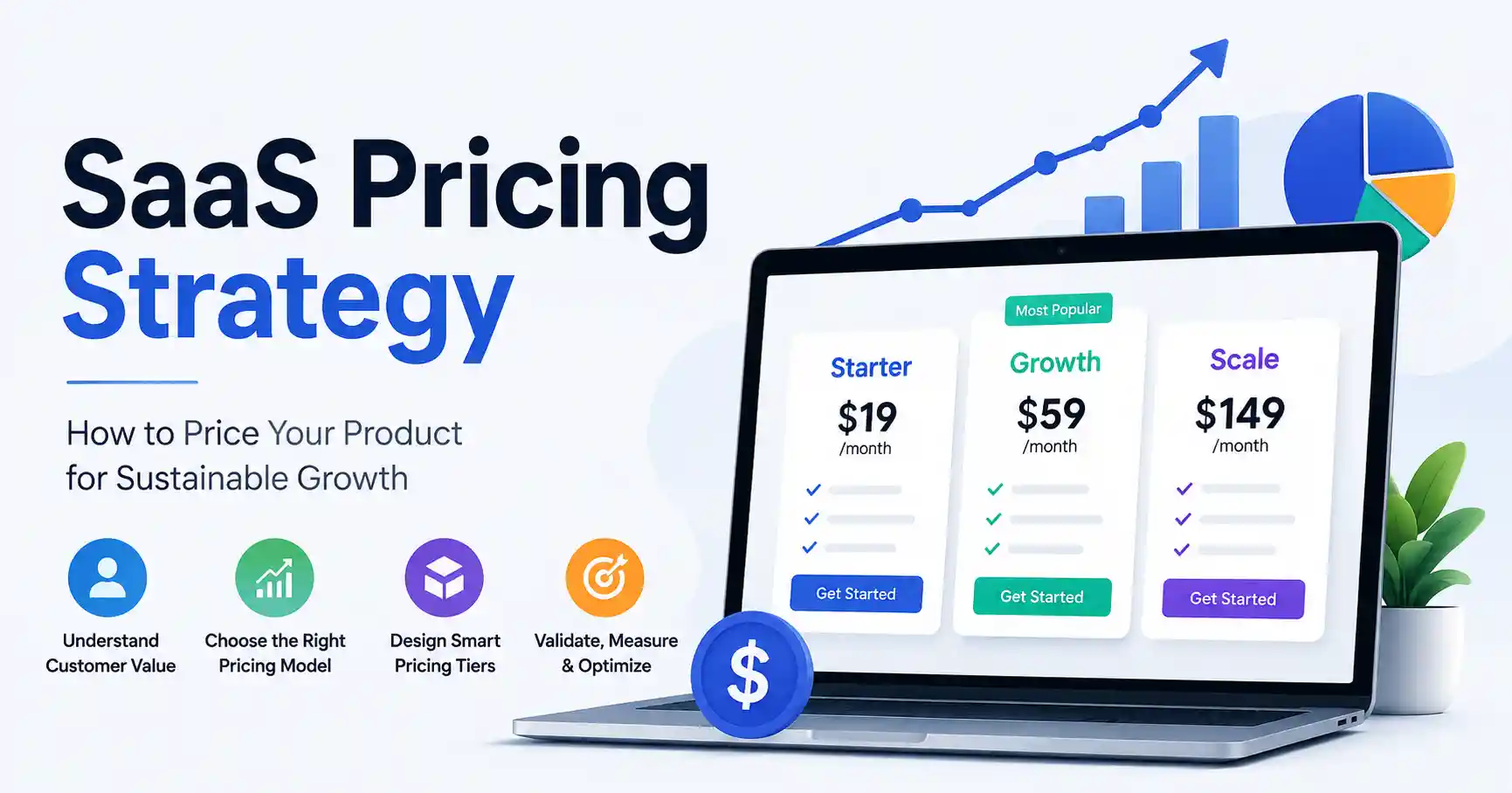
Starter: $19 per month for individuals
Growth: $59 per month for small teams
Scale: $149 per month for larger teams
Enterprise: Custom pricing for advanced requirements
Do not create tiers simply by adding random features. Give each plan a clear reason to exist.
Your Growth plan might include automation and integrations because those become important when a team starts relying heavily on the product.
Step 4: Validate Willingness to Pay
Your first price is a hypothesis, not a permanent decision.
Talk to prospects and existing customers about pricing. Ask questions such as:
- What would make this product worth paying for?
- Which plan would you choose today?
- What would make the product too expensive?
- What alternative would you use if this product did not exist?
You can also test different packages, price points, annual discounts, and upgrade paths.
A useful approach is to compare stated feedback with actual behavior. If customers repeatedly say a price is high but continue buying, their behavior may be more useful than their initial opinion.
For a deeper explanation of value based pricing, see this Stripe guide to value driven pricing.
Step 5: Measure and Improve Pricing
Pricing needs a fresh look whenever your product shifts, your market moves, or your buyers change. Keep an eye on the numbers. Conversion rates, average revenue per account, expansion revenue, churn, upgrades, and lifetime value tell the story.
Take a simple clue. If everyone buys the bottom tier and never climbs higher, your pricing steps lack bite. Or maybe people keep begging for custom setups. That means a whole new packaging strategy is overdue.
Your pricing page can also become an important part of your experimentation program. Test the structure, messaging, plan limits, annual options, and upgrade triggers rather than changing price randomly.
Best Practices and Tips
- Use value based pricing where possible. Focus on the financial or operational value customers receive instead of only calculating your costs.
- Keep your pricing page easy to understand. Customers should quickly know what they get, who each plan is for, and when they should upgrade.
- Create natural upgrade triggers. Higher usage, more users, advanced reporting, automation, and integrations can all create legitimate reasons to move up.
- Offer annual billing carefully. An annual plan can improve cash flow and retention, but do not rely on excessive discounts to close customers.
- Segment enterprise customers. Larger accounts often need security controls, integrations, support, onboarding, and procurement flexibility that smaller customers do not need.
- Review pricing regularly. A pricing strategy that worked at 100 customers may not work at 10,000 customers.
- Connect pricing with your positioning. Premium pricing requires premium perceived value, strong proof, and clear differentiation.
For additional perspective on SaaS pricing models and packaging, see this Paddle SaaS pricing strategy guide.
Common Mistakes
1. Copying Competitors
Competitor pricing is useful for context, but it should not determine your price. Your customers, positioning, product value, and acquisition model may be completely different.
2. Pricing Based Only on Costs
Your hosting and development costs do not determine customer value. A product that costs $50 to serve could potentially be worth thousands to a customer.
3. Creating Too Many Plans
Six or seven complicated plans can make customers hesitate. Use fewer plans with clearer differences.
4. Hiding the Upgrade Path
If customers cannot understand why they should move to the next plan, expansion revenue becomes harder to generate.
5. Never Revisiting Pricing
The market eddies and flows, Products change. Customers want more, always more, so pricing? It’s not just for day one, nope, it’s this ongoing, crucial business decision.
Tools
A few tools can support your pricing research and decision making:
- Subscriptions, usage, or tiers. Stripe Billing handles it all, even the combos.
- Paddle masters SaaS monetization, guiding your pricing models and overall strategy.
- Analyze visitor conversions on pricing pages via Google Analytics.
- Hotjar exposes pricing page friction instantly, laying bare exactly how visitors browse offers.
- It connects everything. Your CRM maps pricing decisions to buyer pushback, customer tiers, and actual deal outcomes
Inspect your own metrics first. Why purchase costly tools before letting existing data steer every investment?
FAQ’s
What is the best SaaS pricing strategy?
Look, no single strategy works every time. Valuebased pricing? It’s usually a solid bet. But ultimately, the right model hinges on how customers actually get value, how they use your stuff, and which specific groups you’re serving.
How many pricing plans should a SaaS company have?
Usually, a couple, maybe four choices, will hit the mark for most SaaS companies. The exact number? Not the real issue, What actually counts is if each plan tackles a distinct customer problem.
Should SaaS products offer a free plan?
A free plan? That works if customers get real value without needing tons of support. But if those freebies hog resources yet never upgrade, it’s a bad deal.
How often should SaaS pricing be reviewed?
You should check your prices often. Look at what customers say, how many people buy, how many leave, and how much more existing customers spend. Also, keep an eye on competitors. A good start is a formal review every 6-12 months.
Is usage based pricing better than subscription pricing?
Not necessarily. Usage based pricing works well when usage closely follows customer value. Subscription pricing can be better when customers want predictable costs. Some SaaS companies combine both approaches.
Conclusion
Forget hunting for a single magic price, A smart SaaS pricing strategy means really getting what your customers value. Pick a good pricing model, Design clear plans. Check if people will actually pay what you ask. And then? Keep tweaking it, always learning from how customers act.
First off, figure out your ideal customer. What does your product do for them? Then, choose a pricing metric that scales as that value grows. Build simple tiers. Now, watch what happens when they see the bill.
For more SaaS growth and acquisition insights, explore SaaS growth hacking strategies for startups and learn how intent driven research can support your broader growth strategy in this SaaS keyword research guide.