
Have you ever felt like your marketing team spends more time, handling campaigns than actually growing the business
You’re not alone. As SaaS companies scale up, managing leads, onboarding users, guiding prospects , and keeping customers happy gets more intricate, fast. And that’s where SaaS marketing automation tools come in. These platforms automate routine work, shape personalized customer pathways, and improve marketing efficiency, without you having to add staff again , and again .
The right automation platform can change how a SaaS company attracts, engages, and retains customers. In this guide, you will see the best SaaS marketing automation tools available in 2026 , which features matter most, and how to choose the right solution for your current growth stage .
What Are SaaS Marketing Automation Tools and Why Do Companies Need Them?
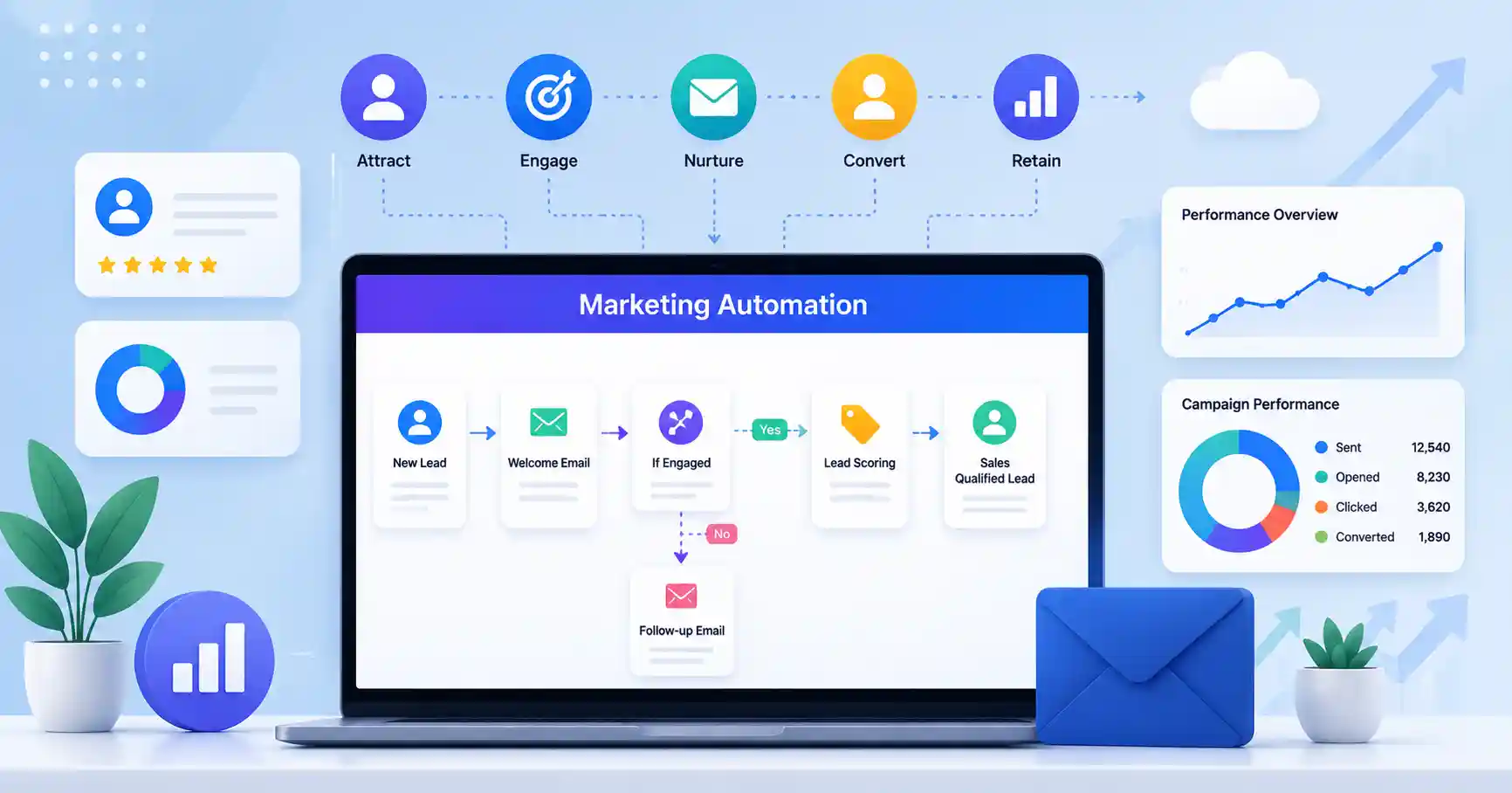
SaaS marketing automation tools are software platforms made to automate marketing activities across the whole customer journey, so not just the first touch point.
Rather than doing things by hand like sending emails, assigning leads, or watching user behavior, these tools run everything automatically using prepared workflows, and they also react to real time customer actions.
Most modern platforms help businesses:
- Generate leads
- Nurture prospects
- Automate email campaigns
- Score and segment leads
- Personalize customer experiences
- Improve customer retention
For example if someone signs up for a free trial but they don’t finish onboarding, the automation platform can automatically set off a string, of learning emails, that are made to point them toward activation.
This sort of automation helps SaaS companies grow without tiring out their own teams too much.
Why Are SaaS Marketing Automation Tools Becoming Essential in 2026?
Customer expectations keep rising, and people are noticing it. They want personalized experiences, quick communication, and actually relevant suggestions. The moment you grow your customer base it becomes hard to do all that manually, almost impossible in practice , because there’s just too much moving parts.
Benefits of using SaaS marketing automation tools include:
- Faster lead nurturing
- Better customer engagement
- Improved conversion rates
- Higher customer retention
- More efficient marketing operations
- Better sales and marketing alignment
Many successful SaaS companies combine automation with strong SaaS conversion optimization strategies to maximize customer acquisition and revenue growth.
As marketing expert Ann Handley once said:
“Make the customer the hero of your story.”
Marketing automation helps make that possible at scale.
Which Features Matter Most When Choosing SaaS Marketing Automation Software?
Not every platform offers the same capabilities.
Before you put money into software, take a look at the features that touch your growth aims directly, don’t skip that part.
A lot of SaaS marketers rely on the HubSpot Marketing Automation Guide, to get a clearer view of how automation workflows, lead nurture, and customer journey mapping can boost campaign outcomes.
Behavioral Tracking
The best tools monitor how users interact with your product and website.
Examples include:
- Feature usage
- Trial activity
- Page visits
- Purchase behavior
Behavioral tracking allows you to send highly relevant messages based on real user actions.
Lead Scoring
Lead scoring automatically, ranks prospects according to how much they engage and what buying intent they signal, like a kind of compass or indicator. It helps sales teams quickly focus on the most valuable opportunities , instead of spending time on the ones that are still a little ambiguous . Overall it makes the whole process feel calmer and more precise.
Email Marketing Automation
Email remains one of the most effective channels for SaaS growth.
Look for platforms that support:
- Drip campaigns
- Lifecycle marketing
- Triggered emails
- Segmentation
- Personalization
CRM Integration
Your automation platform should work, like almost seamlessly, with your CRM system.
This is what makes it happen, sales marketing and customer success teams can all use the same customer data in a consistent way and without much friction.
Reporting and Analytics
Without analytics, optimization becomes guesswork.
Strong reporting should include:
- Conversion tracking
- Revenue attribution
- Campaign performance
- Customer journey insights
What Are the Best SaaS Marketing Automation Tools in 2026?
These platforms keep showing up again and again as some of the best marketing automation software, for SaaS organizations, even when you think you already checked everything.
| Platform | Best For | Key Strength | Pricing Level |
| HubSpot Marketing Hub | Growing SaaS companies | All-in-one marketing platform | High |
| ActiveCampaign | SMB SaaS businesses | Email automation and segmentation | Medium |
| Customer.io | Product-led SaaS companies | Behavioral automation | Medium |
| Marketo | Enterprise SaaS organizations | Advanced automation workflows | High |
| Mailchimp | Early-stage startups | Simplicity and affordability | Low |
| Brevo | Budget-conscious teams | Multi-channel marketing automation | Low |
Key Takeaway: Customer.io and HubSpot still look like some of the strongest choices for SaaS companies that are doing lifecycle marketing, and keeping customer engagement going.
HubSpot Marketing Hub
HubSpot offers one of the most complete marketing automation ecosystems available.
Its strengths include:
- CRM integration
- Lead management
- Email automation
- Marketing analytics
- Customer journey tracking
Customer.io
Customer.io was built with product-led businesses in mind.
It excels at:
- Behavioral messaging
- User segmentation
- Lifecycle campaigns
- Product-triggered automation
ActiveCampaign
ActiveCampaign brings strong automation tools, without the enterprise level price tag that most people imagine. Some SaaS startups choose it because it hits that middle sweet spot for affordability and functional depth, which is helpful when you want the workflow features but not the massive cost.
Marketo
Marketo still stays a well-liked option for bigger SaaS teams who need more sophisticated marketing workflows and yeah, a bit of orchestration too, in many cases.
Mailchimp
Mailchimp works well for startups , that want a straightforward way to automate email campaigns and keep track of their audiences, honestly it feels practical and easy to manage.
How Can SaaS Startups Successfully Implement Marketing Automation?
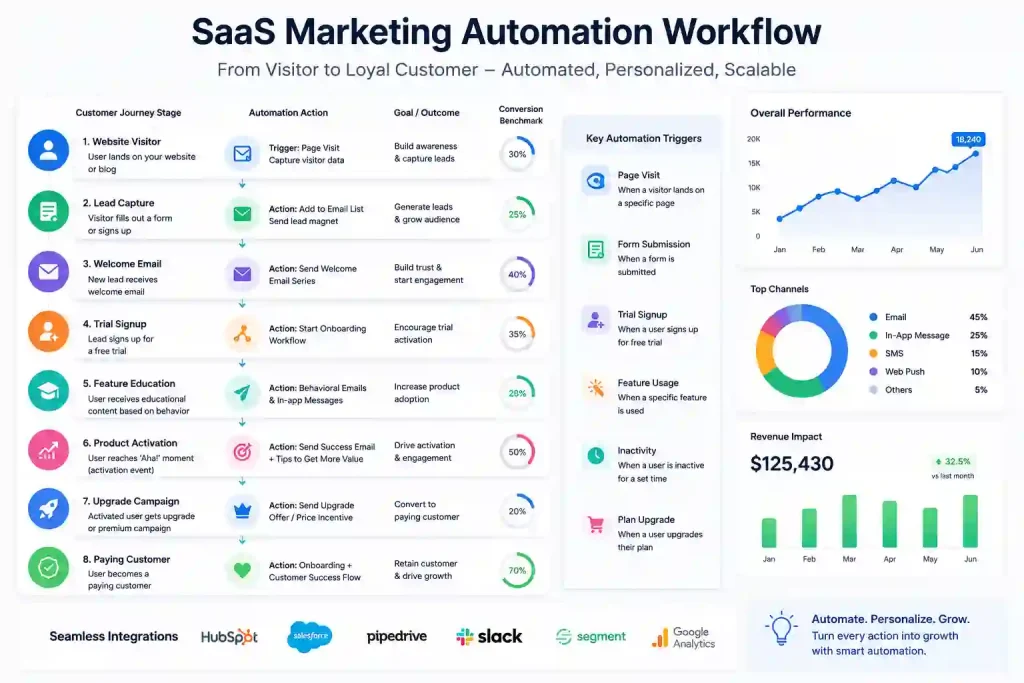
Buying software is easy. Implementing it effectively is where most businesses struggle.
Step 1: Define Your Customer Journey
Map every stage of the customer lifecycle.
Typical stages include:
- Visitor
- Lead
- Trial user
- Active customer
- Power user
- Expansion opportunity
Understanding the journey helps create meaningful automation workflows.
Step 2: Connect Your Data Sources
Integrate:
- CRM
- Product analytics
- Website tracking
- Email platform
- Customer support tools
The more complete your data, the better your automation performs.
Step 3: Build Lifecycle Workflows
Create workflows for:
- Welcome sequences
- Trial onboarding
- Feature adoption
- Upgrade campaigns
- Churn prevention
Step 4: Personalize Communication
Generic messages rarely perform well.
Use:
- User behavior
- Company size
- Industry
- Product activity
to personalize messaging.
Step 5: Continuously Optimize
Automation should evolve with your customers.
Review:
- Open rates
- Conversion rates
- Retention metrics
- Revenue impact
on a regular basis.
Many high-growth companies combine automation platforms with broader SaaS growth hacking strategies for startups to accelerate customer acquisition and retention.
What Common Mistakes Should SaaS Companies Avoid?
Marketing automation can produce incredible results when used correctly.
However, several mistakes frequently limit success.
Avoid:
- Automating poor processes
- Sending too many emails
- Ignoring user behavior data
- Overcomplicating workflows
- Failing to measure results
- Using the same message for every audience
Remember, automation should improve customer experiences, not make them feel robotic.
Which Secondary Keywords Support SaaS Marketing Automation SEO?
The following keywords frequently appear in top-performing content and help strengthen topical relevance:
- marketing automation software
- customer journey automation
- email marketing automation
- lead nurturing software
- customer engagement platform
These related terms help with search visibility, while also making it easier for readers to stumble on more specific solutions .
For deeper marketing automation best practice ideas, quite a few SaaS people point to HubSpot’s marketing automation resource center.
Frequently Asked Questions
What are the best SaaS marketing automation tools out there, for teams that are moving fast?
In 2026, HubSpot, Customer.io, ActiveCampaign, Marketo, and Mailchimp are among the more popular options most people name.
Do startups really need marketing automation, like right now?
Yes. Automation lets startups scale their promotional work without adding a big chunk of headcount. it makes outreach more steady, and less manual.
Which tool tends to fit product-led SaaS best?
Customer.io is pretty strong for product led growth since it handles behavioral triggers, and also lifecycle oriented campaigns.
Can marketing automation help with customer retention?
Definitely. Things like automated onboarding, ongoing engagement sequence and churn prevention workflows can boost retention in a very noticeable way, honestly. Sometimes it works best when the setup is tidy but the ongoing touches are flexible, you know.
How long does setup usually take?
Most SaaS teams manage to get basic automation workflows going within a few weeks. When it gets more advanced, it usually takes longer , though, because it depends on the data at hand, the types of triggers involved, and how many routes or journeys you want active all at the same time.
Conclusion
The best SaaS marketing automation tools do way more than just send emails. They help companies craft, customized buyer moments, automate repetitive chores, and put together scalable growth frameworks, that actually stick.
Whether you pick HubSpot, Customer.io, ActiveCampaign, Marketo, or another solution, the real win comes from how well you tune automation to match your customer journey. Not just “run it”, but make it click with what people are doing and when.
Go small first, aim for automation that has real meaning, and keep tuning everything based on customer behavior. Little by little, marketing automation can turn into one of the strongest growth engines in your SaaS business.
Which marketing automation platform is your team using right now? Drop your experience and jump into the conversation.