

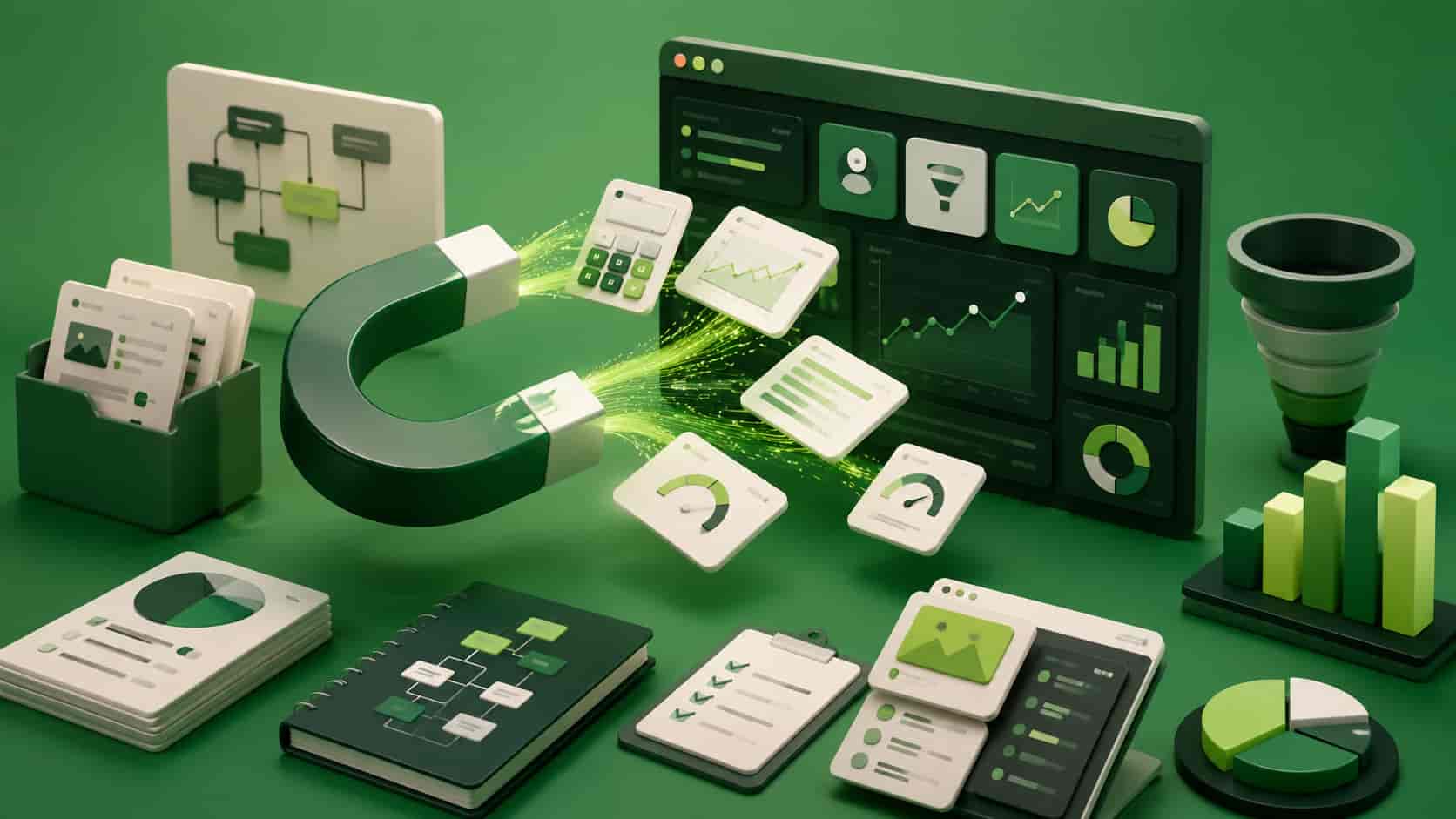
Most SaaS lead magnets don’t fail because the content is bad, not really. They fail because they pull in people who were never going to buy.
And that uncomfortable truth sits underneath the endless parade of “Ultimate Guides,” generic ebooks, and 40-page PDFs nobody finishes. You can generate thousands of leads with broad educational content, and still miss pipeline goals, because downloads don’t automatically mean buying intent.
HubSpot made the ebook era look normal. Then product-led growth showed up and changed the whole game.
Now, the highest converting SaaS lead magnets act less like content marketing, more like product experiences. They reduce uncertainty, create momentum, and move users one step closer to activation.
If your lead magnet could realistically be consumed by students, competitors, job seekers, or random marketers who have zero intent to buy, then you’re probably collecting vanity metrics, not revenue.
Introduction
• The best SaaS lead magnets help users achieve a small outcome, not only learn something.
• Conversion quality matters more than the opt-in volume, like it always has, it just depends on how you’re measuring it.
• Product-adjacent lead magnets keep beating informational PDFs because they reduce the time-to-value, quicker than you think.
The shift happening right now is subtle but real, smart SaaS companies are quietly swapping “downloadable content” for “interactive utility”.
That changes everything.
Why Most SaaS Lead Magnets Underperform
Most lead magnets underperform because they optimize for reach instead of purchase intent, and that tiny difference shows up later.
A lead magnet should do two things at once, filter users and attract them, but people often only do the second part.
If anyone can use it, then your ICP probably isn’t narrow enough.
Here’s what usually happens in practice.
A SaaS company publishes an ebook, a checklist, or a webinar replay, then they expect magic.
Traffic comes in. Leads increase. The marketing dashboard looks healthy, good numbers after all.
Then sales complains, because the leads are not qualified, not really.
Nobody books demos.
Email engagement drops after Day 3, and then it stays low.
Pipeline contribution stays weak, and everyone pretends it’s normal.
The problem isn’t lead generation. It’s lead magnet market fit, you know.
The best performing SaaS lead magnets sit right next to the exact bruise your product touches, not later, not in a vague way.
Like this:
• A CRM company offering a “sales call scoring calculator”
• An SEO platform offering a “traffic decay detector”
• A payroll SaaS offering a “misclassification risk checker”
See the rhythm?
Those pieces create real urgency because they reveal a problem users already recognize.
That’s honestly different from educational content.
Educational content teaches.
Conversion focused lead magnets diagnose.
The best lead magnets do more than hand over facts, they spark self awareness, in a way people can feel.
What Types of SaaS Lead Magnets Convert Best?
Interactive and outcome driven lead magnets convert best because they deliver immediate value before the sales conversation even happens.
Static PDFs still work in some industries, especially enterprise B2B, but in most SaaS categories people expect value sooner, like faster than you can say “sign up”.
Below, there’s a comparison of common SaaS lead magnets and how they usually do in the wild, not always but often.
| Lead Magnet Type | Conversion Quality | Effort to Create | Best Use Case |
|---|---|---|---|
| Ebook/PDF Guide | Low-Medium | Low | Early-stage awareness |
| Template Pack | Medium | Low-Medium | Workflow-driven SaaS |
| ROI Calculator | High | Medium | Sales-led SaaS |
| Free Audit Tool | Very High | High | Agencies & analytics SaaS |
| Benchmark Report | High | High | Enterprise SaaS |
| Interactive Quiz | Medium-High | Medium | Segmentation & personalization |
| Free Micro-Tool | Very High | High | Product-led growth |
Insight: the more the lead magnet feels like the real product experience, the better the conversion quality tends to be, even when audiences are cold.
A good real-world example is Ahrefs.
Their free SEO tools tend to beat the usual ebook or checklist style lead magnets, because users get immediate usefulness before any account is created. The tool becomes the trust builder, right there in the first minutes.
Another strong example is Notion.
Their template ecosystem works because it just puts the product directly into the user’s workflow, so it feels immediate, and a bit unavoidable.
That’s the deeper insight many marketers miss.
The best lead magnets often blur the line between marketing and onboarding, in practice.
When users feel momentum before signup, conversion friction drops a lot, faster than you expect.
How Do You Build a SaaS Lead Magnet That Actually Generates Pipeline?
The best SaaS lead magnets are built backwards from sales conversations, not keyword research.
Start by listing the friction points inside your funnel, the places where people stall.
Here is a process that works consistently for B2B SaaS teams.
1. Identify the “Pre-Purchase Anxiety”
What uncertainty blocks the decision to buy?
Examples:
• “Will this tool really save time?”
• “How much revenue are we leaking?”
• “Are we doing this incorrectly?”
• “How do we benchmark against competitors?”
Your lead magnet should reduce that unease, quickly.
2. Build for Speed to Value
Users should see a real, meaningful outcome in about 3-5 minutes.
This is where most ebooks fail, they do the whole “start reading” thing, and then nothing.
Nobody wants homework, not even a little.
People want progress, and they want it fast.
3. Make the Result Personalized
Generic advice converts poorly.
Personalized outputs convert better, because users feel emotionally connected to their own information, their own mess, their own numbers.
That’s why things like:
• scorecards
• calculators
• audits
• assessments
• and benchmarks
perform so well.
4. Gate the Insight, Not the Setup
One of the biggest CRO mistakes I keep seeing in SaaS lead gen is putting the form way too early.
If users have not felt value yet, they will not submit willingly.
So instead:
• let them start the process
• build curiosity
• then gate the final result
This boosts submission intent, dramatically.
5. Link the Lead Magnet to Activation
A lead magnet should naturally pull them into:
• a free trial
• a demo
• a product workflow
• or a sales conversation
If there is no clean next step that makes sense, conversions stall and the momentum just dies.
Strong SaaS lead magnets don’t feel like marketing assets, they feel like useful product extensions, like something you’d actually use not just download.
What Small SaaS Companies Get Wrong About Lead Magnets
Small SaaS companies often try to copy enterprise content strategies that only work because the brand has real authority.
A startup publishing a 60-page “State of AI” report probably won’t beat a sharp, focused diagnostic tool, in plain terms.
And this matters because smaller SaaS teams have limited:
• engineering bandwidth
• ad budgets
• and audience trust
So the content economics shift. Not in a small way, either.
Instead of pumping out more content, smaller SaaS companies should aim for a narrower utility.
A niche calculator for one job to be done often outperforms a broad industry report.
For example:
• A Shopify analytics app could ship a “profit leakage calculator” for operators
• A recruiting SaaS could offer a “cost-per-hire benchmark estimator” for hiring managers
• A fleet management platform might do a fuel inefficiency audit, you know like a practical check rather than just a brochure
The more narrow the pain is, the clearer the intent signal becomes.
This matters even more when you are paying for acquisition.
Broader lead magnets can end up lowering CPL, but that does not automatically mean better results.
When your lead magnet is focused, it can improve CAC efficiency.
Those outcomes are not the same at all.
One path is mostly contacts, the other is customers.
A 2025 study from Databox noted that marketers are putting more emphasis on lead quality metrics instead of raw lead volume, because low intent leads can bloat acquisition costs later.
That direction will keep going, especially as AI generated content makes informational assets less differentiated.
If AI can summarize your ebook in 10 seconds, then your lead magnet has to deliver something AI cannot, like personalization, interaction, diagnostics, or workflow acceleration.
In the AI search era, utility is taking over as the main value exchange, information is no longer the top currency.
Should You Gate SaaS Content Anymore?
You should gate high-intent assets, not the top of funnel education.
Over gating kills organic reach and it reduces trust too, even if the email list grows.
This is where a lot of SaaS teams overcorrect, they just swing too hard.
They go one of two ways, either:
• gate everything
• or gate nothing
A smarter approach is intent based gating, like actually matching what the visitor wants.
Here’s a framework that helps, pretty straightforward but effective.
| Content Type | Gate or Ungate? | Why |
|---|---|---|
| Blog posts | Ungated | SEO and discovery |
| Industry education | Ungated | Authority building |
| Templates | Partial gate | Moderate intent |
| Benchmarks | Gated | High perceived value |
| ROI calculators | Gated after interaction | Strong buyer intent |
| Audits & assessments | Gated | Personalized insight |
| Product demos | Gated | Sales qualification |
Insight: gate when there is real personalization, or proprietary value, not just because you want emails.
One overlooked tactic is progressive profiling.
Instead of asking for, in the first interaction:
• name
• company
• phone number
• job title
• company size
• and budget
collect the info in steps, little by little.
Every new form field brings extra friction, and it shows up fast.
The best SaaS funnels feel more like conversations than actual applications, if that makes sense.
That’s why interactive lead magnets beat static forms, in practice.
They get people engaged first, before you ask for any kind of commitment.
Modern lead generation is less about just capturing leads and more about winning tiny micro-commitments.
Conclusion: SaaS Lead Magnets Is Product-Led
The next wave of SaaS lead magnets will start looking like pretty light product moments, not just pages.
Right now we can see this movement in several places, like:
• AI tools
• developer platforms
• productivity SaaS
• and analytics products
The companies doing well right now aren’t only teaching people, there’s more to it.
They let users try out the capability first, before the purchase decision. And it shifts the psychology completely, you feel it.