

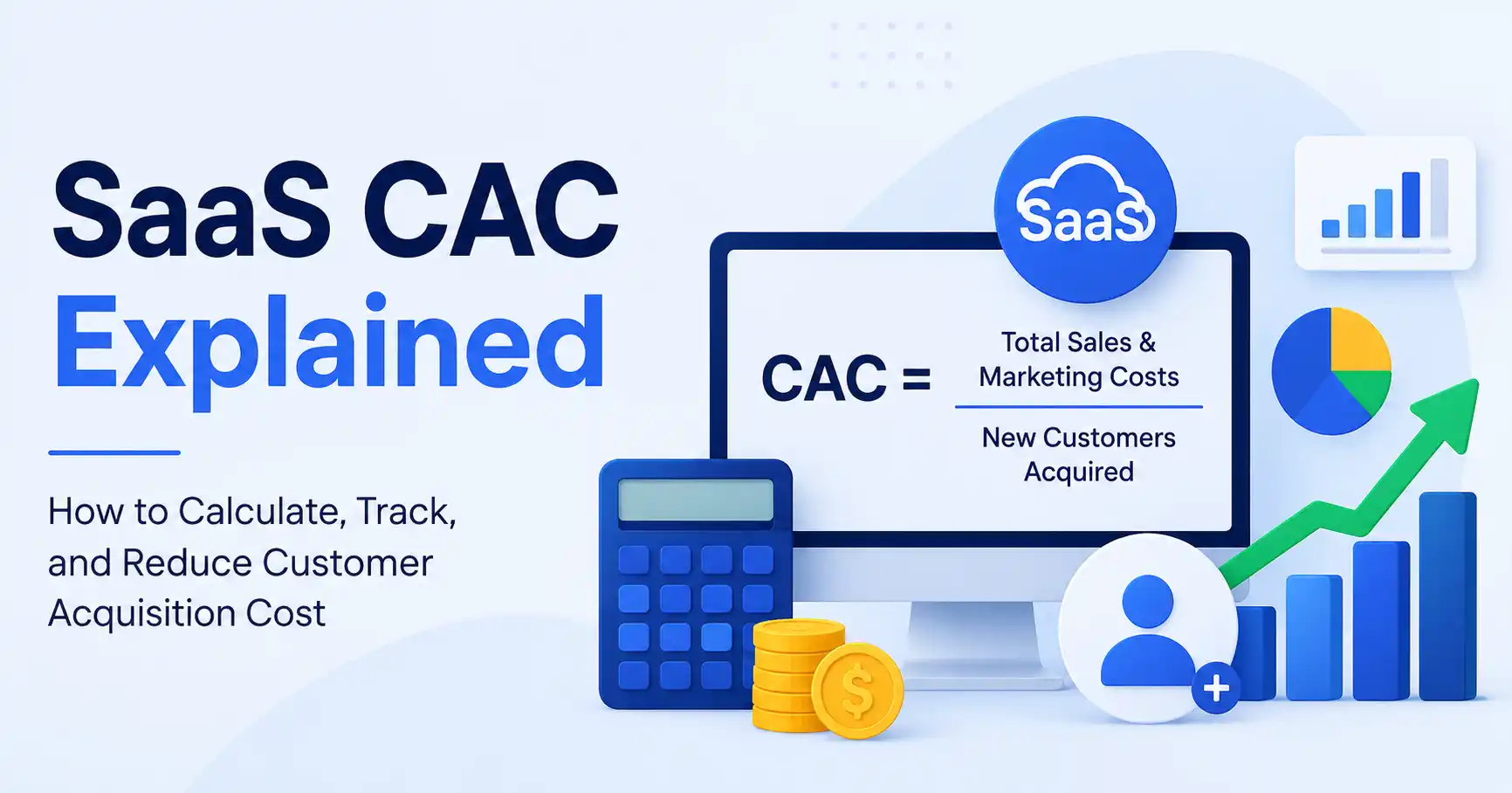
Total SaaS CAC counts every single cent spent acquiring that one fresh subscriber, Simple math.It is arguably the best metric for checking if your growth engine actually works. Watch out, though. A climbing CAC turns fast growth into expensive growth fast, especially if churn is creeping up. In this guide, you will learn how to figure out your SaaS CAC, which exact expenses to count, how it stacks up against customer lifetime value, and ways to slash acquisition costs without stalling your momentum.
Table of Contents
- What is SaaS CAC
- Why SaaS CAC is Important
- Step by Step Guide
- Best Practices and Tips
- Common Mistakes
- Tools
- FAQs
- Conclusion
What is SaaS CAC
SaaS CAC is the average amount a SaaS company spends to acquire one new paying customer during a specific period. The basic CAC formula is:
CAC = Total Sales and Marketing Costs / Number of New Customers Acquired
For example, suppose a SaaS company drops fifty grand on advertising, sales salaries, marketing software, content, and assorted acquisition grind in one single quarter. If it ropes in 250 new paying customers, that CAC lands at 200 dollars per head.
Count paying users. Not window shoppers, not casual leads, and certainly not free trial users who ghost before paying. The expenses must map to that exact same timeframe.
For a deeper dive into SaaS marketing channels and acquisition strategy, check out SaaS digital marketing.
Why SaaS CAC is Important
SaaS customer acquisition cost rules. Efficiency fuels growth. Profit follows.
- It shows how efficiently sales and marketing budgets create new customers.
- It helps you identify expensive acquisition channels.
- It makes revenue forecasting more realistic.
- It helps determine whether your pricing can support profitable growth.
- It provides an important comparison point for customer lifetime value.
A two hundred dollar CAC might look great for one SaaS startup and ruin the next. That metric stays totally blind until you stack it against customer lifetime value, gross margins, churn, and how fast you recoup the cash..
Most folks in SaaS throw around a three to one LTV to CAC ratio as the absolute gold standard. Take it with a massive grain of salt, Pricing, margins, and shifting sales cycles rewrite the math every single time.
Step by Step Guide
Step 1: Define Your Measurement Period
Choose a fixed horizon, perhaps a full year or just a quarter. SaaS companies heavily favor these shorter tracks since software deals simply refuse to close quickly.
For example, if your sales cycle is 60 days, comparing January spending with January customers can give a misleading result. Some January acquisition costs may produce customers in February or March.
Use a consistent reporting window and keep the methodology stable so that changes in CAC actually mean something.
Step 2: Calculate Your Total Acquisition Costs
Add the costs directly associated with acquiring customers. Depending on your business model, this can include:
- Paid advertising
- Sales salaries and commissions
- Marketing salaries
- Agency and contractor fees
- Content production
- Marketing and sales software
- Events and sponsorships
- Lead generation campaigns
The exact definition can vary, but consistency matters more than pretending there is one perfect formula. Stripe recommends including sales and marketing costs that are directly tied to customer acquisition.
Step 3: Count New Paying Customers
You’ve got to nail down the real number of new customers from that period. Say you got a thousand leads, got three hundred into free trials, but only seventyfive actually paid. Your customer acquisition cost needs to be figured using those seventyfive. Not the trial users, and definitely not the first thousand raw leads. This strict rule stops teams from fudging their spending figures.
Step 4: Calculate and Segment CAC
Use the formula:
CAC = Total Acquisition Costs / New Paying Customers
Imagine your quarterly acquisition cost is 120,000 dollars and you gained 300 new customers.
120,000 / 300 = 400 dollars CAC
Do not stop at blended CAC. Segment it by channel, customer type, and acquisition motion when possible.
| CAC View | Example | What It Tells You |
| Blended CAC | 400 dollars | Overall acquisition efficiency |
| Paid CAC | 550 dollars | Efficiency of paid acquisition |
| Organic CAC | 180 dollars | Cost of SEO and content acquisition |
| Sales Assisted CAC | 900 dollars | Cost of human assisted acquisition |
| Enterprise CAC | 2,500 dollars | Cost of acquiring larger accounts |
| SMB CAC | 250 dollars | Efficiency of smaller accounts |
Key takeaway: Blended CAC tells you what happened, but segmented CAC helps you understand why it happened.
Step 5: Compare CAC With LTV and Payback
Acquisition cost by itself tells you basically nothing. You have to stack it up against lifetime value, retention, gross margins, and your payback window.
Take a software outfit with a one grand acquisition cost and a four grand lifetime value. Looks decent on paper. But what if gross margins are weak or it takes forever to get that cash back? The model completely falls apart.
Payback gets down to brass tacks. How fast do you actually earn back what you spent to land that buyer?
Say you drop twelve hundred bucks bringing someone in, and they net you two hundred a month in gross profit. That means a six month payback stretch.
Best Practices and Tips
- Track CAC by channel
Do not rely only on blended CAC. Compare paid search, paid social, SEO, outbound sales, referrals, partnerships, and other channels. - Separate new customer CAC from expansion
Upsells and cross sells should not be mixed into new customer acquisition reporting. Keep acquisition and expansion economics separate. - Track CAC with gross margin
Revenue alone can make acquisition look healthier than it really is. Gross margin provides a better view of the money available to recover CAC. - Watch CAC payback
A growing CAC may be acceptable if customer value and margins are also increasing. Payback tells you how quickly acquisition spending comes back. - Improve conversion before increasing traffic
If your website receives 10,000 qualified visitors but converts poorly, buying more traffic can simply increase wasted spending. Fix the funnel first. - Invest in compounding channels
SEO, useful content, referrals, partnerships, and product led growth can create acquisition leverage over time. A strong SaaS organic traffic strategy can reduce dependence on continuously increasing paid media budgets. - Connect acquisition with retention
A low CAC is not enough if customers churn quickly. Improving retention can increase LTV and make the same CAC more valuable. See these SaaS retention marketing strategies for practical retention ideas.
Common Mistakes
Using Leads Instead of Customers
A lead is not a customer. Using leads in the CAC denominator makes acquisition appear cheaper than it actually is.
Looking Only at Advertising Spend
SaaS CAC can include sales salaries, commissions, software, content, agencies, and other acquisition costs. Ignoring these costs creates an incomplete picture.
Mixing Different Customer Segments
Enterprise and SMB customers often have dramatically different acquisition costs. Combining them can hide important problems.
Ignoring Time Lag
A sales campaign launched today may produce customers several weeks or months later. Comparing spending and customers without considering the sales cycle can distort CAC.
Optimizing CAC Without Looking at LTV
Cutting acquisition costs is not automatically good. A cheaper channel that brings customers with poor retention may produce worse economics than a more expensive channel with high LTV.
Tools
HubSpot
HubSpot can connect sales and marketing activity with customer data, making it useful for tracking acquisition performance across channels. Its guidance also recommends calculating CAC using sales and marketing costs divided by new customers.
Stripe
Stripe is useful for SaaS businesses that need billing and revenue data alongside acquisition analysis. Its SaaS CAC guidance covers CAC calculation, segmentation, LTV to CAC, and payback considerations.
Google Analytics
Google Analytics maps user behavior and traffic, but remains invaluable for pinpointing exactly which digital channels drive your actual sales today.
Mixpanel
Mixpanel links SaaS acquisition straight to product usage and user behavior. Why does that matter? It shows you if people coming from a specific marketing channel actually stick around and get engaged.
FAQ’s
What is a good SaaS CAC?
Forget a single good SaaS CAC. It just doesn’t exist. Everything hinges on your gross margin, retention, pricing, sales cycle, and overall model. A five hundred dollar cost to acquire a customer sounds great for a high ticket B2B tool. For a cheap self serve app, Way too steep.
How is SaaS CAC calculated?
Divide your overall marketing and sales expenses by the new paying customers acquired throughout that exact timeframe. That is it.
What is a healthy LTV to CAC ratio for SaaS?
That 3 to 1 ratio is a popular guidepost. But honestly, companies really need to look at their own margins, where they are in growth, how well they keep customers. And how fast they get paid back. It’s not a onesizefitsall target.
Should SaaS companies calculate CAC by channel?
Channel level CAC exposes who actually stays and which wasteful sources simply swallow your budget without a single good reason.
How can SaaS companies reduce CAC?
Wanna boost conversions? Go after customers who actually want your stuff, Get more referrals. Make onboarding smoother and keep people around, Grow naturally, and ditch any spending that isn’t pulling in new customers.
Conclusion
SaaS customer acquisition cost goes way beyond a standard marketing metric. It is a vital unit economics gauge telling you how well your company turns sales and marketing cash into paying customers. Start with a solid formula, but do not stop at blended numbers. Segment your spending by channel and customer type, weigh it against lifetime value and gross margin, and track payback speed. The smartest move right now? Calculate your CAC for the past quarter and break it down completely by channel. Find the exact spots where acquisition cost and customer value drift farthest apart. That gives your team a concrete starting point to fix SaaS growth efficiency immediately.