

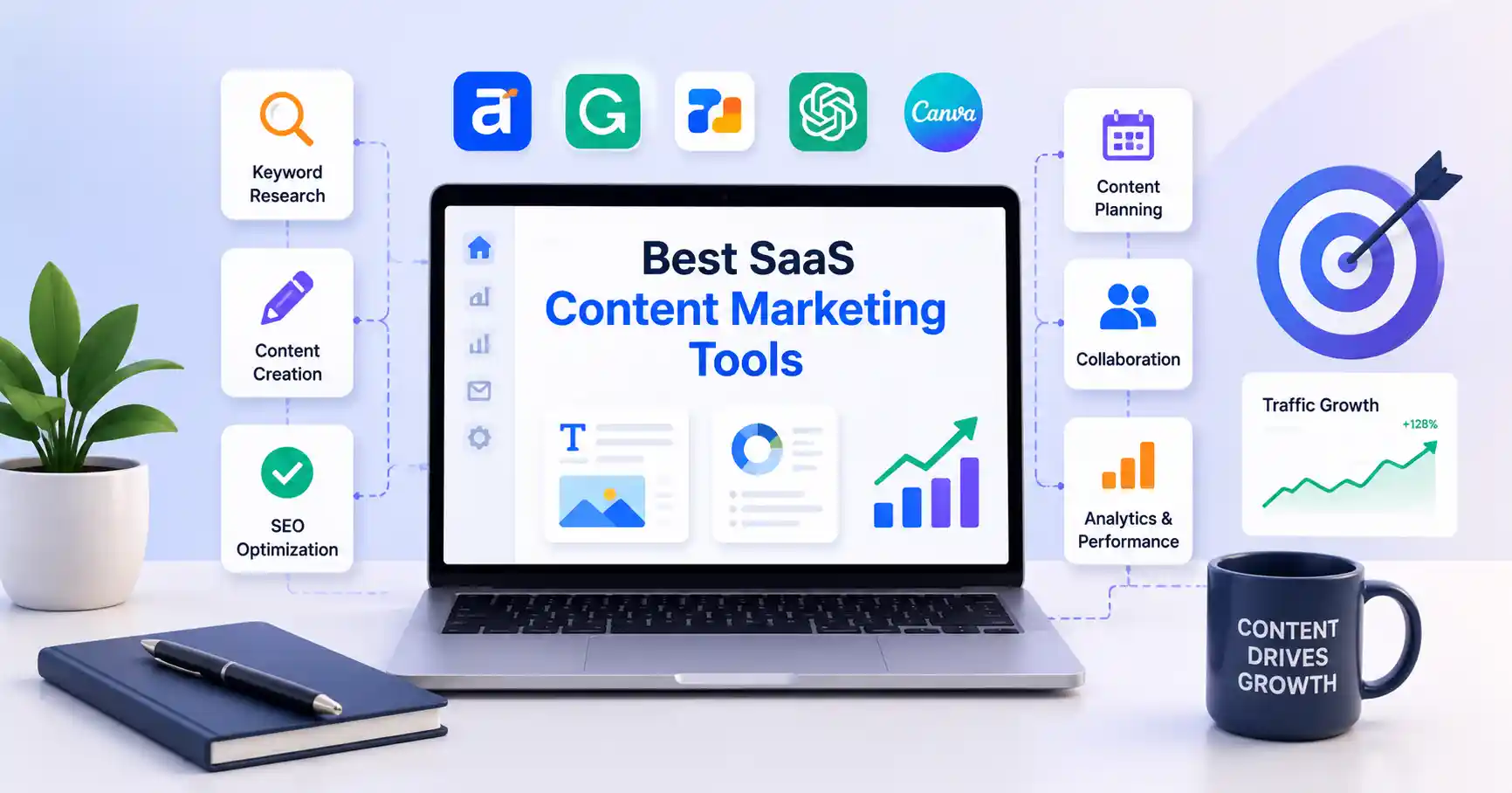
If you’re running a SaaS business, you’ve probably noticed that making solid content, like consistently, is one of the hardest parts. Between writing blog posts, tweaking them for search engines, handling social media, and then measuring performance, content marketing ends up being way more than just posting articles.
That’s exactly where SaaS content marketing tools come into play. They kind of streamline content creation and all the rest of the stuff keyword research, teamwork, enhancement, publishing, and analytics too so your marketing team can move quicker, without cutting corners on quality.
In this guide, you’ll find out what SaaS content marketing tools are , why they actually matter, how to select the right set for your needs, and which platforms are worth your time.
Table of Contents
- What are SaaS content marketing tools?
- Why are SaaS content marketing tools important?
- Step-by-step guide to choosing the right content marketing tools
- Best practices for using SaaS content marketing tools
- Common mistakes to avoid
- Best SaaS content marketing tools compared
- Frequently asked questions
- Conclusion
What are SaaS content marketing tools?
SaaS content marketing tools are basically software platforms that help businesses plan, craft, improve, publish, circulate, and also track content across multiple marketing channels. Instead of constantly juggling a bunch of spreadsheets, and a handful of disconnected apps, these tools kind of bring the whole content workflow together in one place.
For instance, picture yourself writing a blog about customer onboarding. You might use Ahrefs to track keywords, Grammarly to refine the text, Surfer SEO to adjust the pages for ranking, Canva for featured images or maybe even quick visuals, and then use Google Analytics to review performance after you publish.
When you put it all together, these platforms form an efficient content marketing workflow.
Why are SaaS content marketing tools important?
Content marketing has become one of the most effective ways for SaaS companies to draw qualified traffic , and in the long run build those steady customer bonds which really matter.
The right tools help you:
- Save time by automating repetitive tasks.
- Discover content opportunities through keyword research.
- Improve SEO performance.
- Collaborate efficiently with writers and designers.
- Measure content performance using real data.
- Scale content production without sacrificing quality.
If you’re building your SaaS marketing strategy, it’s also worth exploring our guide on Best SaaS Marketing Automation Tools to understand how automation and content marketing work together to generate and nurture leads.
Step-by-Step Guide to Choosing the Right SaaS Content Marketing Tools
Step 1: Identify your content marketing goals
Start by understanding what you want to achieve.
Are you trying to increase organic traffic?
Generate more demo requests?
Improve customer education?
Different goals require different tools.
For example, SEO-focused businesses may prioritize keyword research platforms, while product-led SaaS companies might invest more heavily in content collaboration and analytics.
Step 2: Build a complete content workflow
Content marketing isn’t just writing blog posts.
A complete workflow usually includes:
- Keyword research
- Content planning
- Writing
- Editing
- SEO optimization
- Graphic design
- Publishing
- Performance tracking
Choosing tools that integrate smoothly makes the process much easier.
Creating high-quality content is only one part of SEO success. You’ll also need the right SEO toolkit to discover keywords, monitor rankings, and identify optimization opportunities. Our Best SEO Tools for SaaS Startups in 2026 guide compares the platforms that can help you improve your search visibility.
Step 3: Compare features before pricing
Many businesses choose software based only on cost.
Instead, compare:
- SEO capabilities
- AI assistance
- Collaboration features
- Workflow automation
- Integrations
- Analytics
- Ease of use
The cheapest platform isn’t always the best investment.
Step 4: Test before committing
Most major SaaS content marketing platforms will usually give you a free trial, so honestly just take it. Try them out, and don’t overthink it. While you’re in, create a few pieces of content, invite a couple teammates, and watch how naturally the platform lands in your day to day workflow, before you actually purchase anything.
Step 5: Measure content performance continuously
Publishing content is only the beginning.
Review metrics such as:
- Organic traffic
- Keyword rankings
- Time on page
- Conversion rate
- Backlinks
- Customer acquisition
For a deeper understanding of how Google measures website performance, Google’s Search Central SEO Documentation provides excellent guidance on creating helpful, search-friendly content.
Best Practices for Using SaaS Content Marketing Tools
Following a few proven practices can help you get much better results.
- Focus on solving customer problems instead of chasing keywords.
- Build topic clusters instead of publishing isolated articles.
- Update existing content regularly.
- Combine AI tools with human editing.
- Maintain a consistent publishing schedule.
- Use internal links to connect related topics naturally.
- Track performance monthly and improve older content instead of only creating new articles.
One of the biggest differences between average SaaS blogs and the high performing ones is more consistency, rather than publishing volume, it just feels a bit more… I don’t know repetitive sometimes but like, in a good way.
Common Mistakes to Avoid
Even the best SaaS content marketing tools wont deliver much if theyre used kinda wrong, like at the wrong moment, or with the wrong setup. So its better to avoid a few common mistakes, because only then you can squeeze the most value from your content marketing work, and not waste time.
Creating content without understanding search intent
A lot of businesses get stuck on keywords and then kind of forget the actual why behind it all, like the reason people are searching in the first place. Every article should answer a real question or help with a genuine problem, not just chase traffic numbers, or whatever.
Using too many disconnected tools
Managing like ten different platforms, honestly, tends to create more confusion than any real productivity, especially when you keep switching contexts. Whenever you can, go for tools that mesh well with your current workflow, not just something “that works” on its own.
Publishing without measuring results
Making content without tracking performance is kinda like driving, without any map. Just review your analytics on a regular basis, so you can spot what articles bring in traffic, spark leads , and end up with those conversions.
Ignoring content updates
Search trends, they really change over time. Going back to older articles and refreshing them with new information , fresh examples and updated statistics can often raise rankings a lot quicker than rushing out brand-new content all the time.
Relying entirely on AI
AI can speed up research, a bit of drafting too, but the human touch the expertise, editing, and those original insights are still, absolutely crucial for making SaaS content that feels trustworthy.
Best SaaS Content Marketing Tools Compared
Different tools kind of deal with different needs. Some are meant more for keyword discovery, while others go toward writing tasks, performance tuning, teaming together, or data analytics, it depends.
| Tool | Best For | Key Features | Ideal For |
| Ahrefs | SEO & Keyword Research | Keyword Explorer, Backlink Analysis, Site Audit | SEO Teams |
| Semrush | Content Strategy | Keyword Research, Content Toolkit, Competitor Analysis | Growing SaaS Companies |
| Surfer SEO | Content Optimization | Content Score, NLP Keywords, SERP Analysis | Content Writers |
| Grammarly | Content Editing | Grammar, Tone, Readability | Marketing Teams |
| Canva | Visual Content | Social Graphics, Blog Images, Templates | Designers & Marketers |
| Google Analytics 4 | Performance Tracking | Traffic Analysis, User Behavior, Conversions | All SaaS Businesses |
Key takeaway: The best results come from combining complementary tools rather than relying on a single platform to handle every aspect of content marketing.
Which SaaS content marketing tools should you choose?
The right combination kinda depends on what you want your business to achieve and just how big your team is.
For startups ,start with reasonably priced tools like Grammarly, Canva, Google Analytics 4, and Google Search Console. They cover almost everything you need to create a sturdy content marketing base.
For growing SaaS businesses : add platforms such as Ahrefs or Semrush, for keyword research and competitor checks. Surfer SEO can also assist with polishing each article before it goes live.
For larger marketing teams, consider investing in collaborative platforms that blend content planning, workflow management, SEO optimization, and reporting . That way teams can keep publishing on a steady rhythm while also staying consistent in overall quality across all pages.
Instead of picking software just because it has the longest feature list, go with tools that simplify your workflow, and save your team time in practical ways.
FAQ’s
What are SaaS content marketing tools?
SaaS content marketing tools kind of help businesses dig into research, create, refine , publish, and also measure content in a more efficient way. They basically smooth out the whole content marketing journey, from planning phases to performance analysis, so it’s less hassle overall.
Which content marketing tool is best for SaaS startups?
For startups, you can use Ahrefs or Semrush for SEO, Grammarly for the editing part , Canva for the visuals, and Google Analytics 4 for performance tracking, sort of a practical set. It feels like a very solid combo overall , you know.
Do I need multiple content marketing tools?
Usually, yes. Most businesses use some mix of SEO plus writing, design, and analytics tools because every platform specializes in some differe nt stage of the content workflow, like one helps with ranking, another with publishing, and another with measuring outcomes.
Can AI replace content marketing tools?
AI can help speed up content production, sure, but it still doesn’t fully replace the keyword research part, the SEO tweaking, the analytics, or that human knowhow. The best outcomes tend to show up when you mix AI with seasoned marketers and also the specialized tool set. Without that blend, it’s kind of like having power but no map.
How often should I update SaaS content?
Take a look at those important articles maybe every three to six months, just to be sure. Like, updating the stats , the screenshots, the examples, and the SEO bits (stuff people search for) helps keep rankings where they are and also gives a smoother user experience, overall.
Conclusion
Choosing the right SaaS content marketing tools isn’t about grabbing as many platforms as possible, it’s more like building a simple workflow that helps your team produce useful content again and again , then polish it for search engines and actually tie it back to real business outcomes.
Whether you’re launching your first SaaS product or scaling something that’s already running strong, putting thought into the right blend of content marketing tools will boost productivity, tighten your SEO strategy, and slowly bring in more well-matched, qualified customers.
Since search engines keep evolving and AI powered search feels more normal every month, businesses that keep publishing helpful, well organized, and experience driven content will keep standing out. Don’t just chase every shiny new trend. Instead focus on solving customer problems, measuring what works, and improving your content as you go, based on what you learn.
If you’re trying to grow your SaaS business through content marketing, start by selecting the tools that match where you are today, set up a steady publishing rhythm, and then tweak your plan using real performance data. Small refinements made consistently, usually end up being the biggest long term win.