

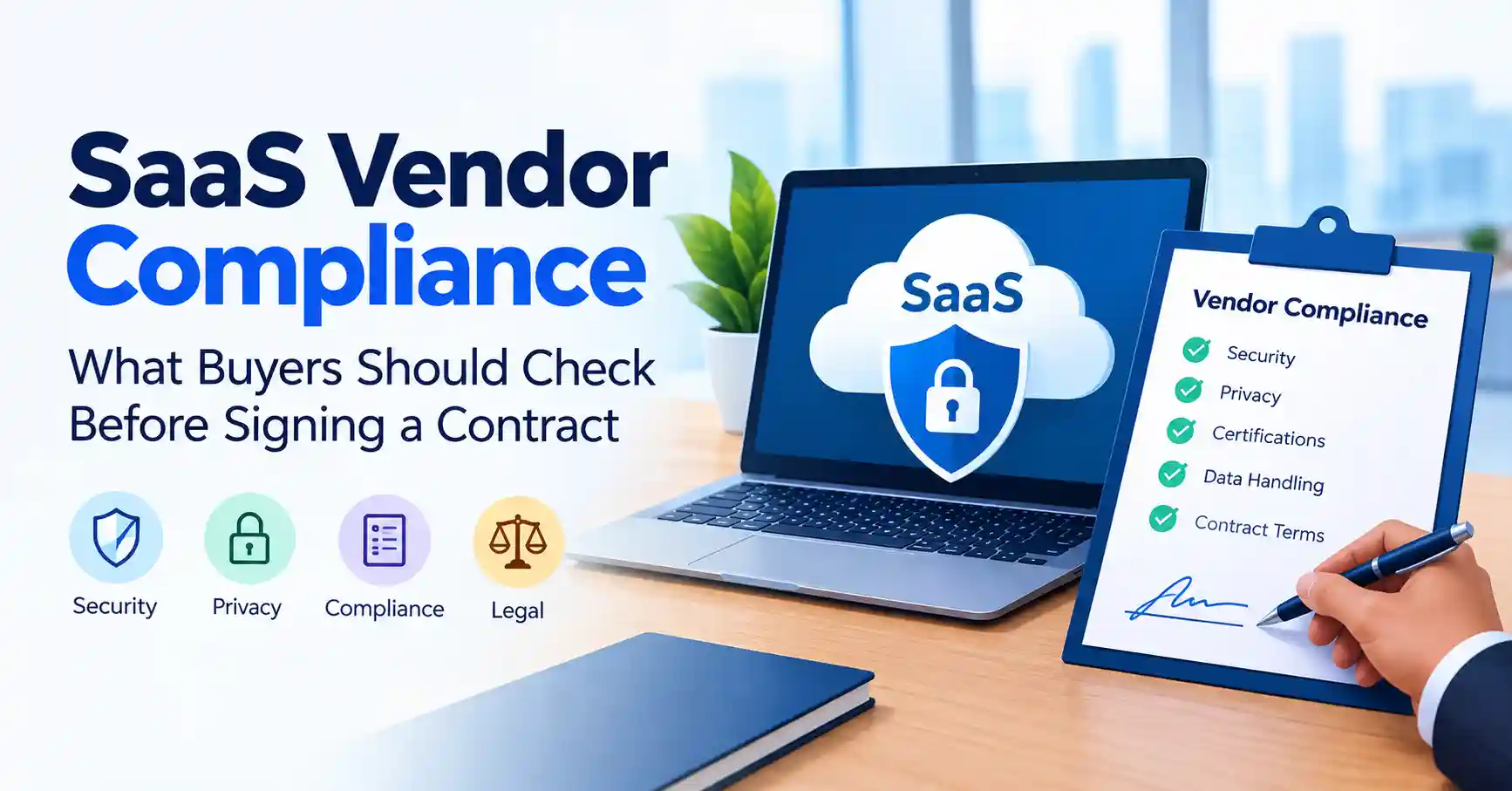
SaaS vendor compliance? It’s basically checking out a software company before you hand over your sensitive business data. You need to know if they can truly hit your security marks, respect privacy rules, and stick to any laws or contract terms you’re bound by.
Don’t let a slick security page or a few badge icons fool you, though. Those aren’t enough, you still have to really dig into what those badges even mean. Plus, you’ve got to see how the vendor handles customer data every single day and what their plan is when something inevitably goes wrong.
So, this guide breaks down what to look at, what documents to ask for, and even a simple process for actually running a SaaS vendor compliance check that delivers.
Table of Contents
- What is SaaS Vendor Compliance
- Why SaaS Vendor Compliance is Important
- Step by Step Guide
- Best Practices and Tips
- Common Mistakes
- Tools
- FAQs
- Conclusion
What is SaaS Vendor Compliance
Vendor compliance is just verifying if a SaaS provider aligns with your requirements for security, privacy, legal duties, and daily functioning.
When your company adopts a SaaS solution to store customer identities, email addresses, billing details. And support histories, you cannot limit your inquiries. Obviously, check for SOC 2 certification. But you must ascertain precisely the geographical location where your information will reside, who has clearance to view it, which third parties might touch it, how the vendor handles security incidents, and what exact protocol exists for purging your files once the contract finally concludes. These are never minor points.
NIST talks about supply chain due diligence by saying you should research and confirm key details about tech suppliers before you buy from them. It also says you should scale how deep you look based on how important that supplier is to your work.
So a good vendor check ties written compliance proof to a SaaS vendor security assessment.
Internal link opportunity: Insert a link here to your Saasyntic page on SaaS security or SaaS risk management. Use anchor text like SaaS security best practices.
Why SaaS Vendor Compliance is Important
A SaaS vendor can still fit into your security and compliance setup. Even if the app runs on their side, not yours, it can be managed as part of your controls.
Key reasons to perform vendor compliance checks include:
• Protecting sensitive customer and business data from avoidable security risks
• Meeting contractual and regulatory requirements that apply to your organization
• Understanding whether the vendors security controls match the risk of the service
• Reducing surprises during customer security reviews and procurement audits
• Establishing clear responsibilities if a breach, outage, or compliance issue occurs
A vendor may have strong security controls while still failing to meet a specific requirement your business has. Compliance should therefore be assessed against your actual use case rather than treated as a generic badge.
Step by Step Guide
Step 1: Classify the Data and Business Risk
First, list what the SaaS tool will read, save, and handle.
Put each type of data into a group like public, internal, confidential, personal, financial, or highly sensitive. After that, judge how much the app matters for daily business work.
For instance, a project tool that only stores public project details may need a lighter check than a customer support tool that includes personal data and past customer account records.
NIST due diligence guidance for 2026 also points out that supplier checks should change based on things like how critical the supplier is and the risk level during acquisition.
Step 2: Verify Certifications and Audit Reports
Do not rely only on logos displayed on a vendors website. Ask for the actual compliance documentation.
Common evidence includes:
• SOC 2 Type II report
• ISO 27001 certificate
• Penetration testing summary
• Data processing agreement
• Business continuity documentation
• Information security policies
Check the scope and dates. A vendor can have a certification, but it may only apply to one product, one setting, or one business unit.
For instance, if you are purchasing a product that was just released, do not assume the whole firm is covered. Ask instead whether that new product is inside the audit scope.
Step 3: Review Data Privacy and Data Handling
Determine what personal information the vendor processes and why.
Ask:
• Where is customer data stored
• Which countries can data be transferred to
• Who can access production data
• How long is data retained
• Can customers request deletion
• What subprocessors are used
• How are international data transfers handled
If the vendor processes personal data on your behalf, review the contractual data protection terms carefully. Depending on the applicable law and relationship, requirements can include documented processing responsibilities and technical and organizational security measures.
Internal link opportunity: Add a link here to a Saasyntic article about SaaS data privacy using anchor text such as SaaS data privacy requirements.
Step 4: Examine Security and Incident Response Controls
What steps does the vendor use to keep the service safe each day?
Ask about encryption first, then identity and access management. Also ask whether multi factor authentication is required. Next, talk about vulnerability management and how patches are handled.
Clarify what gets logged and where the logs are kept.Make sure backups are covered, and ask about disaster recovery plans too. You should also ask how employee access is controlled inside the vendor’s organization.
For incident response, push for clear details. Ask how fast they say they will alert customers once a security issue is found. Then ask what they will include in that notice.
For instance, if your contract says notification within 24 hours, but their usual terms allow a few days, fix that mismatch before you sign.On software supply chain risk, review what NIST suggests.
Ask about how they build their software, how they manage third party dependencies, and what controls they use for the software supply chain.
Step 5: Review Contracts, Subprocessors, and Exit Requirements
Those security forms are just the beginning, Really comb through the contract. Scrutinize rules on privacy, breach alerts, audits, retention, secrecy, and when things end.
Pay particular attention to subprocessors. A SaaS provider may rely on cloud hosting, payment, analytics, customer support, or infrastructure providers. You should understand which third parties can access or process your information.
Also define the exit process. Confirm how your data will be exported, returned, or securely deleted when the contract ends.
SaaS Vendor Compliance Evidence Comparison
Different evidence types answer different questions. Buyers should not treat them as interchangeable.
| Evidence | What it shows | What to check | Best use |
| SOC 2 Type II | Operating effectiveness of selected controls | Scope, period, exceptions | Security due diligence |
| ISO 27001 | Information security management system certification | Certificate scope and validity | Management system assurance |
| Penetration test | Testing of technical security controls | Test date, scope, findings | Technical risk review |
| DPA | Data processing responsibilities | Processing, transfers, subprocessors | Privacy compliance |
| Security questionnaire | Vendor supplied control information | Answers and supporting evidence | Initial screening |
| Business continuity plan | Approach to service disruption | Recovery objectives and testing | Operational resilience |
No one document shows the whole vendor compliance picture. Buyers should use more than that one proof. They need to gather outside evidence, then also check the contract terms and how the vendor actually runs day to day..
Best Practices and Tips
• Match review depth to risk. Do not spend the same effort on every SaaS application.
• Ask for evidence instead of accepting unsupported compliance claims.
• Check document dates. Old audit reports may not reflect the current environment.
• Verify scope carefully. A company wide certification may not automatically cover every product.
• Review subprocessors before approving a vendor.
• Put critical security requirements into the contract rather than relying only on sales commitments.
• Reassess important vendors periodically instead of treating compliance as a one time procurement task.
NIST says due diligence is something you do all the time. It treats it as part of risk management, not a one time task. It also tells you to check what you find against more than one source when that is possible.
Common Mistakes
Relying Only on Compliance Badges
A SOC 2 or ISO badge offers proof, sure. But it completely glosses over your specific, actual operational context.
Treating All Vendors the Same
A low risk collaboration tool and a platform processing sensitive customer information should not automatically receive identical reviews.
Ignoring Subprocessors
A vendor can have strong internal controls while relying on third parties that introduce additional data or operational risks.
Skipping Contract Review
Security questionnaires do not replace contractual commitments. Make sure important requirements are reflected in the agreement.
Forgetting Vendor Exit
Organizations often focus heavily on onboarding and overlook what happens when the relationship ends. Data export and deletion should be addressed before signing.
Tools
Several categories of tools can support a SaaS vendor compliance program:
- Vendor risk tools can bring questionnaires, documents, scores, and review steps into one place.
- Security rating tools can show how a vendor stacks up from the outside.
- Compliance automation tools can gather proof and keep audit items up to date.
- Contract tools can log security terms, renewal dates, and ongoing duties.
- Internal risk logs can list vendor risks, the person in charge, mitigation steps, and check in dates.
For small teams, a simple spreadsheet and a shared evidence folder can work well. This helps when there are only a few vendors to handle.
External resource idea: Add a link to NIST guidance on supply chain risk management. Point it to the National Institute of Standards and Technology official page.
External resource idea: Add a link to the NIST vendor due diligence guide. Connect it to the latest NIST SP 1326 guidance.
FAQ’s
Is SOC 2 enough for SaaS vendor compliance
A SOC 2 report? Yeah, it shows how a company manages some of its controls. But don’t mistake that for proof. It doesn’t mean a vendor hits every single privacy rule, law, contract term, or business need.
What documents should a SaaS buyer request
People often ask for SOC 2 or ISO 27001 papers. They may also want details from penetration tests. You might be asked for the security policy. Some clients ask how data is handled and what terms apply. They also want the list of subprocessors. Business continuity plans can come up too. On top of that, they may request incident response steps.
How often should SaaS vendors be reviewed
How often you check should match the level of risk. If a vendor is critical and deals with sensitive data, or if it supports a key business process, you usually need to monitor it more often. For low risk apps, less frequent checks are typically enough.
Should startups perform SaaS vendor compliance checks
Sure. Keep the review simple. First, point out what data is in scope. Next, look at what the vendor shows for security. Then, check the privacy terms. Finally, write down the key risks you find.
What is the most important thing to check
One check never suffices. First, inspect the underlying data alongside business impacts. Then, verify how vendor controls, proof, contracts, and operational realities actually handle those exact risks.
Conclusion
SaaS vendor compliance isn’t just about a certification badge anymore. Buyers need to really dig into a software company’s security, its privacy policies, all the audit evidence, even its subprocessors. They should check the contracts, incident response plans, and exit procedures, all of it, measured against the actual business risk.
So, what’s next? Build a vendor assessment checklist you can use again and again. First, classify each SaaS provider by risk. Ask for proof, then make sure that proof actually covers what it claims. Document any holes you find, and get crucial requirements written right into the contract. This way, vendor reviews get quicker, more consistent, and a lot easier to back up when audits or customer security checks roll around.