
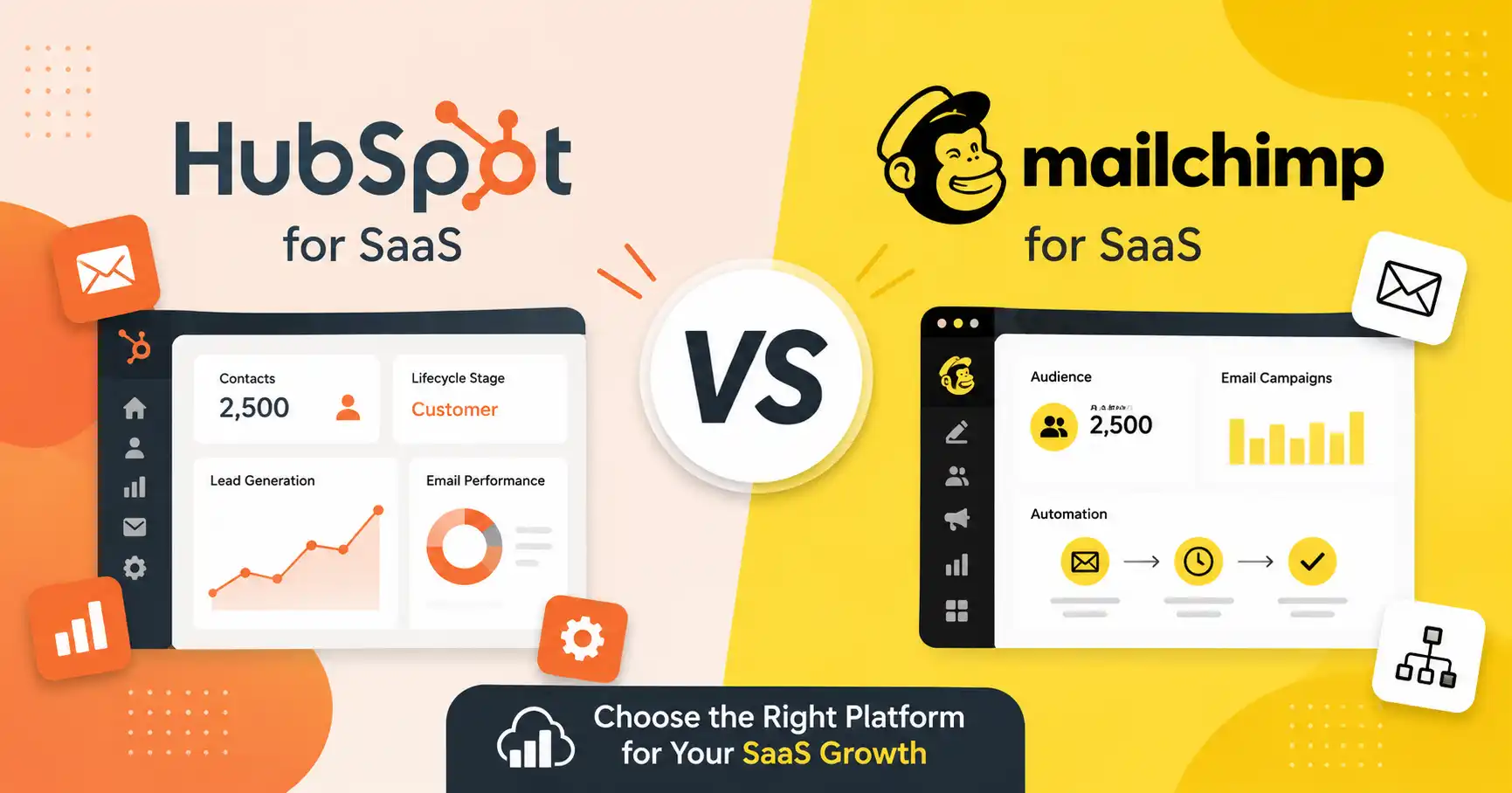
Choosing the right marketing platform can seriously effect how a SaaS company snag leads, nurture prospects, and keep existing customers active. HubSpot and Mailchimp are both known widely, but they do not aim at the same issues. In this HubSpot vs Mailchimp for SaaS comparison , we are going to review features, automation, CRM support, pricing, how well they scale, and the day to day usability. After reading it, you should be able to decide which platform fits your SaaS growth phase, and also matches your marketing workflow more cleanly.
Table of Contents
- What is HubSpot vs Mailchimp for SaaS
- Why HubSpot vs Mailchimp for SaaS is Important
- HubSpot vs Mailchimp for SaaS Comparison
- Step by Step Guide to Choosing the Right Platform
- Best Practices and Tips
- Common Mistakes
- Useful Tools
- FAQs
- Conclusion
What is HubSpot vs Mailchimp for SaaS
HubSpot and Mailchimp are marketing platforms, that can help SaaS companies run email campaigns, handle contacts, automate outreach, and keep customer communication more steady. The overall idea is similar but the execution feels different, you know, in a few core ways.
HubSpot shows up as this wider customer platform thing, with a CRM inside it, plus a bit of marketing automation, sales tools, service support, reporting and even customer journey orchestration.Mailchimp feels more centered around email and SMS marketing , audience care, those marketing automation workflows, and the constant campaign fine tuning so the messages keep getting better over time.
Like imagine a SaaS firm with around 2,000 trial users. With Mailchimp the team can dispatch onboarding emails, build segmentation rules, and handle subscriber lists. With HubSpot those same marketing interactions can be stitched to CRM personas, sales activity logs, lead scoring, and other adjacent customer context things.
So when a SaaS business moves past plain email blasts, and starts doing connected lifecycle marketing, that gap starts to feel pretty noticeable.
Why HubSpot vs Mailchimp for SaaS is Important
Choosing between these platforms really matters because SaaS marketing is rarely only about mailing a bunch of newsletters and calling it done
The right platform can help you:
- Set up automated onboarding and lead nurturing
- Split prospects using behavior patterns and where they are in the customer cycle
- Link your marketing work with sales signals
- Follow leads through the entire buyer journey
- See which campaigns actually feed business growth
A smaller SaaS company might not need a big marketing suite right away. But a scaling SaaS business with multiple teams, separate sales pipelines, and more involved customer journeys may eventually require stronger CRM features as well as deeper automation
HubSpot vs Mailchimp for SaaS comparison
The best choice depends on what your SaaS company needs today and how you picture your marketing system, in the next two or three years
| Feature | HubSpot | Mailchimp |
|---|---|---|
| Best for | CRM and full life-cycle marketing | Email and audience promotion |
| Email marketing | Reliable | Reliable |
| CRM | Built in | More limited compared with HubSpot |
| Automation | Advanced options at higher tiers | Strong email focused automation, it is more linear in practice |
| Sales integration | Great | In general it needs integrations |
| Reporting | Wide marketing and customer reporting | Solid campaign reporting |
| Ease of use | More features can lead to extra complexity | Typically easier to get going with |
| Scalability | Solid option for growing teams | Solid option for email centered teams |
Key takeaway: HubSpot is often better for linked SaaS marketing and sales workflows , while Mailchimp is appealing when email marketing is the main priority
Pricing also needs close attention. HubSpot has free utilities plus paid Marketing Hub tiers, and the cost tends to rise depending on things like marketing contacts and plan tier. Its Professional plan right now begins at 800 dollars per month if billed annually , and then extra onboarding plus other expenses can apply at that level.
Mailchimp now has a free plan that supports up to 250 contacts, plus paid tiers that go up depending on your contact numbers and the features you need. Their Standard package currently begins at 20 dollars a month for 500 contacts. Still, pricing can change based on the plan type, audience size, any promotions running , plus taxes and your region.
For up to date pricing, it is worth checking the official HubSpot Marketing Hub pricing guide and the Mailchimp pricing plans before you make a purchase call.
Step by Step Guide to Choosing Between HubSpot and Mailchimp
Step 1: Define Your SaaS Marketing Goals
First, you should name the problem you want to solve, before you even compare tools, really.
If your main goal is sending product updates, newsletters, promotional blasts, and those standard nurture pings, Mailchimp may do the job just fine.
But if you’re trying to connect lead capture with sales follow ups, customer records, lead scoring, and marketing automation, HubSpot is usually a better fit.
For example, a SaaS startup using a plain product led growth approach might begin with email campaigns. Meanwhile, a B2B SaaS company selling annual agreements may need a CRM, plus sales automation, sooner rather than later.
Step 2: Map Your Customer Journey
Jot down what happens from the first time someone lands on your website, to the moment they become a paying customer.
A common SaaS path could be like this:
Visitor then lead, then free trial, then activated user, then paying customer, then expansion customer.
After that, note the emails and behaviors you need at every step.
Mailchimp can manage a lot of email centered workflows. HubSpot starts to shine when you want marketing, sales, and customer context linked together in one place.
Step 3: Check Your CRM Requirements
Do your marketing platform really have to be the single source of customer info, or can something else take care of that in the background.
If your sales team is already spending most days inside a separate CRM, Mailchimp can act as a practical email layer that links with that system and keeps everything moving.
If your goal is for marketing and sales to run from the same customer records , HubSpot has the clear advantage, because its CRM is embedded in the platform not attached later.
That becomes really important when a prospect lands on a pricing page, grabs a piece of content, starts a trial, and then goes straight into a sales conversation.
Step 4: Compare Automation Needs
Do not judge automation only by how many workflow features are listed.
Instead, check what you actually need for your situation.
A basic SaaS onboarding flow might include:
- A welcome email right after signup
- A product setup message after one day
- A feature education email after three days
- A nudge reminder when activation has not happened
- An upgrade message near the end of the trial period
For a simple sequence, either platform might work. For more complex workflows tied to sales activity, lifecycle stage, customer traits, and multiple channels, HubSpot can give you a bit more flexibility to build, and also to adjust later if needed.
Step 5: Calculate the Total Cost of Ownership
Do not compare only the first subscription numbers.
Instead, add up the overall cost of:
- Contacts
- Users
- Email volume
- Automation abilities
- CRM requirements
- Integrations
- Reporting
- Onboarding
A tool that looks more affordable can end up costing more, if you need several extra tools to cover skills, that a different platform already includes.
Also paying for the advanced HubSpot features your team never actually uses is not a smart investment, and it often appears quickly in the budget.
Best Practices and Tips
- Begin with your customer journey instead of the software features. The workflow should decide the tool you pick, not the other way around.
- Split your users by how they behave, not only by demographics. A trial user who used one key feature needs different messaging than someone who never actually logged in.
- Track activation events. For SaaS companies, an email click is useful, but product activation is often a lot more important. You want to know when someone really steps in, not just when they tap a link.
- Connect marketing and revenue data whenever you can. This gives you clearer signal about whether your campaigns are actually creating customers, versus only driving clicks that don’t go anywhere.
- Keep automation simple at first. Build a few high value workflows before you end up with dozens of complicated sequences, because the value of basic stuff shows up faster.
- Review your contact database regularly. Older and inactive contacts can quietly raise costs and make your reporting feel less meaningful, even when the dashboards look fine.
- Test the platform with real workflows before you commit. Create one onboarding journey, one lead nurture sequence, and one customer re engagement campaign , then adjust.
For more guidance on building a SaaS marketing system, see our SaaS marketing automation tools guide.
If email is a big chunk in your strategy, our SaaS email marketing guide can also help you map the lifecycle campaigns, and get the timing a bit more clear.
Common Mistakes
Choosing Based Only on Price
Going with the lowest priced starting plan is not always the lowest priced long term option. Think about contact growth, your automation needs, and how well you need integrations to fit.
Treating Email Marketing as the Entire SaaS Funnel
Email matters, but SaaS growth depends on acquisition, activation, retention, and expansion. So email alone will not carry everything.
Ignoring Data Structure
If customer data is organized in a messy way, even a strong automation platform becomes harder to actually operate and use.
Building Too Many Automations
More workflows, does not automatically equal better marketing. Begin with journeys that are tied to clear, trackable business outcomes.
Forgetting About Migration
Before switching platforms, plan how you will transfer contacts, tags, segments, templates, past or historical data, and automation logic. If you miss this piece later it gets painful.
Useful Tools
HubSpot feels helpful when you need a CRM , marketing automation, sales workflows, and reporting all in one connected ecosystem, not too many tools talking past each other.
Mailchimp is helpful when email and audience marketing are the main needs, like you want newsletters, campaigns, and basic engagement tracking.
A CRM can support teams by keeping a structured perspective on prospects, deals, and customers.
Analytics tools can support you to measure traffic, conversions, activation, and revenue, even when things get a little messy.
Product analytics tools can clarify whether email campaigns are really pushing people toward meaningful product actions.
FAQ’s
Is HubSpot better than Mailchimp for SaaS?
That depends on your SaaS motion, yeah it really does. HubSpot is usually more solid for teams that need CRM foundations, sales integration, lifecycle marketing, and deeper automation. Mailchimp can work better for teams that are mainly focused on email marketing and audience engagement.
Is Mailchimp good for SaaS companies?
Yes. Mailchimp can work pretty well for SaaS companies that need email campaigns, list based segmentation, newsletters, and marketing automation. It helps a lot without requiring you to drag in a huge CRM platform.
Is HubSpot too expensive for a SaaS startup?
Yes, both platforms support integrations. Mailchimp says it links up with hundreds of applications, including things like Salesforce, Stripe, QuickBooks Online , and Squarespace.
Can HubSpot and Mailchimp integrate with other tools?
Yes, both platforms support integrations. Mailchimp says it links up with hundreds of applications, including things like Salesforce, Stripe, QuickBooks Online , and Squarespace.
Which is easier for a small SaaS team?
Mailchimp is usually simpler when the core focus is email marketing. HubSpot can take longer to set up, because it includes a wider stack of CRM plus marketing capabilities
Conclusion
Trying to decide HubSpot vs Mailchimp for SaaS usually ends up as this kind of question about how much marketing plumbing you really need , and what that stack is supposed to do day to day, without any big fuss.
Go with Mailchimp if your main focus is email campaigns audience segmentation, and direct automation. Go with HubSpot if you want marketing plus a CRM , sales automation, and customer data all in one place, not separate pieces that keep slipping out of sync.
A next step that feels practical is to sketch your SaaS customer journey, then build one actual campaign inside each platform. Compare the setup work , how the data is treated, what workflows you can run, reporting that reads clean, and the total cost. That hands on trial often shows which platform fits your business better than a pure feature list alone.