
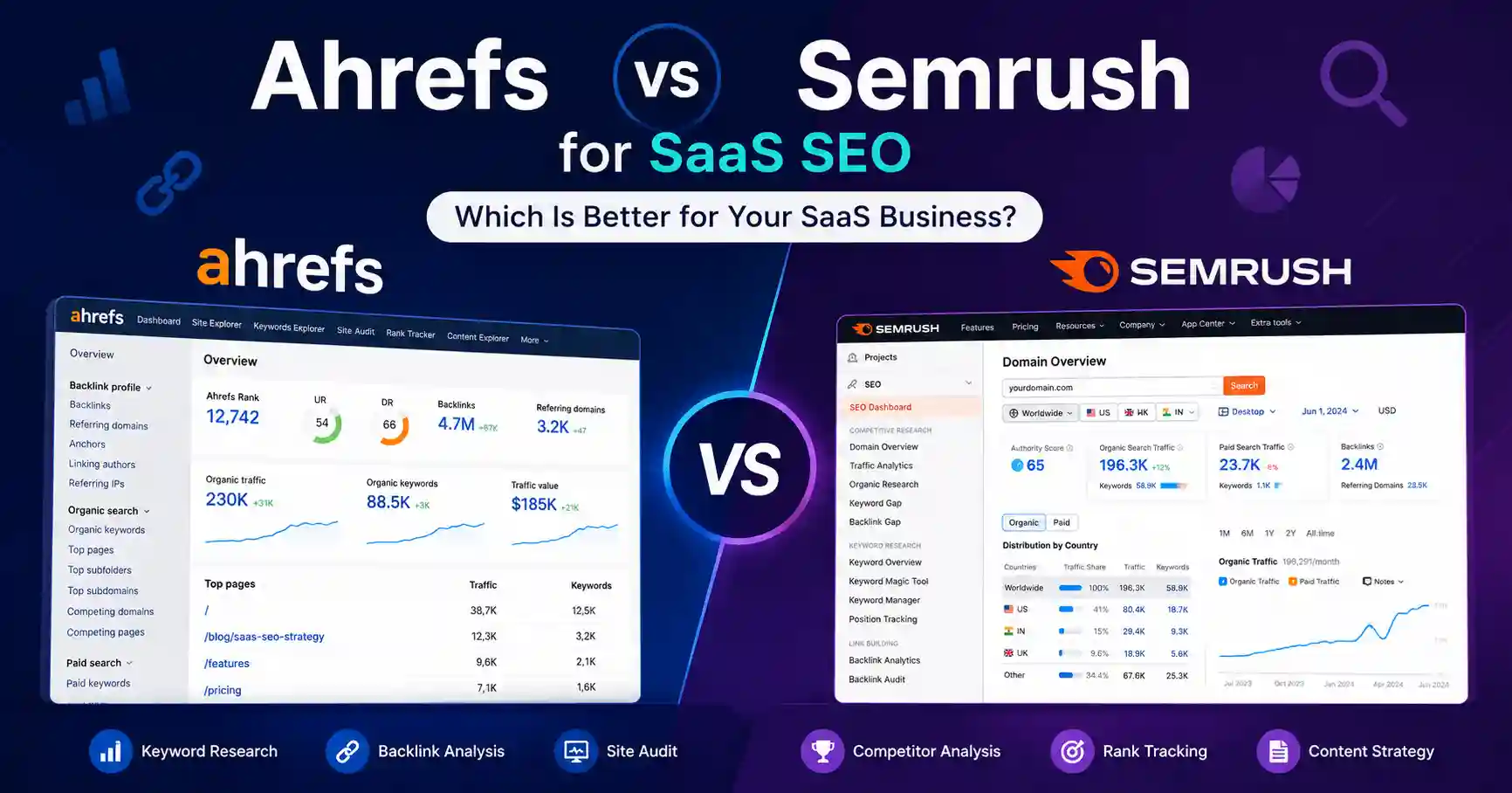
If you are running a SaaS business, you’ve probably ran into the Ahrefs vs Semrush debate for SaaS , and honestly it feels kinda endless. Both tools are among the most popular SEO platforms, with features that go from keyword research and competitor analysis, to backlink tracking and technical SEO audits. The real snag is figuring out which one matches your SaaS growth plan, and not just what looks good on paper.
Here’s the thing though , there isn’t one tool that’s always better. Each has its own strong points, and those strengths tend to line up with different business goals. In this guide, we’ll look at Ahrefs and Semrush from a SaaS angle, break down key features, pricing, and the kinds of use cases you actually see in the wild, then help you pick the right platform based on what your SEO objectives are trying to achieve.
Table of Contents
- What is Ahrefs vs Semrush for SaaS?
- Why is Ahrefs vs Semrush for SaaS important?
- Step-by-step guide to choosing the right tool
- Ahrefs vs Semrush comparison table
- Best practices
- Common mistakes
- Other SEO tools worth considering
- FAQs
- Conclusion
What is Ahrefs vs Semrush for SaaS?
Comparing Ahrefs against Semrush for SaaS means weighing two top SEO platforms. The goal? Finding which one truly backs a software company’s search strategy.
Both platforms help businesses:
- Find valuable keywords.
- Analyze competitors.
- Audit website health.
- Monitor backlinks.
- Track keyword rankings.
- Discover content opportunities.
For example, picture you are rolling out a project management SaaS, like, you can lean on Ahrefs to dig up low competition keywords ,and at the same time use Semrush to keep an eye on competitors, perform technical audits, and then tune your content plan.
Even though both platforms kind of overlap in a bunch of places, their real strong points shift depending on what kind of marketing goals you’re aiming at.
Why is Ahrefs vs Semrush for SaaS Important?
Choosing the right SEO platform can directly impact your organic growth.
Some reasons why this comparison matters include:
- Better keyword research for SaaS-specific search intent.
- Improved competitor analysis.
- Stronger backlink acquisition strategies.
- Faster identification of technical SEO issues.
- Better content planning for long-term organic traffic.
If you’re planning a complete SEO strategy, our guide on Best SEO Tools for SaaS Startups in 2026 can help you explore additional SEO platforms beyond Ahrefs and Semrush.
Step-by-Step Guide to Choosing Between Ahrefs and Semrush
Step 1: Identify your SEO goals
Before subscribing to either platform, define your objectives.
Do you want to increase organic traffic?
Improve backlink authority?
Track competitors?
Generate more qualified SaaS leads?
Knowing your priorities makes the decision much easier.
Step 2: Compare keyword research capabilities
Keyword research still stays the basis for SaaS SEO, like most of the time.
Ahrefs is pretty well known for having this huge keyword database and click metrics, so marketers can grasp what search people really do, in practice, not just theory.
Semrush on the other hand, gives a more nuanced keyword intent breakdown and merges keyword discovery with content marketing utilities, which makes the whole process feel kinda stitched together even when it gets a bit tangled.
If your strategy also includes creating SEO-focused blog content, our article on Best SaaS Content Marketing Tools explains how content optimization platforms complement keyword research.
Step 3: Evaluate competitor analysis
Competitor research helps you spot ranking chances that maybe you did not see before.
Semrush is pretty strong at showing extensive competitor visibility reports, plus paid search insights, market trends, and also keyword gap analysis.
Ahrefs leans more on backlinks, pages that are already winning, and how organic keywords are actually performing.
For SaaS companies coming into crowded markets, Semrush often delivers wider marketing intelligence, kind of big picture type of view.
Step 4: Compare technical SEO features
Technical SEO messes with every page on your website, like it or not.
Both tools, include site audits broken link detection crawl reports and performance monitoring.
Semrush feels a bit more guided, with “do this next” style recommendations.
Ahrefs tends to hand you cleaner reports, and the explanations are more thorough which seasoned SEO practitioners often like.
And if you want to connect technical improvements to real long term progress, our guide on Technical SEO ROI lays it out, basically showing why resolving technical glitches usually brings one of the best returns in SEO.
Step 5: Consider reporting and scalability
As your SaaS business grows, reporting becomes increasingly important.
Think about:
- Team collaboration
- Scheduled reports
- Client reporting
- API access
- Historical data
- Dashboard customization
If a few departments depend on those SEO insights, then Semrush usually has more robust reporting , and also better “team work” collaboration features, kind of.
Ahrefs vs Semrush Comparison
| Feature | Ahrefs | Semrush | Best For |
| Keyword Research | Excellent keyword database | Excellent keyword intent & trends | Tie |
| Backlink Analysis | Outstanding | Very Good | Ahrefs |
| Competitor Analysis | Strong | Excellent | Semrush |
| Technical SEO Audit | Excellent | Excellent | Tie |
| Content Marketing | Basic | Advanced | Semrush |
| Rank Tracking | Excellent | Excellent | Tie |
| PPC Research | Limited | Outstanding | Semrush |
| Ease of Use | Simple interface | Feature-rich dashboard | Depends on experience |
Key takeaway: If backlinks and organic SEO are really what you care about the most, then Ahrefs is a solid, decent choice. But if you want one all in one digital marketing cockpit, with SEO plus PPC, content promotion and competitive intelligence , Semrush tends to be more versatile, overall.
Best Practices for Using Ahrefs or Semrush
Whichever platform you choose, following a few best practices will help maximize your investment.
- Focus on search intent instead of search volume alone.
- Analyze competitors regularly instead of only once.
- Track keyword rankings monthly.
- Build topic clusters rather than isolated articles.
- Monitor backlinks and remove toxic links when necessary.
- Refresh older content using new keyword opportunities.
- Combine SEO insights with content marketing and technical optimization.
Google also provides valuable guidance through the Google Search Central SEO Documentation, which explains how to create helpful content and improve website visibility using Google’s recommended practices.
Common Mistakes When Comparing Ahrefs and Semrush
A lot of SaaS companies buy an SEO platform, kinda expecting quick results, like, right away. But honestly, even the best tool won’t lift rankings unless it’s put to work the right way, and that part matters.
Choosing based only on price
Pricing is important, sure but it shouldnt be the final deciding factor. Like, a platform that helps you pinpoint profitable keywords or nudge up conversions often gives you a much better return, than a cheaper alternative, you know.
Ignoring business goals
Ahrefs and Semrush do a bit different job, like in a slightly sideways way. If your main goal is building backlinks, then Ahrefs can work better. But if you’re trying to cover SEO plus PPC, content marketing, and also competitor research all in one place, Semrush is often the stronger pick .
Looking only at keyword volume
High volume keywords usually come with pretty intense competition, like, you know. SaaS companies often get better results, by going after lower-volume keywords that carry a stronger commercial intent more “buyer ready” energy so to speak.
Not using the site audit feature
A lot of marketers spend most of their time chasing keywords, while kind of overlooking technical SEO. Stuff like broken links , duplicate content, pages that load too slow, and crawl errors can hit rankings pretty hard, even if you are doing the keyword research right.
Skipping competitor analysis
Your competitors can uncover valuable chances. When you look over their top pages, and the backlink sources, or even how they craft content strategies, you can spot the holes they leave open, that you can go for.
Other SEO Tools Worth Considering
Although Ahrefs and Semrush dominate the market, they’re not the only options available.
| Tool | Best For | Key Strength |
| Google Search Console | Performance Monitoring | Free keyword and indexing insights |
| Screaming Frog SEO Spider | Technical SEO | Website crawling and technical audits |
| Surfer SEO | Content Optimization | On-page SEO recommendations |
| Moz Pro | SEO Beginners | Keyword research and site audits |
| SE Ranking | Budget-Friendly SEO | Rank tracking and competitor monitoring |
Which Tool Should SaaS Businesses Choose?
There’s no universal winner because every SaaS business has different goals.
Choose Ahrefs if you:
- Focus primarily on organic SEO.
- Need industry-leading backlink analysis.
- Want a clean, intuitive interface.
- Spend most of your time researching keywords and competitors.
Choose Semrush if you:
- Want an all-in-one marketing platform.
- Manage SEO and PPC campaigns together.
- Need advanced competitor intelligence.
- Require content marketing and reporting tools.
For quite a few SaaS companies in growth mode, Semrush feels like it brings more broad functionality, while Ahrefs stays the go-to option for a bunch of SEO specialists who are really focused on backlinks, and organic search. It kinda seems split this way, even if people argue a bit.
FAQ’s
Is Ahrefs better than Semrush for SaaS SEO?
It really depends on what you are trying to do. Ahrefs shines mostly at backlink analysis and organic keyword discovery, whereas Semrush feels like a broader kind of digital marketing tool set, it covers SEO, PPC, content promotion, and competitor research all in one, kind of.
Which platform has better keyword research?
Both platforms are quite good, yeah. Ahrefs gives a lot of keyword info and also click metrics, meanwhile Semrush seems better for keyword intent mapping and topic research too, in a more nuanced way.
Is Semrush worth the higher price?
For businesses juggling SEO , PPC , competitor analysis, and content marketing all at once, Semrush usually brings pretty good value because it seems to mesh multiple marketing tools into a single platform, you know, kind of in one place.
Can startups use Ahrefs or Semrush?
Yeah. Both platforms, are basically fine for startups, but the smaller team kind of should pick the one that matches what they need right now and the budget, also like. In other words it depends how urgent their business focus is, not so much on the grand scale of things.
Do I need both Ahrefs and Semrush?
Most SaaS businesses don’t really. Either platform can handle some pretty strong SEO strategy, like in practice. Some larger agencies and enterprise teams, well they end up using both, to sort of combine Ahrefs’ backlink insights with Semrush’s marketing intelligence.
Conclusion
Choosing between Ahrefs vs Semrush for SaaS isnt really about locating the “best” tool, more like figuring out the right fit for what your business actually wants. It sounds simple, but in practice it can get a bit messy.
If your main focus is link intelligence, organic search, and competitor SEO analysis, Ahrefs is hard to outdo. The interface feels clean, and that backlink database is seriously strong so a lot of SEO professionals stick with it for day to day work.
On the other hand, if your company wants a full digital marketing suite that ties together SEO, content marketing, PPC research, social media signals, and competitive intelligence, Semrush tends to cover more ground. It’s the kind of platform that can quietly support multiple marketing teams without making everything feel scattered.
No matter what you choose, try to keep the goal in mind: SEO wins when you keep publishing useful content, tighten technical performance, attract real high quality backlinks, and actually understand your audience. It’s not just about having the priciest software on your desk.
So start by naming your biggest SEO problem, pick the platform that resolves that issue the best, then apply what you learn on a consistent basis. Over time, that steady discipline usually beats the cycle of swapping tools every few months.