
Ever wonder why certain SaaS sites rake in demo requests by the bucketload while others can barely get a single click? It is baffling. Most of the time, the gap isn’t just the product itself, the real issue? It’s how that tool is actually shown, in practice, once someone hits the page.
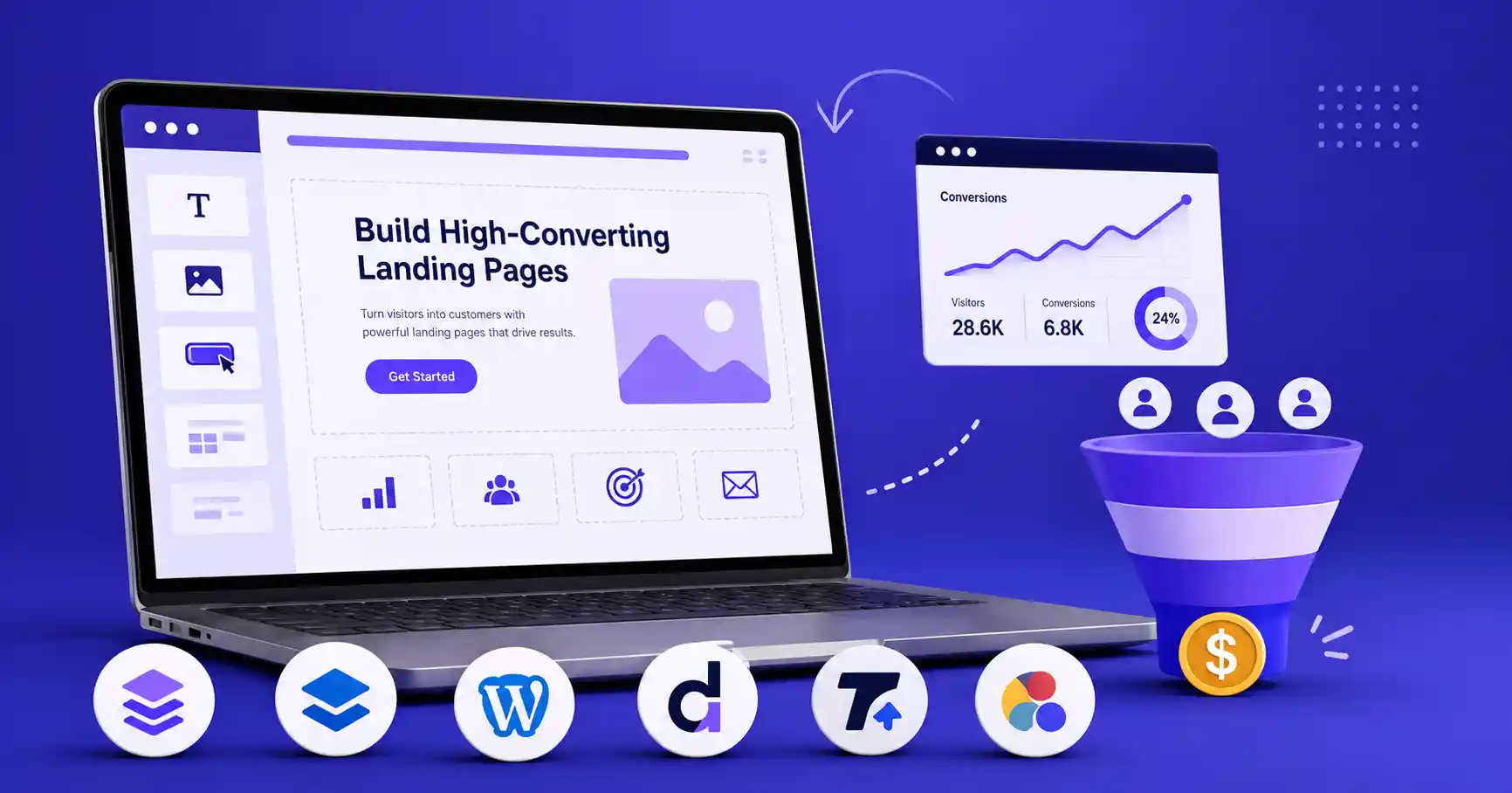
For these teams, every visitor who lands there from Google Ads, social media, or a random search arrives with an expectation. They want quick answers, specific benefits, and a sense of trust before they gamble their time. That is where SaaS landing page builders become so useful. Instead of nagging developers for every tiny adjustment, marketing squads can spin up, test. And polish new layouts on their own schedule. It makes a massive difference. These tools let companies ship focused campaigns, raise conversion rates, and build smoother user experiences.
In this article, we will look at what SaaS landing page builders are, why they matter , and also how to pick the right platform. We will then check which tools are supporting SaaS companies to craft high-performing pages, with better results.
What are landing page builders for SaaS?
Landing page builders for SaaS are tools platforms that let software companies build dedicated web pages, aimed at a specific marketing objective.
Unlike a normal homepage that tries to explain everything about a company, a SaaS landing page usually has one main intent.
That purpose could be:
- Getting users to start a free trial
- Booking a product demo
- Downloading a resource
- Joining a waitlist
- Signing up for a webinar
For example, a project management SaaS company running Google Ads for “team collaboration software” would not want people to land on some generic home page.
Instead, they could set up a dedicated entry page pointing at:
- How teams collaborate better
- How projects stay organized
- How productivity improves
- Why users should start a free trial
This focused approach tends to make a more direct link between what the user is really trying to do and the SaaS solution they get.
Most modern landing page builders bundle design tools, analytics, testing capabilities, and integrations, that help marketers enhance campaign results without having to keep pinging technical teams every time something changes.
Per HubSpot’s marketing resources landing pages matter because they convert visitors into leads, by delivering a concentrated experience that matches a particular campaign.
Why are landing page builders important for SaaS businesses?
SaaS marketing is extremely competitive, and it can feel a little relentless.
A visitor who is looking at several software solutions, might just take a few seconds to decide if your product is worth deeper attention.
A strong landing page, that is optimized well, supports companies by showing value fast and clearly.
However, landing pages are only one part of a successful SaaS acquisition system. A complete B2B SaaS marketing strategy helps businesses attract the right audience, improve engagement, and convert visitors into customers.
Here are some reasons why SaaS companies use landing page builders:
Faster campaign launches
Marketing teams often need to produce pages quickly for new features, paid campaigns product launches, or those industry specific pushes.
A landing page builder lets marketers craft and ship pages without having to wait weeks on development resources.
Better conversion optimization
SaaS landing pages are sort of built around user actions, yknow.
Instead of distracting visitors with a lot of different navigation options , they guide people toward one conversion goal, rather straight.
Easier A/B testing
Successful SaaS companies rarely depend on assumptions.
They test:
- Headlines
- Call-to-action buttons
- Page layouts
- Pricing messages
- Customer testimonials
- Landing page builders make these experiments easier to manage.
Better alignment with marketing campaigns
When some visitor clicks an ad about “CRM software for startups”, they really expect something tied to startups, not random things. A dedicated landing page helps keep the whole customer journey smoother, more direct, and easier to follow.
Improved lead generation
Whether the goal is free trials, demo bookings, or email signups, landing pages help SaaS businesses catch more, qualified leads.
You can also go beyond this SaaS growth playbook and pick up more marketing insights on Saasyntic:
How should SaaS companies choose the right landing page builder?
Choosing a landing page builder is not only about design.
The right platform should match your marketing process, team structure, and growth goals.
Here are the key steps to consider.
Step 1: Define your landing page objective
Before selecting a tool, try to grasp what you want the page to do, like the outcome. A landing page for enterprise demo requests will look wildly different than a page that is promoting a free SaaS trial, and those goals tend to pull the layout in separate directions too.
Common objectives include:
- Lead collection
- Product demonstrations
- Feature promotion
- Customer onboarding
- Content downloads
Like, an accounting SaaS firm aiming at small businesses might build a landing page that is centered on “Automated Tax Reports for Small Business Owners” and not just shove the whole software platform in front of people.
The clearer the objective, the easier it becomes to choose the right structure.
Step 2: Identify the features your team needs
Different SaaS teams require different capabilities.
Some businesses need advanced conversion verification, while others just want straightforward drag and drop control.
Important features include:
- Easy page editing
- Mobile optimization
- A/B testing
- Analytics tracking
- CRM integrations
- AI copy assistance
- Marketing automation support
A startup might put forward speed, and keep it simple more easily, while an enterprise SaaS company can demand a higher degree of advanced personalisation , like real tailoring across teams and workflows.
Step 3: Compare popular SaaS landing page builders
Several platforms are widely used by SaaS marketers.
| Platform | Best For | Key Features | Pricing |
| Unbounce | Conversion-focused campaigns | A/B testing, AI optimization, smart landing pages | Paid plans |
| Webflow | Custom SaaS websites | Advanced design control, animations, CMS | Paid plans |
| HubSpot Landing Pages | CRM-focused businesses | Marketing automation, analytics, CRM connection | Free and paid plans |
| Leadpages | Small SaaS teams | Templates, lead capture, easy editing | Paid plans |
| Instapage | Enterprise campaigns | Personalization, collaboration, advanced testing | Enterprise pricing |
The best landing page builder depends on where your business is at. Startups often need speed together with a more low cost approach, while larger SaaS companies usually want deeper optimization tools, and more careful tuning for conversions.
Step 4: Build a landing page focused on user problems
Many SaaS companies make the mistake of talking only about their features.
Visitors usually do not care about features first.
They care about outcomes.
Instead of saying:
“Our platform includes automated workflow management.”
A stronger message would be:
“Reduce manual tasks and save hours every week with automated workflows.”
A high-performing SaaS landing page usually includes:
- A clear headline
- A strong value proposition
- Product screenshots or videos
- Customer reviews
- Trust signals
- Simple calls to action
For example, software companies like project management tools often show real dashboards because users want to visualize how the product works before signing up.
Step 5: Test and improve continuously
A landing page is never truly finished.
SaaS marketers should regularly review performance data and improve the page.
Important metrics include:
- Conversion rate
- Trial signups
- Demo requests
- Bounce rate
- Cost per acquisition
- User engagement
Small changes can create significant improvements.
Changing a headline, simplifying a form, or adding customer proof can increase conversions over time.
Using structured A/B testing and experimentation allows SaaS marketers to make decisions based on user behavior rather than assumptions
Best practices for SaaS landing pages
Creating a landing page is easy.
Creating one that converts requires strategy.
Here are some practical tips:
Focus on one main action
Avoid giving visitors too many options.
A page promoting a free trial should focus mainly on getting users to start that trial.
Write benefits before features
Users want to understand how your product improves their situation.
Explain the result, not just the functionality.
Add social proof
Customer reviews, case studies, and logos help reduce uncertainty.
Keep the page simple
Too many sections, buttons, and messages can confuse visitors.
Optimize mobile experience
Many SaaS users research products from mobile devices.
Match your landing page with your traffic source
An advertisement and landing page should feel like part of the same conversation.
Use analytics to guide decisions
Data should influence changes, not assumptions.
Common mistakes SaaS companies make with landing pages
Even well-funded SaaS companies make landing page mistakes.
Sending all traffic to the homepage
A homepage explains the company.
A landing page focuses on one conversion goal.
They serve different purposes.
Overloading visitors with features
A long feature list does not automatically create interest.
Focus on customer problems and outcomes.
Ignoring page speed
A slow landing page can reduce conversions before users even see your offer.
Not testing different versions
The first version is rarely the best version.
Testing helps discover what actually works.
Using unclear messaging
Visitors should immediately understand:
What the product does
Who it helps
Why they should care
Popular tools used by SaaS marketers
Unbounce
Unbounce is pretty popular with marketers who lean hard into conversion optimization, and yeah it includes testing features plus various tools meant to help with landing page performance improvements, in a pretty direct way. You end up with what you need for tweaking and measuring, so the page can start doing better, sooner.
Webflow
Webflow tends to get used by SaaS teams who want total control over the website’s design, while also sidestepping the usual development workflows. It feels more nimble that way, because the layout, sections, and interactions stay in their hands, not tangled in back and forth approvals.
HubSpot Landing Pages
HubSpot can work pretty well for businesses that already have a CRM together with marketing automation tools, because landing page builds link right in with the customer data. In other words it feels more seamless, not just with lead capture, but with everything downstream too.
Leadpages
Leadpages can be helpful for smaller SaaS teams that want to build basic landing pages, and do lead capture. It’s for people who need a straightforward page creation setup, not a complicated process.
Instapage
Instapage tends to work best for bigger marketing crews running several campaigns, where personalization matters and collaboration is happening too. In practice it feels more suited to teams that need things to stay organized across different offers, not just one simple setup.
Also, if a business is aiming to sharpen its broader SaaS SEO plan, they can check out Saasyntic’s SaaS SEO services. This is a practical option when you want more visibility, and stronger search results over time.
What does the future look like for SaaS landing pages?
The future of SaaS landing pages is moving toward more personalization and automation.
AI-powered tools are already helping marketers:
- Generate page copy
- Analyze visitor behavior
- Create personalized experiences
- Improve conversion rates
Future landing pages may automatically adjust messaging based on user industry, location, behavior, or previous interactions.
This shift is closely connected with the growth of SaaS marketing automation tools, which help companies personalize campaigns, manage customer journeys, and improve marketing efficiency.
This means SaaS websites will become less like static pages and more like intelligent sales assistants.
Final Thoughts
Landing page builders for SaaS have changed how software companies think about marketing campaigns, like a shift, you know, not just the obvious stuff.
Instead of waiting for long development cycles, marketing teams can now spin up focused pages, test ideas, and push conversions forward a lot faster.
But the tool by itself is only one slice of the full picture.
A solid SaaS landing page still comes down to knowing what customers actually struggle with, communicating the value in a clear way, and then refining everything with real-world data.
The best SaaS companies are not only making pages.
They are building those small, practical experiences that help a visitor grasp what’s going on, feel confident, and decide to go with your product.
The best landing page builder gives you a strong base, but the strategy is what turns into real results.
FAQs
What are the best landing page builders for SaaS companies?
A lot of people go with Unbounce, Webflow , HubSpot Landing Pages, Leadpages, or Instapage. Honestly the best pick depends on what you’re trying to do, the budget you can manage, and your marketing needs, not just one single thing.
Can SaaS companies create landing pages without developers?
Marketers build slick pages now just by dragging and dropping, Who needs to code anymore? It’s that simple.
How do SaaS landing pages improve conversions?
These pages actually guide you. They speak plainly, no wasted words. Totally unlike most web stuff.
Should SaaS companies create multiple landing pages?
Bespoke landing pages sharpen relevance, driving conversions skyward. They hit hard, Why ever settle for less?
How often should SaaS landing pages be optimized?
SaaS outfits must obsessively audit metrics. Smart teams pivot constantly; raw data reveals the harsh truth of what works versus total failure.