


Introduction:
• SaaS blog traffic flows only when certain content targets certain keywords and fits the audience.
• Think about content clusters, long tail keywords, and untold user pain points.
• SEO will have a perpetual advantage in the minds of small businesses, as they prioritize campaigns for those goals rather than trying their best on anonymous stages.
Blog and traffic means everything when not running any traffic,-just as a store with no board can exist but practically nobody will walk through the door. Now for a small startup, particularly in SaaS, making sure any approach to a rally for blog strategy is grounded in constructive actions. This way, blogging becomes a mechanism to perpetually serve loads of traffic into the sales funnel.
However, let’s get real here- most SaaS blogs to fly blind. They consider what they think is important: but beyond and while producing any meaningful traffic or really gathering leads, what else could they possibly do? This is not just this content stuff- as in they actually need to get their sights on the content that counts, not to mention the confection of a solid long-term strategy.
Before going further about how to go from random blog posts to flowing traffic in droves, we will consider:
What Is Working for a SaaS Blog Strategy?
Quick answer: An effective SaaS blog strategy is based on constant, SEO-optimized content that is all about your customers’ pains, needs, challenges, and search intent.
A successful SaaS blog does not solely talk about your product. It speaks to the issues that challenge your audience whether that be improving team productivity or automating workflow. SaaS businesses tend to focus more on self-promotion; most people didn’t search “how awesome my tool is,” but for solution.
To that effect, the HubSpot blog drives traffic to their website by answering questions like ‘How to increase sales through marketing automation” and “How to improve team collaboration.” These may not be directly about HubSpot, and that’s looking at critical points of pain for their target market. The goal goes for the building of trust and name, not just ranking for the product.
Key Insight: Leaning to Customer Questions Is a Reason the Blogging in SaaS Works!
How Can You Pick the Best Blog Topics?
Use competitive analysis to identify the most suitable blog topics that would cater to your core audience. This covers keyword research and customer feedback integrated with competitive analysis.
Discovering topics for blog writing will be initiated with research. How participants can chase research is discussed herewith:
• Keyword research: Use the marketing software such as Ahrefs and SEMrush to discover low-competition high-volume keywords that traverse with the interests of your audience.
• Competitor analysis: Study the content that works but was produced by competing companies at the top. What keywords are their selves ranking for? In what types of content format are they authored?
• Customer feedback: Do not lose sight of the users who actually use software. They provide the best insights into what content will resonate with the desired audience.
Example: If the SaaS company supplying an AI-driven project management device is looking for a couple of blog topics, then “How AI Expands Project Management” or “Benefits of AI for Small Businesses” are not just cuisines that will plump up crash landing angles, but that actually drives the right type of visitor who is actively looking for a solution that your software essentially provides.
Key takeaway: Deploy an approach that is largely based on blending keyword research, competitor insights, and customer feedback to let you score a genuinely qualified overflow of pertinent blog topics.
How Do You Ensure Your Blog Content Is Constantly Contributing?
Quick answer: Start building your SEO, long-form content, and content clusters for long-term organic traffic enhancement.
The most important aspect of building a consistent stream of traffic is not just making content but making content that search engines adore by doing the following:
- SEO Optimization
For every post, emphasize keyword targeting, internal linking, and on-page SEO. Make use of long-tail keywords, meta tag-optimization, as well as a fast blog with mobile optimization.
- Content Cluster
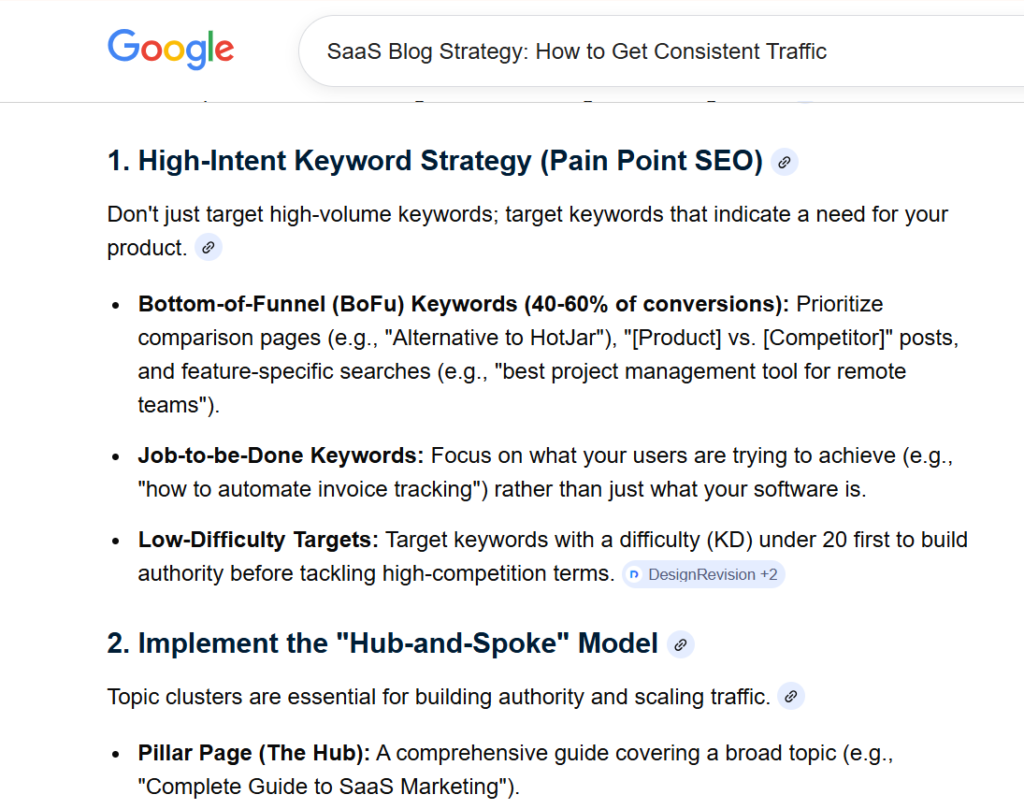
The practice of creating content clusters instead of publishing isolated posts is the other good idea. This would involve creating multiple entries on related topics, all linking back to a central pillar page (e.g., “AI in SaaS” with related articles “AI algorithms in SaaS,” “AI for customer support,” and “Implementing AI in SaaS applications”). Your SEO game gets stronger, as it shows search engines that you’re an authority on a subject.
- Long-form Content
If it is long-form content, Google loves it (1,500-2,000 words). It has better chances of ranking for more keywords and delivers greater value to the user. Claim that your posts are all-encompassing-feel free to ask about whatever questions there may be regarding that topic.
Case Study: Buffer consistently ranks high for relevant SaaS-related queries with blog posts that run into several thousand words. Their strategy involves developing deep, comprehensive yet long posts on beginning-to-end topics.
Takeaway: Consistent traffic comes from SEO-optimized, long-form content organized into content clusters.
How Do You Convert Traffic into Leads?
Quick answer: Use strong CTAs, lead magnets, and case studies to turn blog traffic into potential customers.
Once your SaaS blog starts to attract traffic, the next challenge is to convert those visitors. It’s not enough to just have traffic; it needs to be turned into leads. Here’s how to go about it:
- Lead Magnets
Offer free downloads (white papers, eBooks, templates) in exchange for email addresses. These should be valuable resources that complement the content that you are creating.
- Clear Calls to Action (CTAs)
Each post must have a clear CTA. Whether it is taking the free trial offer, requesting a demo, or downloading a guide, direct visitors to the next step in the sales funnel.
- Case Studies and Social Proof
Peer recommendations almost always have more power than an overt sales message. Such an investment strategy helps the visitors to move toward acting on what they had a chance to learn.
Example: PandaDoc invariably relates its case studies while attempting to slip in some strong CTAs within content put up on its blog posts. That effort eventually allows for the highest possible conversions. This is particularly the case when PandaDoc can put a story on the table-to speak of how its solution has effectively driven success for various other companies, which is a very quick time frame to make awnings for the visitors themselves.
SaaS comps make mistakes they believe that organic traffic effect
- Social Media
Repurpose content from your blog to social media posts. Share snippets, infographics, and key insights. Post in LinkedIn, Twitter, and Facebook groups, particularly in SaaS communities.
- Email Newsletters
Send your latest blog posts to subscribers via an email newsletter to encourage interactions. This keeps them thinking about your content and hence encourages repeat visits.
- Partnerships
A collaboration with influencers, guest bloggers, or partner firms is the third form of this distribution method. Sharing content between these various sources enables penetration into each other’s audience.
Data Point: Zendesk has successfully employed social media, email newsletters, and partner networks to try out their blog content. This multi-channel approach played masterfully in driving traffic to their blog.
Key Insight: Content distribution ensures that a wider range of audiences reaches your blog post, thereby strengthening more traffic for the site.
How Do You Measure Success and Iterate on Your Strategy?
Quick answer: Use analytics tools like traffic, time on page, bounce rate and conversions to get a grip on your metrics and keep refining your strategies according to data.
In order to prove that your blog strategy works, you are supposed to keep measuring and adjusting it. Metrics that are considered crucial are listed below:
| Topic | Strategy |
|---|---|
| Blog Topics | Use keyword research, competitor analysis, and customer feedback. |
| SEO Optimization | Focus on long-tail keywords and on-page SEO. |
| Content Clusters | Create related posts linking to a pillar page. |
| Lead Generation | Use CTAs and lead magnets like eBooks and demos. |
| Content Distribution | Share content via social media and email. |
| Performance Tracking | Measure traffic, bounce rate, and conversions. |
Example of measuring this would be: Use Google Analytics and Hotjar as a vehicle to determine how well people are interacting with your website and formulating strategies on how you might capitalize these findings for your website including revising your CTAs or building out more content.
Key takeaway: Always measure your blog’s performance and iterate on the strategy for better results.
Conclusion
Putting up a SaaS blog to get consistent traffic should be seen as a long-tailed investment mechanism; it’s not a crash-and-grab action. The right set of content writing, SEO, distribution strategies, and site conversion can make significant leads from your blog. Writing blog posts mean little to a blog when they do not drive towards your business goals. The succesful approach is not restricted to the big companies; small SaaS businesses can employ a mixture of these techniques to standing on equals. Consistency is the watchword, and another is to keep iterating every single day. If you are starting or looking to improve, you want to aim at producing some valuable content for your target market, optimizing the content for search engines, and achieving conversions through customized CTAs and lead magnets.