
Choosing between a SaaS SEO agency and hiring internally is a headache when you want organic growth without torching your budget or sanity. Agencies bring proven frameworks and deep optimization skills. Promoting from within keeps you firmly in the driver seat since they already know your product inside and out. Which path to lean toward? That hinges entirely on your current growth stage, cash flow, ambitions, and just how badly your search rankings are bleeding. This guide maps out both directions so you can finally pick what fits your software business.
Table of Contents
- What is SaaS SEO Agency vs In House
- Why SaaS SEO Agency vs In House is Important
- SaaS SEO Agency vs In House Comparison
- Step by Step Guide
- Best Practices and Tips
- Common Mistakes
- Tools
- FAQs
- Conclusion
What is SaaS SEO Agency vs In House
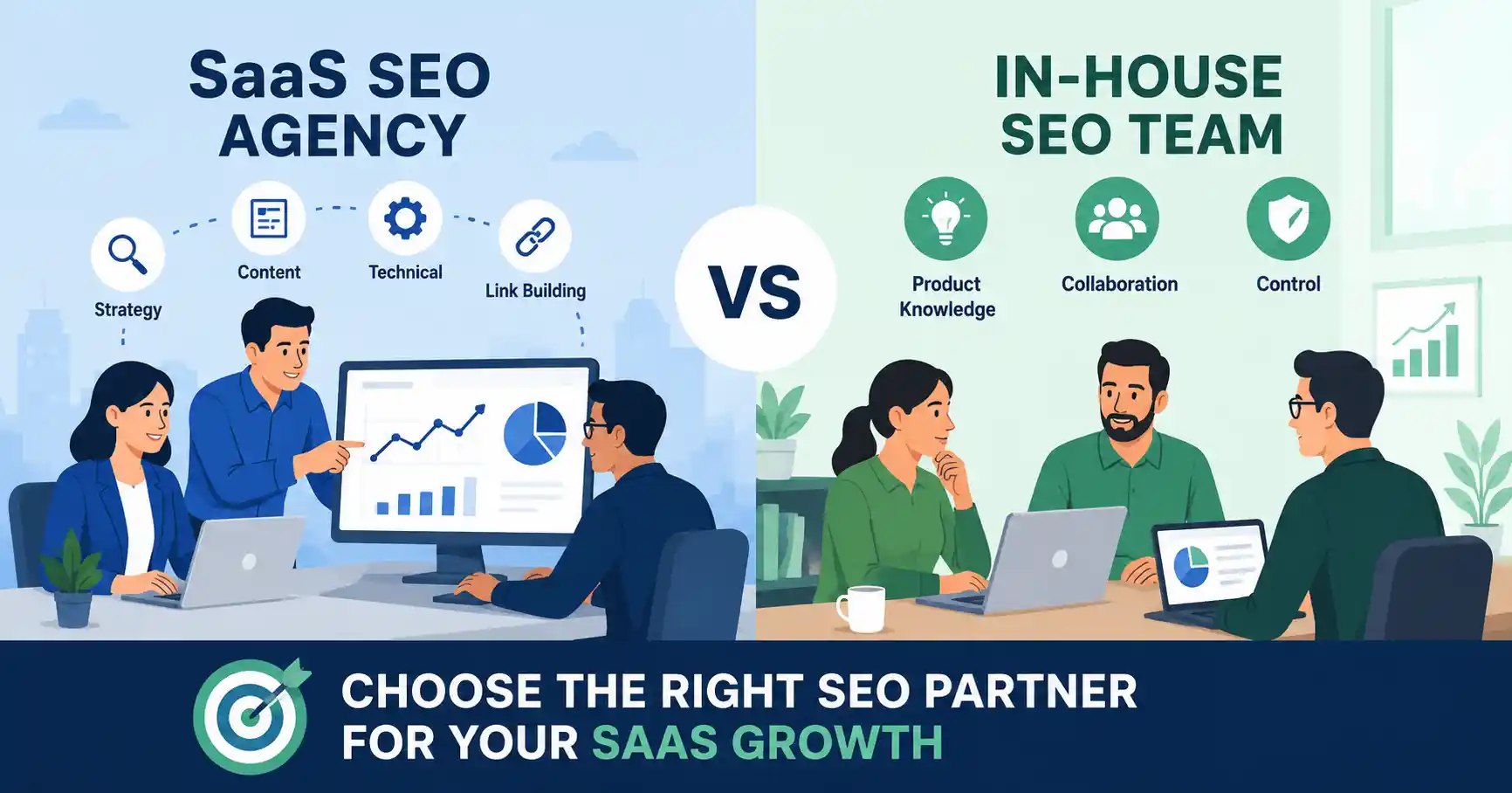
SaaS SEO agency vs in house comes down to picking an outside firm or building your own squad from scratch. Both paths work. They just solve entirely different headaches.
An outside agency usually hands you a full bench. Strategists, content writers, technical gurus, link builders, and analytics folks all rolled into one bill. An in house setup means actual employees on your payroll. They eat, sleep, and breathe your product, sitting right next to engineering and marketing.
Take a B2B software startup trying to claw its way into a brutal market with zero organic traffic. An agency can jump in, map keywords, patch up messy code, churn out product led content, and build authority much faster. Why? Because they already have the playbook dialed in.
Still, going in house makes sense once you have the budget for a dedicated crew. That is when you want SEO baked right into product updates and daily marketing moves.
Why SaaS SEO Agency vs In House is Important
Choosing the wrong model can slow organic growth and make SEO unnecessarily expensive.
- Cost structure changes significantly between an agency and a full internal team.
- Agencies bring many skills, No need to hire lots of people.
- Oh, they know. And they’re wired into everyone here, too.
- SaaS SEO needs relentless technical, content, and authority work. Surface tweaks always fail.
- Your current business phase dictates model selection far beyond simply choosing the cheapest option.
SaaS SEO Agency vs In House Comparison
The following table compares the main factors SaaS companies should evaluate before making a decision.
| Factor | SaaS SEO Agency | In House Team | Best Fit |
| Initial cost | Usually lower than building a full team | Higher hiring and payroll cost | Agency |
| Specialist expertise | Access to multiple specialists | Requires multiple hires | Agency |
| Product knowledge | Takes time to develop | Usually very strong | In House |
| Scalability | Easy to add resources | Requires additional hiring | Agency |
| Internal collaboration | Requires strong communication | Usually easier | In House |
| Strategic control | Shared with external partner | Fully internal | In House |
| Speed to execution | Often faster initially | Can be slower while hiring | Agency |
The best choice is usually the model that gives your company enough expertise and execution capacity without creating unnecessary management overhead.
Step by Step Guide
Step 1: Define Your SEO Goals
Pinpoint your exact business outcomes from SEO right now. Drop the tired debate about whether an internal hire costs more than outsourcing to an external agency. Focus squarely on core targets like qualified organic pipeline, product signups, category visibility, or actual customer acquisition. Take a SaaS firm selling to enterprise buyers. They care about high intent comparison keywords, not useless blog traffic.
Step 2: Audit Your Current Resources
Take a hard look at your roster, Does anyone actually know technical SEO? Can your team explain dense product problems without losing the reader. And do your developers even have the bandwidth to execute fixes? Who is handling link acquisition or digital PR right now, If you are missing several key pieces, hiring a whole department takes forever. An agency plugs those gaps instantly.
Step 3: Compare the Real Cost
Count the full bill. Stop fixating purely on baseline salaries versus agency retainers.
Building in house means coughing up for an SEO lead, writers, dev help, tool subscriptions, recruiter cuts, management hours, and benefits, whereas a firm bundles all those disparate specialists into one monthly invoice.
It just makes sense. For a growing SaaS shop, outsourcing usually beats onboarding three or four full time salaries before your organic engine actually finds its footing.
Step 4: Evaluate Your Need for Control
Think about how tight SEO needs to be with your product and engineering crews. When SEO leans hard on things like product architecture, big technical overhauls, programmatic pages, or constant new launches, an in house team really shines. They’re right there with the decision makers. An agency can totally still hack it, but you’ll need someone clearly in charge, developer access, and a solid system for getting their advice put into action.
Step 5: Choose the Operating Model
Decisions don’t have to be agency vs, in house forever. A SaaS outfit could begin with an agency, gather know how, and then snag an SEO chief. Or maybe a company keeps a lean internal crew but taps an agency for tricky tech stuff, content gigs, digital PR, or going global. The best setup is usually a mix. Internal people own the strategy and get the business context, External pros chip in where the company’s own expertise falls short.
Best Practices and Tips
- Choose based on business goals, not agency reputation or hiring trends.
- Ask agencies for examples involving SaaS companies with similar sales cycles and markets.
- Give internal SEO owners clear responsibility even when an agency handles execution.
- Measure organic performance using qualified pipeline, conversions, and revenue alongside traffic.
- Create a documented SEO roadmap so internal and external teams work from the same priorities.
- Give SEO recommendations a clear implementation owner and deadline.
- Review performance regularly and adjust the mix of internal and external resources as the company grows.
Google Search Console lets teams see impressions, clicks, CTR, queries, and page performance from organic search. Want to know how search engines find and handle content? Take a gander at Google’s SEO Starter Guide. It’s quite informative.
Common Mistakes
Hiring an Agency Without Internal Ownership
An agency cannot compensate for a company that has no one responsible for decisions, approvals, and implementation.
Hiring Too Early
Building a large SEO department before organic acquisition is proven can create unnecessary fixed costs.
Measuring Only Rankings
Ranking improvements are useful, but they do not automatically translate into qualified leads or revenue.
Ignoring Implementation
A technically excellent SEO strategy produces little value if developers and content teams never implement the recommendations.
Choosing Based Only on Price
The cheapest option can become expensive if it produces low quality content, weak strategy, or slow execution.
Tools
Google Search Console
Useful for monitoring search queries, clicks, impressions, click through rate, and page level performance.
Google Analytics
Links connect the customer’s journey to actual sales.
Ahrefs
This tool rocks. Keyword research, competitor intel, backlinks, content brainstorming, all covered.
Semrush
Keyword research. Competitor analysis, Technical SEO. All that marketing data, conveniently delivered.
Screaming Frog
This thing is a monster for site crawls. All the tech SEO headaches, broken links, content duplication, redirect mess, even weird metadata, it finds them all.
For SaaS teams building a broader growth strategy, reviewing the SaaS marketing resources can also help connect SEO with other acquisition activities.
FAQ’s
Is a SaaS SEO agency better than an in house team?
Not always, no. An agency usually wins if you need specialized talent and want things done yesterday, minus the headache of building a huge team. But when SEO’s woven into product development, engineering, and the company’s long game strategy? In house is probably smarter.
Is in house SaaS SEO cheaper?
Growth does save money, no question. But payroll? That’s just a sliver of the actual cost. Think benefits, software, management layers, and those rare experts. Even a small crew needs outside help.
When should a SaaS company hire an in house SEO team?
Internal hiring wins when SEO drives growth, you need relentless teamwork across product, engineering, content, and marketing. It just makes sense.
Can a SaaS company use both an agency and an in house team?
Absolutely. A hybrid setup often crushes it. Your in house crew sets the vision, decides what matters most, then an agency steps in, handles the specialized tasks, or just adds extra muscle.
How should SaaS SEO success be measured?
Monitor bottom line outcomes like organic leads, your pipeline, conversions, acquisition costs, and actual revenue. Always. Then check search metrics such as impressions, clicks, rankings, and click through rates. Treat those merely as supporting clues rather than the ultimate definition of success. Google itself advises utilizing Search Console data just to figure out how users find and interact with your pages.
Conclusion
There is no universal winner in the SaaS SEO agency versus in house debate. Agencies bring speed, specialized muscle, and raw adaptability. In house squads, they grasp the product deeply, hold tighter control, and sync up smoothly.
Everything hinges on your budget, growth phase, search maturity, and bandwidth. Lacking niche talent, An agency provides instant momentum right when you need it most.
But when search is already your primary growth engine, building internal capability creates deep, lasting ownership.
Audit your current skills, goals, costs, and execution capacity first. Then pick the model that actually plugs your biggest operational gaps, rather than just grabbing the cheaper option on paper.
For internal linking, tie this piece back to your broader marketing library. Google even explicitly recommends using descriptive anchor text so users and search bots easily grasp how related pages connect.
.