

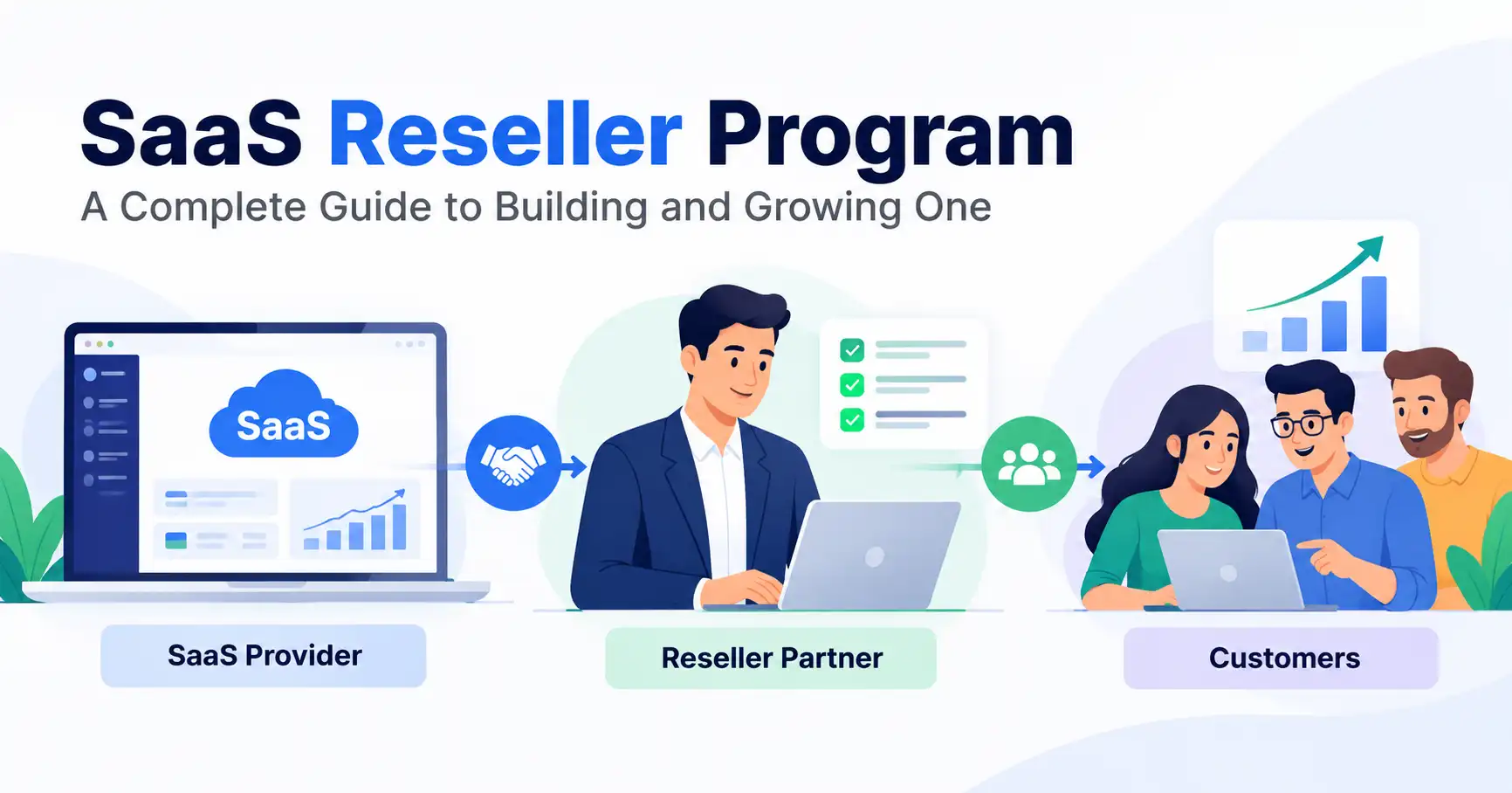
A SaaS reseller program helps software companies reach new customers through partners instead of depending solely on their in house sales teams. For agencies, consultants, and IT service providers, it also offers a way to generate revenue by selling software that complements their existing services.
But offering a discount and signing up partners isn’t enough to build a successful program. SaaS companies need a sustainable pricing model, clearly defined responsibilities, useful sales resources, and a reliable way to measure results.
Here’s how SaaS reseller programs work, how resellers earn money, and what it takes to build one that supports long term growth.
What Is a SaaS Reseller Program?
A SaaS reseller program allows a software provider to authorize another business to sell its software under agreed commercial terms.
Resellers may purchase subscriptions at discounted rates and sell them to customers at an agreed or permitted price. Depending on the arrangement, they may also handle billing, customer relationships, implementation, or first line support.
Consider a project management software company that partners with a digital agency serving small businesses. The agency sells the software alongside its consulting services, while the provider gains access to customers through an established business relationship.
When the arrangement works well, everyone benefits: the provider gains another sales channel, the reseller earns revenue, and customers get a solution that fits their needs.
How does a SaaS reseller program work?
Most programs follow a straightforward process:
- The SaaS company defines its target audience, pricing, and reseller requirements.
- It recruits suitable partners and agrees on commercial terms.
- Resellers receive product training, sales materials, and onboarding support.
- Partners identify prospects and sell the software through the agreed process.
- Both parties monitor revenue, customer satisfaction, renewals, and program costs.
Before the first sale, both sides should agree on who controls pricing, manages contracts, handles subscription billing, and owns the customer relationship.
How Do SaaS Resellers Make Money?
SaaS resellers can earn revenue through resale margins, agreed commissions, and additional services such as implementation or training. The right compensation model depends on the partner’s responsibilities and the terms of the agreement.
Understanding SaaS reseller margins
Consider this hypothetical subscription arrangement:
| Item | Amount |
| Reseller’s purchase price | $75 |
| Customer’s purchase price | $100 |
| Gross profit per subscription | $25 |
| Gross margin on resale price | 25% |
Gross margin is calculated by dividing gross profit by the resale price. Markup uses the purchase price instead, making the markup in this example 33.3%.
These figures illustrate the calculation they aren’t industry benchmarks.
Actual profitability depends on more than the difference between purchase and resale prices. Sales expenses, customer support, payment processing, implementation, and other operating costs all affect the final result.
SaaS providers face a similar trade off. A larger discount may encourage partners to invest more in selling the product, but it also reduces the revenue the provider retains from each subscription.
Before setting reseller prices, model several discount scenarios. Account for customer acquisition costs, support requirements, renewal terms, and the additional customers the channel could realistically bring in.
Types of SaaS Reseller Programs
The right reseller model depends on your product, target customers, and the level of responsibility partners can take on.
| Model | How it works | Best suited for |
| Traditional reseller | Sells subscriptions under a commercial agreement | Software vendors expanding their sales reach |
| Value added reseller (VAR) | Combines software with implementation, customization, or consulting | Complex B2B software |
| Agency reseller | Bundles software with ongoing client services | Marketing, web development, and consulting agencies |
| Managed service provider (MSP) | Combines software with ongoing management and support | IT services and managed technology |
| White label reseller | Offers software under its own brand when the vendor permits it | Businesses seeking a branded software offering |
These models can overlap. An IT service provider, for instance, might resell software while also providing installation, training, and ongoing support.
White label arrangements require particular care because they involve branding rights and may change how customers experience the product. Confirm the vendor’s terms before promising a fully branded solution.
SaaS Reseller vs. Affiliate vs. Referral Program
Although all three models use external partners to reach customers, they differ in how sales happen and who manages the customer relationship. PartnerStack’s reseller guidance also discusses the sales and enablement responsibilities that reseller partnerships can involve.
| Factor | Reseller | Affiliate | Referral |
| Main role | Sells the software | Promotes the product | Introduces potential buyers |
| Sales process | Partner typically handles more of the sale | Vendor usually closes the sale | Vendor usually closes the sale |
| Compensation | Resale margin or agreed commercial terms | Tracked commission | Referral fee or commission |
| Customer relationship | Often managed by the reseller | Usually managed by the vendor | Usually managed by the vendor |
| Typical complexity | Higher | Lower | Moderate |
A reseller program makes sense when partners can actively sell the software or bundle it with their services. Affiliates are often a better fit for promotional reach, while referral programs suit businesses that primarily want qualified introductions.
How to Build a SaaS Reseller Program Step by Step
A strong program starts with a clear commercial model and a workable operating process. Establish both before recruiting partners.
Step 1: Assess channel readiness
Make sure your product solves a clear problem, your target audience is well defined, and your sales team can explain the product consistently.
If customers struggle with onboarding or don’t understand the product’s value, fix those issues before asking partners to sell it.
Step 2: Identify the right resellers
Look for businesses that already serve your ideal customers. An accounting software company, for example, might approach bookkeeping firms and accounting consultants.
Evaluate potential partners based on customer overlap, relevant expertise, sales capability, reputation, and willingness to invest in training.
Step 3: Set pricing and incentives
Choose a wholesale discount, resale pricing policy, or alternative compensation structure that works for both parties.
Clarify whether discounts apply to new subscriptions, renewals, upgrades, and multi year agreements. Avoid promising margins that leave the provider unable to cover its service and support costs.
Step 4: Create a reseller agreement
Put the commercial terms in writing. Cover pricing, payment schedules, billing responsibilities, customer ownership, renewals, support obligations, data protection, and termination conditions.
Deal registration and rules for existing accounts also deserve attention. Without them, a partner and your direct sales team could end up competing for the same customer.
Step 5: Equip partners to sell
Provide product demonstrations, sales presentations, pricing sheets, onboarding guides, and answers to common customer questions. Make sure partners know whom to contact when commercial or technical issues arise.
Good enablement goes beyond product knowledge. Partners also need to understand which customers are the best fit and how to communicate the product’s value.
Step 6: Start with a small pilot
Recruit a manageable group of qualified resellers, track their activity, and collect feedback before expanding the program.
For example, a workflow SaaS company could test its program with three agencies. It could then compare qualified opportunities, completed sales, support requirements, and customer retention to identify which partnerships merit further investment.
Step 7: Refine and expand
Review the results regularly. Use what you learn to improve pricing, training, and partner selection rather than judging success by the number of businesses that sign up.
For a broader framework, explore SaaSyntic’s guide to SaaS partnership strategy.
How to Measure and Manage Reseller Performance
Recruiting partners is only the first step. You also need to understand whether they generate profitable sales and bring in customers who stay.
Focus on these metrics:
- Partner sourced revenue: Revenue generated through reseller relationships.
- Partner activation: Whether approved partners begin selling.
- Conversion rate: The proportion of qualified opportunities that become paying customers.
- Customer retention: Whether reseller acquired customers renew their subscriptions.
- Channel acquisition cost: The total cost of acquiring customers through the reseller channel.
Look at these metrics together. A reseller might generate substantial revenue but require so much training and ongoing support that the relationship becomes unprofitable.
SaaSyntic’s guide to SaaS growth metrics provides additional context for evaluating business performance.
Common SaaS Reseller Program Mistakes
A few avoidable mistakes can undermine an otherwise promising program:
- Choosing partners based on size alone: Prioritize customer overlap, industry knowledge, and sales capability.
- Offering unsustainable discounts: Model the effect on margins before committing to partner pricing.
- Ignoring channel conflict: Establish customer ownership and deal registration rules before partners and internal sales teams pursue the same accounts.
- Providing inadequate training: Give partners the resources they need to explain, demonstrate, and support the product.
- Measuring sign ups instead of outcomes: Focus on active partners, revenue, profitability, and customer retention.
FAQ’s
Is a SaaS reseller program profitable?
It can be, provided the revenue generated through partners justifies the discounts, enablement, sales support, and ongoing service costs. Profitability depends on the product’s economics, partner performance, and customer retention.
What is a good SaaS reseller margin?
There’s no universal margin that works for every SaaS product. Set one by considering operating costs, the reseller’s responsibilities, competitive pricing, and the revenue the provider needs to retain.
Do SaaS resellers need a contract?
A written reseller agreement is strongly advisable. It should define pricing, billing, customer ownership, renewals, support, data protection, and termination terms. Legal requirements vary by jurisdiction.
Can a small business become a SaaS reseller?
Yes. Agencies, consultants, and IT service providers can resell software if they have relevant customer relationships and meet the vendor’s requirements. Starting with one complementary product lets a small business test demand before making a larger investment.
Conclusion
A successful SaaS reseller program brings together the right software and partners who understand the customers they serve. The goal isn’t simply to recruit more resellers it’s to build an arrangement that works commercially for the provider, the partner, and the customer.
Start by validating your pricing, clarifying responsibilities, and working with a small group of qualified partners. Give them practical sales support, measure the results, and expand only when performance justifies the investment.
With clear agreements and regular performance reviews, reseller partnerships can become a valuable part of a SaaS company’s long term growth strategy.