
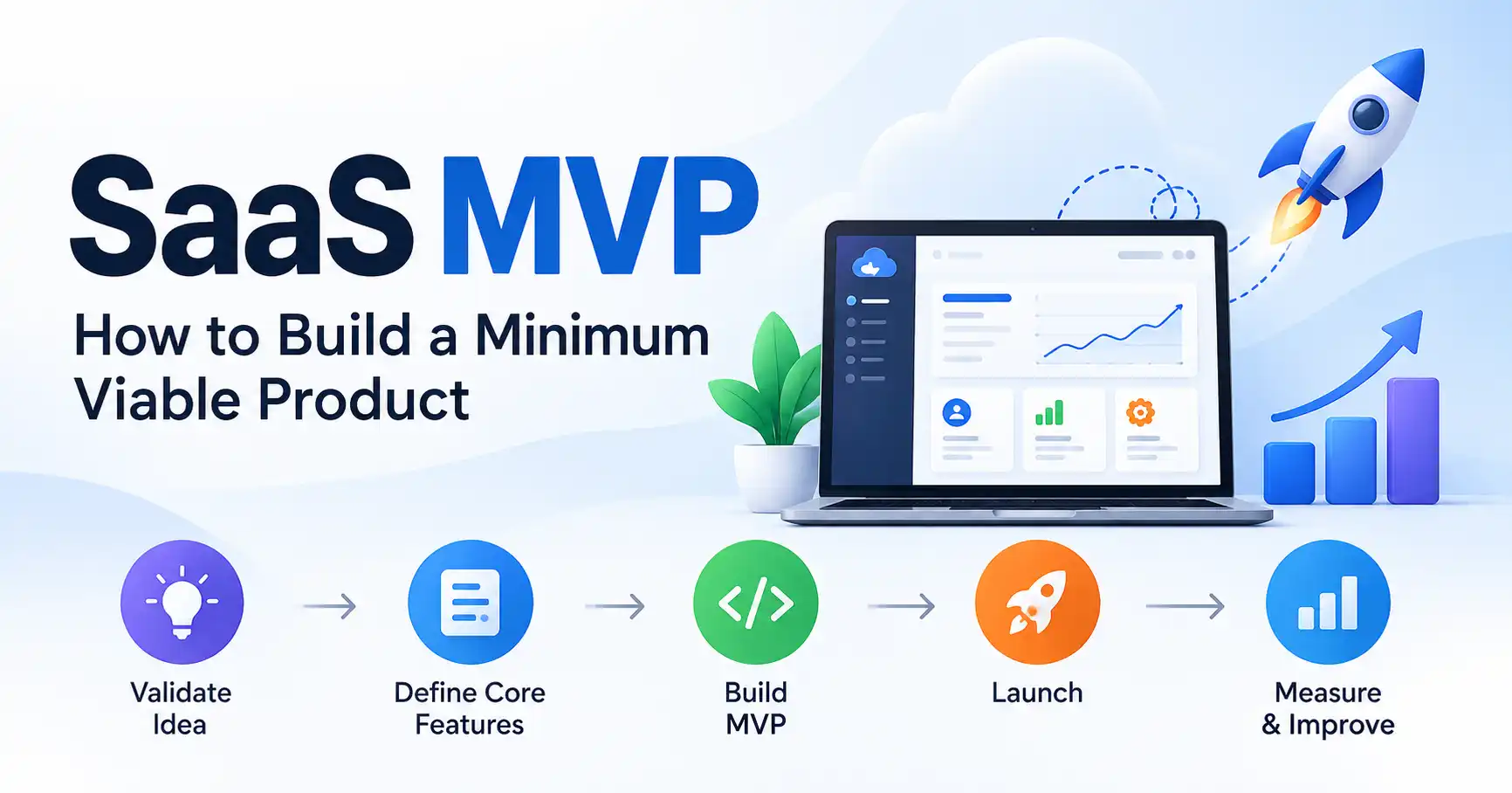
Building a SaaS MVP remains one of the absolute quickest ways to discover whether a software idea fixes a genuine pain point. Stop spending months crafting some bloated product loaded with needless extras. Keep it lean. Focus entirely on the bare minimum useful version you can shove in front of actual humans. Teams utilize this method to test demand, gather raw feedback, keep budgets fiercely tight, and make smarter calls overall. This complete guide walks you through planning, building, launching, and refining your SaaS MVP step by step.
Table of Contents
- What is SaaS MVP
- Why SaaS MVP is Important
- Step by Step Guide
- Best Practices and Tips
- Common Mistakes
- Tools
- FAQs
- Conclusion
What is SaaS MVP
A SaaS MVP is the barebones, first working version of a software product. It packs just enough core features to solve one specific customer headache.
The goal here isn’t a finished masterpiece. You’re building just enough value for early users to test your core assumptions and figure out your next move.
Take social media management tools for small businesses as an example. Down the road, that platform might boast AI content writing, team chat, approval chains, competitor spying, analytics, and deep reporting.
Your MVP? Strip all that away, Just give them a basic post creator, a stripped down calendar, and a scheduler. If those early adopters actually stick with it and fork over cash, boom. You have proof it is time to grow.
This mindset lines up with standard SaaS philosophy: ship a laser focused first draft, then let actual customer habits teach you what to build next.AWS describes its minimum viable service approach as providing enough functionality to attract early users and collect feedback for future development.
Before deciding what belongs in the MVP, it is also useful to understand SaaS product discovery, because discovery helps teams identify the actual problem worth solving rather than simply building requested features.
Why SaaS MVP is Important
A reliable SaaS MVP squashes risk completely. Your crew secures concrete proof before ever wagering huge fortunes on uncertain bets.
Key benefits include:
- Test your product idea on real users before you scale, Cut down wasted development bills by keeping that first feature set lean.
- Gather honest feedback on usability, costs, and customer needs.
- Let actual usage tell you what deserves funding.
- Reach the market sooner and start learning from customers earlier
A focused MVP also creates a better foundation for product planning. Instead of guessing what customers want six months from now, your team can use real usage data and feedback to make the next product decisions.
Stripe also recommends validating the target customer and market before building an MVP and then paying close attention to metrics and feedback after launch.
Step by Step Guide
Step 1: Define the Problem You Want to Solve
Start with the customer problem. Skip the list of features entirely. You need to ask who actually has this pain, how often it bites them, what makeshift fixes they rely on right now, and why those fixes fall short.
Take an AI customer support platform. Don’t just announce you are building one. Narrow it down. Small SaaS teams spend hours every single day answering the exact same support questions.
That gives your crew a concrete target. From there, you can figure out who to focus on, what workflow needs a fix, and what your MVP actually has to do.
Step 2: Validate the Idea
Before writing significant amounts of code, speak with potential users.
Conduct customer interviews, surveys, competitor research, landing page tests, or prototype tests. Look for repeated problems rather than isolated feature requests.
Take onboarding new users. Interview twenty potential customers, and fourteen hit the exact same wall. That beats one random prospect asking for a fancy feature every single time.
Build a simple hypothesis. Small B2B SaaS teams need a straightforward way to walk new customers through onboarding.
Now figure out what data backs that up, What specific proof confirms it? Or kills the idea entirely?
Step 3: Define the MVP Feature Set
This is where many SaaS teams make their biggest mistake. They start adding every feature that might eventually be useful.
Split features into three piles: vital needs, nice extras, and whatever just waits.
For example, an appointment management SaaS MVP may need:
- Customer account creation
- Appointment booking
- Calendar management
- Email confirmation
Version one doesn’t need fancy analytics, phone apps, multiple payment options, heavy automation, or enterprise reporting. Here is a solid rule of thumb. If dropping a feature still lets users reach their core goal, cut it from the MVP. Keep it lean.
Step 4: Build and Launch the MVP
Once the scope is clear, create the product with enough quality to support real usage.
That does not mean building everything perfectly. It means making the core workflow reliable, understandable, secure, and usable.
Pick your tech stack with care. Balance product demands against developer skills, tight budgets, and growth goals. SaaS design brings tricky choices. You have to figure out billing, tenant isolation, auth, databases, logging, integrations, and deployment pipelines.
AWS points out key pillars for cloud tools. Think identity management, tenant separation, telemetry, onboarding, and cost tracking.
Start small. A controlled beta group exposes usability flaws long before the general public arrives.
Step 5: Measure, Learn, and Improve
Launching the MVP isn’t the finish line. It’s just when the real learning starts.
Keep an eye on metrics that prove users actually get value out of what you built. Depending on your product, track activation rates, weekly active users, trial to paid conversion, feature adoption, retention, churn, and raw customer feedback.
Picture this: a hundred people sign up, yet a measly fifteen finish the core workflow. Demand probably isn’t the bottleneck. Maybe the onboarding sucks, the messaging is muddy, the usability is clunky, or a key feature is missing entirely.
Take those hard truths and figure out what to fix next. Put those choices down in a solid SaaS roadmap. That way, dev work stays tied directly to what customers want and what the business actually needs.
Best Practices and Tips
- Target one glaring buyer headache.
- Lock in strict success metrics before a single line of code gets written.
- Always validate assumptions with real prospects first to safeguard your scarce engineering budget, Rank features by customer value, revenue weight, confidence, and brute effort.
- Keep that initial user journey relentlessly straightforward from signup all the way to their first quick win.
- Bake security right into the infrastructure early on.
- Listen to user feedback constantly, then pivot without hesitation whenever the metrics demand a shift.
Feedback floods in constantly. Deciding what actually matters proves brutal. Avoid building random user requests blindly while weighing each idea against your core strategy and real impact. A reliable framework helps product teams navigate those tough calls without endless guesswork.
Common Mistakes
Building Too Many Features
Thirty features means it is no longer an MVP. Piling on that much stuff guarantees endless delays, sloppy tests, massive upkeep headaches, and totally bewildered users.
Skipping Customer Validation
A technically impressive product can still fail if it solves a problem customers do not care enough about.
Copying Competitors
Competitor research is useful, but copying another SaaS product feature by feature does not create a strong product strategy. Focus on your customer’s specific problem.
Ignoring User Feedback
The first version will rarely be perfect. Treat feedback as evidence that helps determine what should change.
Measuring Vanity Metrics
Large signup numbers can look impressive but may not indicate product value. Track activation, engagement, retention, conversion, and other metrics connected to your business model.
Tools
The tools you choose should match the stage of your SaaS MVP rather than add unnecessary complexity.
| Tool | Best For | Primary Use |
| Figma | Product design | Creating wireframes and clickable prototypes |
| Productboard | Product discovery | Organizing feedback and product opportunities |
| Jira | Development teams | Managing engineering work and releases |
| Hotjar | User research | Understanding user behavior |
| Google Forms | Early validation | Collecting simple customer feedback |
Wield tools to slash doubt and sharpen delivery, but keep your MVP lean. Don’t let anything bloat it, that is all.
FAQ’s
How long does it take to build a SaaS MVP?
Timelines vary wildly. A basic MVP might take a few weeks. A complex B2B SaaS tool? Months, Why the gap? Scope, tricky integrations, team size, tech demands, and validation checks all sway the clock. Nothing is set in stone..
How many features should a SaaS MVP have?
Forget the “perfect” feature count. Your MVP needs just what’s essential to solve the core customer problem. If the main job can’t get done without it, okay, maybe, Otherwise, punt it down the road.
Should a SaaS MVP be paid or free?
Charging early users? That tells you if they’ll actually open their wallets. A free beta, on the other hand, just makes collecting initial usage data a breeze. Really, it all boils down to figuring out what you need to learn.
Should I build a prototype before an MVP?
Yeah, usually. A working prototype lets you test out how users get around, what the site says, and if the basic feel is right. You catch glitches before sinking cash into building it, Saves headaches later.
What should I measure after launching an MVP?
Forget the fluff hone in on what truly matters: customer value, bottom line results, Think activation, retention, trial to paid leaps, usage habits, churn rates, and that crucial feedback. The essentials.
Conclusion
Don’t think of your SaaS MVP as a stripped down version of your full product. It’s really about crafting the leanest possible solution, One that still lets you gather solid proof from actual users. That’s the whole point.
So, pin down a core problem first, Is it even a real issue for your target market? Next, slash features to just the critical ones, Build a sturdy main workflow, then launch it. Make sure your goals are measurable. Then use customer behavior and feedback to decide what should come next.
Your next action should be to write down the single customer problem your SaaS product will solve and list the three to five features required to solve it. Everything else can wait until you have evidence that the core solution works.
For additional guidance, the AWS SaaS resources provide technical and operational resources for teams building and scaling SaaS applications.