

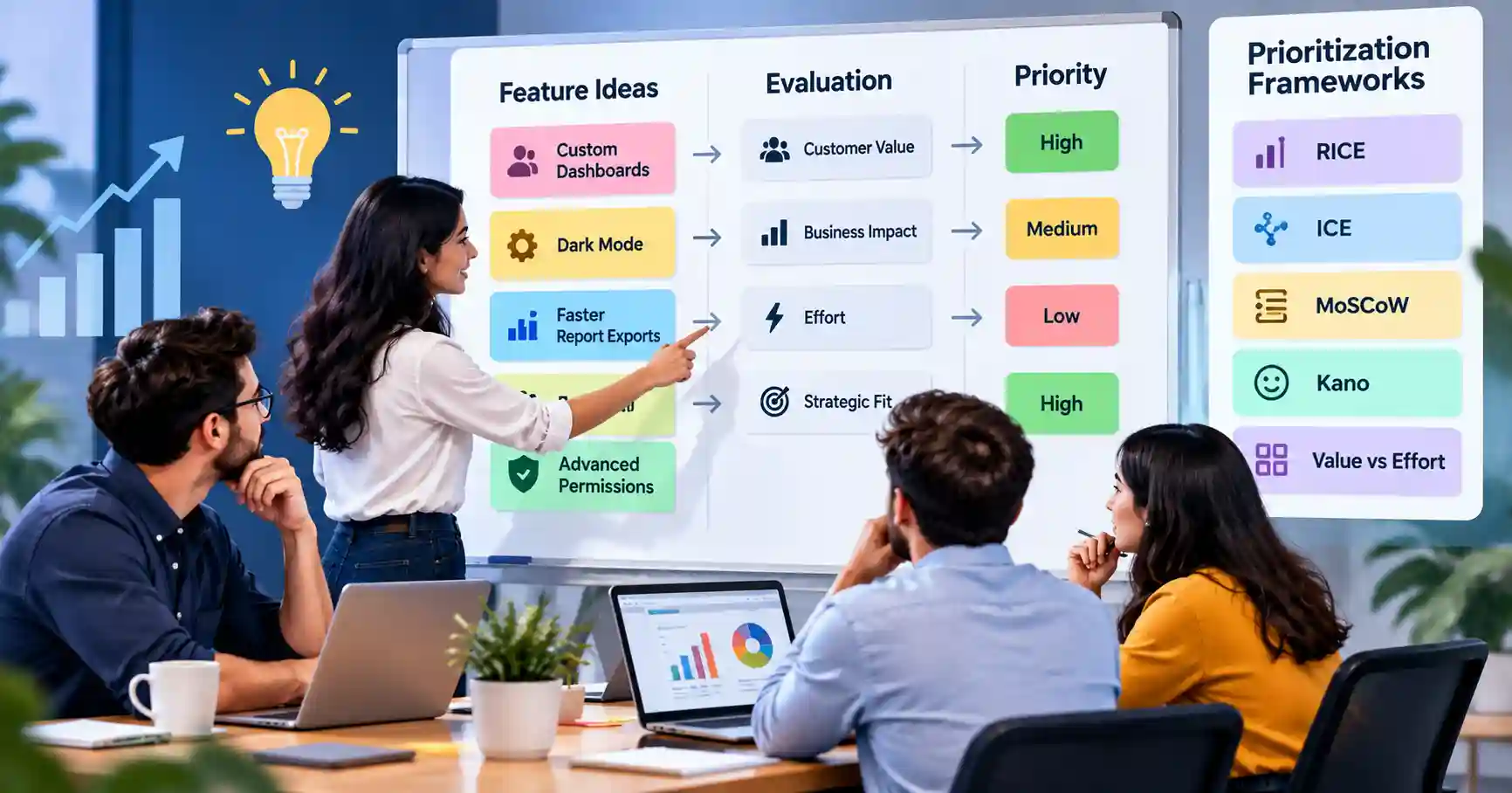
Deciding what to build next paralyzes software teams. Honestly, it is brutal. SaaS feature prioritization gives managers a reliable method to separate urgent needs from deferred noise. Without a clear system, roadmaps become chaotic graveyards of random customer emails, aggressive sales demands, and whatever brilliant concept someone dreamed up over their morning coffee. In this guide, you will figure out how feature prioritization actually works, which specific frameworks are truly worth using. And how to apply them.
Table of Contents
- What is SaaS Feature Prioritization
- Why SaaS Feature Prioritization is Important
- Step by Step Guide
- Best Practices and Tips
- Common Mistakes
- Tools for Feature Prioritization
- Comparison of Prioritization Frameworks
- FAQs
- Conclusion
What is SaaS Feature Prioritization
SaaS feature prioritization simply means figuring out what gets built first. Products constantly drown in bugs, frantic customer asks, fresh ideas, and small tweaks fighting for attention. Teams cannot treat every single ticket as top priority, Instead, they weigh each concept against concrete metrics. Think business impact, raw effort, customer value, urgency, and how confident they actually feel about the outcome.
Picture a SaaS analytics platform staring down three specific requests: custom dashboards, dark mode, and faster report exports. Custom dashboards might hook giant enterprise accounts. Faster exports could instantly make life easier for a huge chunk of your current user base. Dark mode? Nice to have, sure. But it will not move the revenue needle right away.
That is where a framework comes in handy. It forces the team to line these options up against a shared yardstick. Atlassian points to methods like RICE, Kano, MoSCoW, value versus effort matrices, opportunity scoring, and cost of delay.
Dig into broader SaaS product management guides if you want a wider lens on how software companies steer their roadmaps.
Why SaaS Feature Prioritization is Important
A good prioritization process helps SaaS companies avoid spending months building features that create little measurable value.
Key benefits include:
- We’re putting our engineering talent where it counts, hitting the real opportunities, that means tighter connections all around, product, sales, marketing, customer success, everyone.
- We’ll zero in on actual customer issues, not just chasing whatever pops into someone’s head.
- Roadmaps will snap into focus.
- Releases will become far more reliable, Explaining what we’re building, or why something’s stuck? That gets much easier, too.
Teams can’t build it all, so what gets done is a massive deal. A solid framework, you know, gives you actual words for those tough calls. No more guesswork.
Step by Step Guide
Step 1: Collect and Define Feature Ideas
Gather every feature request and product idea. These nuggets of inspiration can surface from customer chats, support emails, sales pitches, data analysis, competitor observation. Or even your own internal team’s brainstorming.
Do not simply write “Build bulk export.” Define the problem behind it.
For example:
Feature: Bulk export
Problem: Customers managing hundreds of records spend too much time exporting data individually.
Expected outcome: Reduce manual work and improve customer satisfaction.
This difference is crucial. Let’s zero in on outcomes and achievements, not just feature labels.
Step 2: Connect Each Feature to a Business or Customer Goal
Next, identify what each feature is expected to improve.
Possible goals include:
- Increasing activation
- Improving retention
- Reducing churn
- Increasing expansion revenue
- Improving conversion
- Reducing support volume
- Meeting an important customer requirement
Picture a SaaS onboarding tool getting asked for advanced user permissions. When big enterprise buyers harp on permissions over sales calls, that specific feature might just drive upsells and lock in renewals. You can lean on your SaaS growth metrics too. Tie raw feature ideas directly to actual business outcomes.
Step 3: Select a Prioritization Framework
No single framework fits every SaaS company out there. Pick your poison based on product maturity, the data you actually have, how fast you need to move, plus the kind of work you do.
RICE comes in handy when you can reliably estimate reach, impact, confidence, and effort. The math is simple, Multiply reach by impact and confidence, then divide by effort. Take a feature touching 5000 users with heavy expected outcomes. It will usually outscore some shiny add on that only helps a tiny slice of your customer base.
For frantic squads, ICE feels lighter because you drop reach entirely and just look at impact, confidence, and ease. MoSCoW works wonders when teams need to brutally slice requirements into must haves, should haves, could haves, and won’t haves.
Step 4: Score and Discuss the Features
Create a simple scoring sheet and evaluate every candidate using the same definitions.
For example, a team might score:
- Reach from 1 to 10
- Impact from 1 to 5
- Confidence from 0 to 1
- Effort from 1 to 10
Forget chasing perfect numbers. The point is dragging hidden assumptions out into the light so everyone can actually talk about them. Say a product manager flags a feature as high impact, but engineering warns the effort is massive. That gap right there gives the team something concrete to dig into before locking down the roadmap.
Step 5: Validate the Priority Before Committing
A score should help you decide, not just make the call for you, before you drop any feature onto that roadmap, dig deeper. Look at actual customer feedback, technical hurdles, big picture goals, rules you have to follow, and the calendar.
Take a feature with a great RICE score. Sounds amazing, right? But wait, it might need a massive database overhaul first. Sometimes the tech work has to happen, Atlassian points out that priorities demand constant tweaks. As products grow and markets shift, you keep updating the plan.
Best Practices and Tips
- Fix the problem before you chase the fix, Figure out why folks are asking for something in the first place.
- Set clear scoring rules. Everyone needs to know what a 5 or a 10 actually means on paper.
- Bring in real evidence. Mix those feature requests with customer interviews, usage numbers, support tickets, and raw feedback.
- Talk to engineering early on. Development headaches totally flip the value versus effort math.
- Separate loud noises from actual importance, A squeaky wheel doesn’t always deserve top billing.
- Keep reviewing your list. New data alters the expected impact overnight.
- And don’t overcomplicate it, If scoring drags on longer than figuring out the issue itself, trim the fat.
Common Mistakes
Prioritizing the Loudest Customer
Big client asks matter. Yet, building every single demand from your top buyer derails the roadmap away from broader product goals. Watch out.
Treating Scores as Absolute Truth
A score is an estimation tool. It does not remove uncertainty or replace product judgment.
Ignoring Engineering Effort
A feature may sound valuable until the team discovers complex integrations, infrastructure changes, or security requirements.
Mixing Different Types of Work
New features, technical debt, bugs, compliance requirements, and experiments may need different evaluation criteria. Putting everything into one scoring model can create misleading comparisons.
Never Updating Priorities
Six months ago? Irrelevant now. Customer habits shift, rivals strike, markets flip, and company strategies pivot entirely on a dime.
Tools for SaaS Feature Prioritization
Product tools, they help teams gather ideas, rank opportunities, and share choices. Honestly.
- Jira Product Discovery can support prioritization and product discovery workflows.
- Confluence provides an RICE template for collaborative prioritization.
- ProductPlan provides resources and frameworks for roadmap and prioritization planning.
- A spreadsheet can work well for smaller teams that need a simple scoring model before adopting dedicated software.
You can also use Atlassian’s prioritization framework guide as a reference when deciding which model fits your workflow.
SaaS Feature Prioritization Framework Comparison
| Framework | Main Factors | Best Used For | Complexity |
| RICE | Reach, Impact, Confidence, Effort | Data informed roadmap decisions | Medium |
| ICE | Impact, Confidence, Ease | Fast feature and experiment decisions | Low |
| MoSCoW | Must, Should, Could, Won’t | Release and requirement planning | Low |
| Kano | Basic, Performance, Delighters | Understanding customer satisfaction | Medium |
| Value vs Effort | Value and delivery effort | Quick roadmap discussions | Low |
That is the main lesson. Pick a framework matching your distinct needs, instead of forcing every single product decision into one rigid, inflexible scoring system today.
FAQ’s
What is the best framework for SaaS feature prioritization?
No single framework rules them all. RICE works brilliantly when solid reach and impact numbers exist. Meanwhile, nimble squads chasing fast calls lean heavily on ICE or Value versus Effort. Just pick your tool.
How often should SaaS features be reprioritized?
Most teams check priorities on a regular cycle. But if customer needs shift, strategy changes, technology jumps, or the market moves, throw out the schedule. Review early.
Should customer requests determine feature priority?
Customer requests are valuable evidence, but they should be evaluated alongside customer reach, business objectives, strategic importance, effort, and other available evidence.
Is RICE suitable for early stage SaaS products?
Early startups rarely have solid usage metrics, that is true. Leaner frameworks like ICE fit much better there, working smoothly without all the heavy noise getting in the way.
Can a SaaS company use multiple prioritization frameworks?
Sure. A squad could lean on Value versus Effort for a quick filter, RICE for roadmap ideas, and MoSCoW for release planning. Just keep the goal of each framework distinct.
Conclusion
SaaS feature prioritization helps product teams make smarter roadmap choices by giving them a reliable way to weigh customer value, business impact, confidence. And how much heavy lifting engineering has to do. RICE, ICE, MoSCoW, Kano, Value versus Effort. They all work, it just depends on what you are facing right now.
The practical starting point is simple. Round up your feature ideas, map out the customer pain, tie every opportunity to a metric that matters, pick a framework that fits, and run it by your product and engineering squads for a reality check.
Start light and tweak your process as your SaaS scales. Nobody is hunting for a magic score here, you just want sharper decisions backed by actual evidence instead of plain guesswork.