
Choosing a SaaS product involves more than comparing features and subscription prices. Your contract spells out what you can use, what you’ll pay, who’s responsible when something goes wrong, and what happens when you decide to leave.
For startups and small businesses, overlooking a single clause can mean unexpected renewal costs, restricted access to business data, or an expensive transition to another provider.
Understanding SaaS contract terms helps you make better purchasing decisions and avoid commitments that no longer suit your business. Here are 12 terms to review before signing, along with practical questions to ask vendors.
What Is a SaaS Contract?
A SaaS contract governs your access to software hosted and managed by a provider. Rather than buying a traditional software copy, your business typically pays a recurring fee to use the service.
The agreement may include several documents:
- Master service agreement (MSA): Sets out the main contractual obligations.
- Order form: Specifies the product, subscription price, number of users, and contract period.
- Service level agreement (SLA): Defines service availability and other performance commitments.
- Data processing agreement (DPA): Outlines relevant responsibilities for processing personal data.
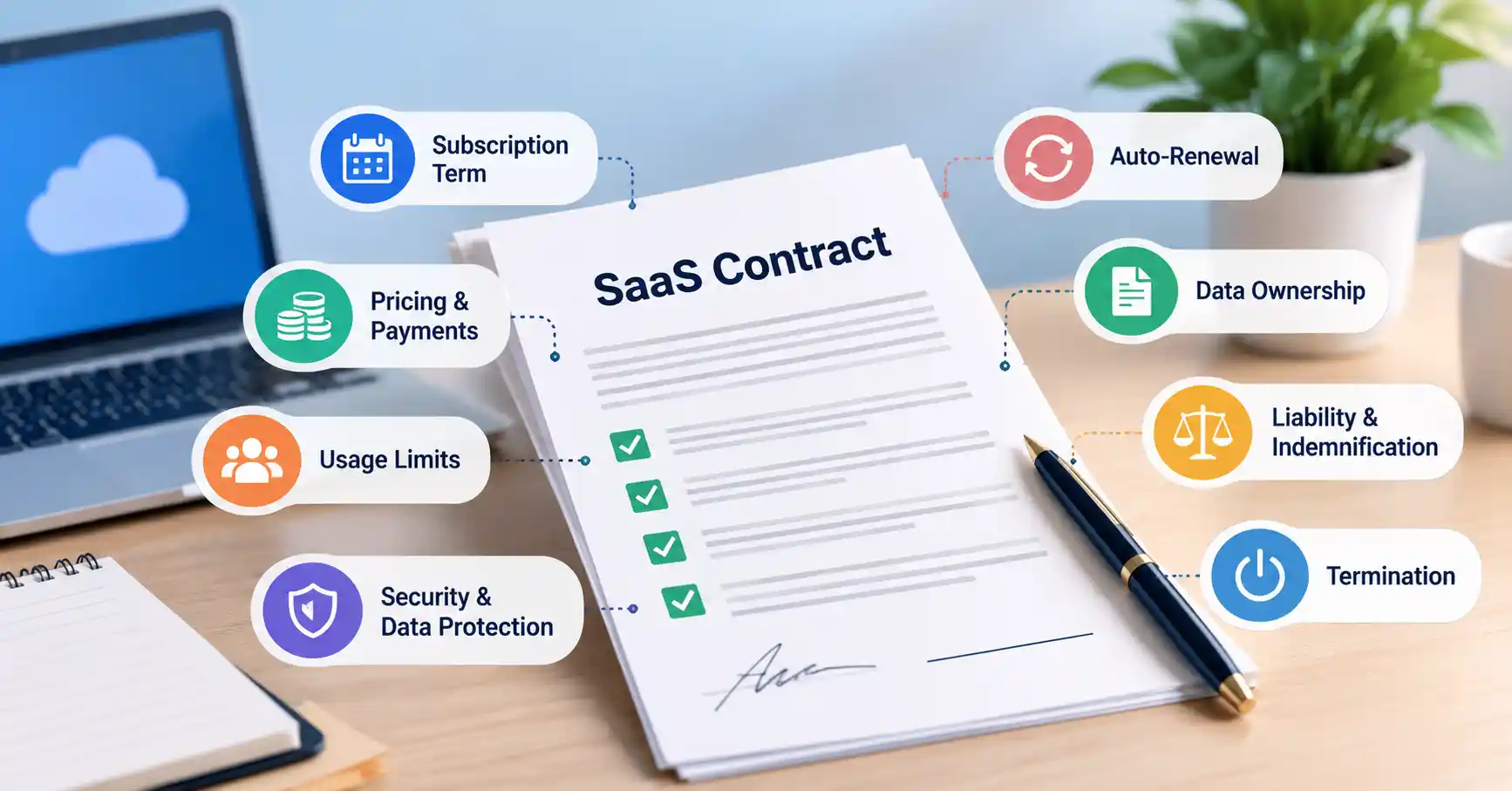
These documents work together, so reading only the main agreement isn’t enough. Check which additional policies form part of the contract and whether the vendor can change them without your approval. key contractual provisions in SaaS agreements
12 SaaS Contract Terms Every Buyer Should Understand
1. Subscription Term and Commitment Period
The subscription term defines how long your agreement lasts. Some contracts run month to month, while others lock you into an annual or multiyear commitment.
An annual plan might offer a lower monthly rate, but that saving can disappear if your needs change and you’re unable to exit early.
What to check: Review the start and end dates, minimum commitment, and any early termination charges. If you’re adopting an unfamiliar product, consider whether the flexibility of a shorter initial term justifies the higher price.
2. Auto Renewal and Cancellation Notice
Auto renewal means your subscription continues automatically unless you give notice within the period specified in the contract.
For example, an annual agreement might renew for another year unless you cancel at least 30 days before expiry. Miss that deadline, and your business could be committed to another billing period.
What to check: Confirm the renewal date, cancellation deadline, required notice method, and whether pricing can change at renewal. Set a calendar reminder well before the notice window closes.
3. Pricing, Price Increases, and Payment Terms
The advertised subscription fee rarely tells the whole story. Implementation, premium support, integrations, extra storage, and usage based charges can all add to the cost.
Check whether the vendor can increase prices during the contract or only when it renews. Payment schedules, late payment charges, taxes, and refund conditions also deserve attention.
Example: A marketing team chooses an affordable platform, only to discover that essential reporting requires a paid add on. The initial price comparison no longer reflects the actual cost.
Ask the vendor to document the complete fee structure and any agreed limits on price increases.
4. Usage Limits, Seats, and Overage Fees
SaaS agreements often set limits on users, API calls, contacts, transactions, storage, or other usage measures. Exceeding those limits can trigger extra charges or restrict access to certain features.
What to check: Understand what’s included, how usage is measured, how overages are billed, and whether you’ll receive alerts before reaching a limit.
If your business is growing quickly, consider how easily you can expand capacity without unexpected costs.
5. Service Level Agreement (SLA) and Uptime
An SLA defines measurable service commitments, which may cover availability, support response times, and maintenance arrangements.
A promise of “99.9% uptime” doesn’t necessarily mean uninterrupted access. The agreement may exclude scheduled maintenance or other circumstances when calculating availability.
What to check: Find out how uptime is measured, which exclusions apply, how to report incidents, and what remedies are available if the vendor falls short.
For business critical software, review backup arrangements, disaster recovery provisions, and support escalation procedures as well.
6. Service Credits and Remedies
Service credits are financial adjustments that may apply when a provider fails to meet its service commitments. However, a credit doesn’t necessarily cover the business losses caused by an outage.
Some agreements also require customers to submit claims within a specified period.
What to check: Review eligibility rules, claim deadlines, credit calculations, and whether repeated service failures give you additional termination rights.
7. Data Ownership, Access, and Permitted Use
Your agreement should clarify who owns the information you upload or create through the service, how the vendor may use it, and how you can retrieve it.
This matters particularly for CRM records, customer conversations, analytics, and proprietary business information.
What to check: Examine ownership rights, permitted processing, access during the subscription, export formats, retention periods, and deletion procedures.
For AI powered tools, ask whether your prompts, uploaded documents, or customer data may be used to train models. Providers can have different policies, so don’t assume your data will automatically be excluded from training.
8. Data Processing Agreement (DPA) and Security Obligations
A DPA outlines relevant responsibilities when a provider processes personal data on your behalf. Depending on the service and applicable laws, it may address security measures, subprocessors, breach notifications, and assistance with data subject requests.
What to check: Review security commitments, incident notification procedures, data locations, subprocessor arrangements, and deletion requirements.
Contract wording alone doesn’t prove that a vendor’s security controls are adequate. A SaaS vendor security assessment can help you examine the provider’s safeguards and supporting evidence.
9. Intellectual Property Rights
Intellectual property (IP) clauses distinguish between the vendor’s software, your existing materials, and content or outputs created while using the service.
For instance, a design platform may retain rights to its software while your business retains rights to uploaded brand assets. The actual position depends on the agreement.
What to check: Look at ownership of uploaded content, rights to generated outputs, permitted uses, third party infringement claims, and restrictions on commercial use.
This is particularly important when using AI tools to create marketing copy, images, or other business assets.
10. Indemnification
Indemnification provisions specify when one party must handle certain third party claims or cover resulting losses and costs.
A vendor might agree to cover specified intellectual property infringement claims involving its software. The agreement could also require your business to cover claims arising from unlawful use of the service.
What to check: Identify covered claims, exclusions, notification requirements, control of the legal defense, and whether the obligations are mutual or one sided.
Don’t assume that an indemnity clause covers every potential dispute. Its scope depends on the wording.
11. Limitation of Liability and Warranties
A limitation of liability clause caps or restricts the compensation a party may owe in specified circumstances. Warranties set out particular promises about the service or its performance.
Pay close attention to the liability cap, excluded damages, and exceptions. A cap based on just a few months of subscription fees may be inadequate if the software handles sensitive information or supports critical operations.
What to check: Examine how the cap is calculated, which damages are excluded, how data loss and confidentiality breaches are treated, and whether indemnification obligations fall within or outside the cap.
There’s no universally appropriate liability cap. The right position depends on the potential impact of a failure, the contract value, and each party’s ability to manage the risk.
12. Termination, Data Export, and Post Contract Deletion
Termination clauses explain how an agreement can end, including what happens after a material breach, an uncured default, or the end of the subscription.
Leaving a service can become complicated if you can’t retrieve your data promptly or face unexpected export fees.
What to check: Review termination rights, cure periods, outstanding payment obligations, export windows, transition assistance, deletion timelines, and additional support fees.
Ask the vendor how long your data remains available after termination and what happens to backup copies. These details can make a significant difference when moving to another provider.
How to Review a SaaS Contract Before Signing
A structured review helps you catch potential problems before they become contractual commitments.
- Gather all relevant documents. Read the main agreement, order form, SLA, DPA, and incorporated policies together.
- Identify business critical risks. Focus on renewal commitments, price changes, data handling, liability, and termination rights.
- Calculate the full cost. Include mandatory add ons, usage charges, support, and potential renewal increases.
- Get unclear terms clarified in writing. Ask the vendor to explain ambiguous clauses and document any agreed changes.
- Track deadlines and obligations. Record renewal notices, payment dates, security reviews, and data export requirements.
For higher value or higher risk purchases, involve legal, security, finance, and procurement stakeholders as needed. The broader SaaS procurement process can help your team coordinate these decisions.
Which SaaS Contract Terms Should You Negotiate First?
Not every clause carries the same level of risk. Prioritize the terms that could have the greatest financial, operational, or legal impact on your business.
| Priority | Terms to review | Questions to ask |
| High | Renewal, pricing, termination | Can we limit renewal increases or negotiate a shorter commitment? |
| High | Data access and deletion | Can we export our data in a usable format after termination? |
| High | Liability and indemnification | Are the limits appropriate for our potential exposure? |
| Context dependent | SLA and support | Do the service commitments meet our operational needs? |
| Context dependent | IP and AI data use | Who controls our content, and how can the provider use it? |
You may not be able to negotiate every provision, especially with standardized contracts. Focus first on the terms that could create the greatest exposure rather than spending time on minor wording changes.
SaaS Contract Terms Checklist for Buyers
Before signing, make sure you’ve reviewed:
- Contract duration and renewal deadlines
- Subscription fees, overages, and price increases
- Usage limits and support commitments
- Data ownership, permitted use, and export rights
- Security obligations and breach notifications
- Intellectual property and indemnification
- Liability caps and warranty exclusions
- Termination rights, deletion, and transition costs
FAQ’s
What should I look for in a SaaS contract?
Start with pricing, renewal conditions, usage limits, data rights, service commitments, liability, and termination. Review all documents incorporated into the agreement, not just the main contract.
Can you negotiate SaaS contract terms?
Yes, depending on the provider and agreement. You can request changes to pricing, renewal notice periods, service commitments, liability provisions, and data export rights. The vendor may reject some requests, particularly under standardized agreements.
What does auto renewal mean in a SaaS contract?
Auto renewal means the subscription continues for another period unless you provide cancellation or non renewal notice according to the contract. Check the exact deadline and required notice method to avoid an unwanted renewal.
What happens to my data when a SaaS contract ends?
That depends on the agreement and applicable law. Check your rights to export data, how long you have to retrieve it, the vendor’s deletion obligations, and whether backup copies are retained.
Conclusion
A SaaS contract is more than a formality. It defines your financial commitment, service expectations, data rights, and options for leaving the provider.
Before signing, pay particular attention to automatic renewal, price increases, liability limits, data usage, and termination. Ask questions when the wording is unclear, and make sure important commitments are documented.
A thorough review helps you understand the trade offs before committing your business to a software subscription.