
Choosing between product led and sales led SaaS models is a massive call for any software company. Get it wrong and you’ll watch your customer acquisition costs spike while growth stalls out entirely. One strategy relies on the software to hook users and drive signups. The other puts human reps front and center to guide deals across the finish line. This guide breaks down both approaches so you can figure out what actually fits your business.
Table of Contents
- What is Product Led vs Sales Led SaaS
- Why Product Led vs Sales Led SaaS is Important
- Step by Step Guide
- Best Practices and Tips
- Common Mistakes
- Tools
- FAQs
- Conclusion
What is Product Led vs Sales Led SaaS
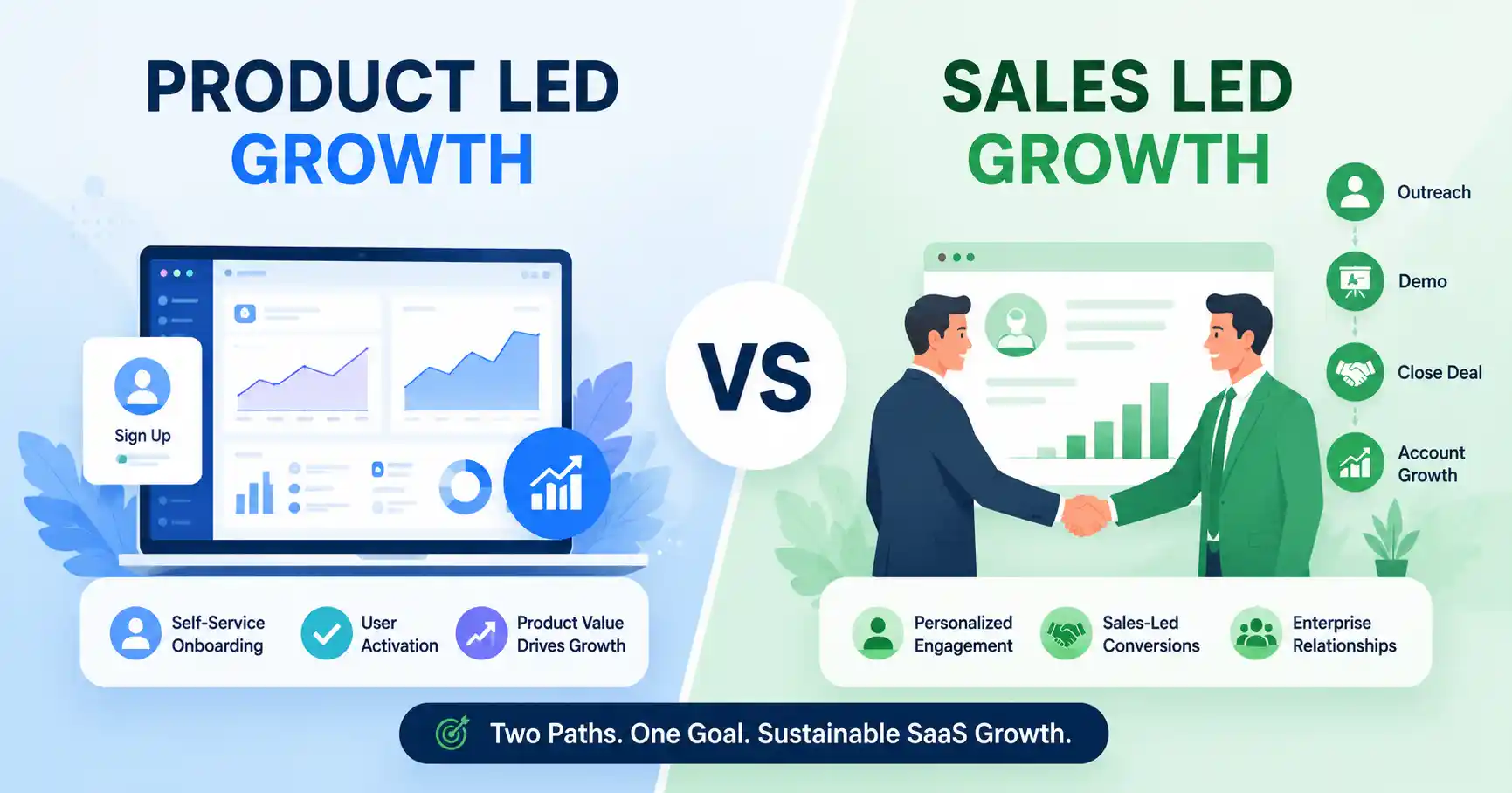
Product led growth puts the software front and center. It pulls in and keeps users without any heavy sales pitch. People jump straight into a free tier or a time limited trial, poke around the features. And only hand over cash once the value becomes undeniable. Simple.
Take Slack as a prime example. Small teams start messaging for free, rope in their coworkers, and test the collaboration tools. Eventually, as usage scales up, they hit hard limits and upgrade.
Sales led growth flips that script entirely, Reps do the heavy lifting. They track down leads, run demos, answer tough questions, haggle over price tags, and finally seal the deal.
Enterprise software companies lean heavily on this method. Big corporate clients demand endless security audits, custom agreements, specialized onboarding, and deep integrations before they spend a single dime.
The difference gets stark when you compare them side by side.
| Factor | Product Led Growth | Sales Led Growth | Hybrid Model |
| Main growth driver | Product experience | Sales team | Product and sales |
| Typical customer | Self service users | Larger accounts | Mixed customer base |
| Sales cycle | Short | Longer | Varies |
| Pricing | Usually transparent | Often customized | Both |
| Best fit | Simple products | Complex products | Growing SaaS companies |
The key takeaway is that product led growth reduces friction, while sales led growth provides more human guidance for complex purchases.
Choosing between product led and sales led growth touches almost every single gear inside a SaaS company. It shapes how marketing drums up interest, how incoming leads get vetted, what the product feels like to use, and how the finance folks score revenue success.
This decision matters. Getting it right helps you:
- Keep customer acquisition costs down by skipping pointless sales calls
- Match your buying process to what the customer actually expects
- Lift activation rates by getting users to the good stuff faster
- Construct a SaaS growth engine that scales
- Bring marketing, product, customer success, and sales onto the same page
Take a simple project management tool, for instance, it usually thrives on self service onboarding. But an enterprise cybersecurity outfit? That requires security reviews, live demos, procurement wrangling, and dedicated account management.
Step by Step Guide
Step 1: Understand Your Ideal Customer
Figure out who actually cuts the check for your software. Look at company headcount, industry verticals, available budgets, technical know how, the buying committee, and the primary use case.
When individual workers or tiny teams can buy without looping in a dozen people, product led growth makes a lot of sense. But if closing a deal means getting sign off from executives, procurement, legal, and IT, a sales led strategy fits much better.
Step 2: Measure Product Complexity
How hard is your software to understand and actually get running?
If setup takes minutes, workflows are intuitive, and time to value is short, go product led. If your platform demands heavy integrations, messy configurations, data migration, or formal training, you need humans from sales in the mix.
A basic analytics dashboard usually wins over users via a free trial. A sprawling enterprise data platform, though, needs a sales engineer and an implementation crew standing by.
Step 3: Analyze Your Pricing and Contract Value
Customer lifetime value is a heavy hitter here.
Low priced SaaS needs an efficient, frictionless purchase path. Spending precious sales hours on a low ticket customer will eat your margins alive. High contract values, however, easily justify a sales led push since one closed deal pulls in massive recurring revenue.
Sometimes a hybrid model is the sweet spot if you serve scrappy startups and massive enterprise accounts under one roof.
Step 4: Evaluate Your Current Funnel
Pull apart your acquisition, activation, conversion, and retention numbers.
Run product led? Then track product qualified leads, activation rates, free to paid flips, expansion revenue, and real feature usage. Sales led? Look at your pipeline, win rates, how long sales take, average contract values, and acquisition costs.
The main goal is simple. Find out where people hit a wall and where your software can clear the path.
.
Step 5: Choose the Right Growth Model
Do not copy a model just because some tech unicorn did it.
Base your pick on your actual buyer, how complex your tool is, your pricing, the buying journey, and basic unit economics. You can also blend both worlds. Maybe you offer a free product tier to pull people in, while a dedicated sales crew chases the heavy hitting enterprise accounts.
For more SaaS growth strategy ideas, explore the resources available at SaaSyntic.
Best Practices and Tips
- Start with customer behavior instead of internal preferences. Let your buyers dictate how much human help they need.
- Track time to value closely. The faster people taste real results, the better your shot at product led growth.
- Build product qualified lead signals. Usage data can tip off your sales reps when an account is ripe for a phone call.
- Keep self service onboarding lean. Ditch unnecessary form fields, mandatory meetings, and setup hoops when people can just do it themselves.
- Use sales reps where they actually move the needle. They should help untangle complex buying decisions instead of reciting product specs found on a web page.
- Test a hybrid approach. Product led and sales led models don’t have to live in separate silos.
- Review your unit economics on the regular. Acquisition costs, lifetime value, retention, and expansion revenue should steer your strategy.
You can also learn more about SaaS growth and digital marketing strategies through SaaSyntic.
Common Mistakes
Choosing Product Led Growth Because It Looks Scalable
Sure, it scales nicely, but it fails to click for every software type. Complex enterprise solutions still demand human guidance.
Building a Free Plan Without a Conversion Strategy
Giving away free access attracts crowds, but it might not pay the bills. You need clear guardrails around features, usage caps, or business needs that push users to upgrade.
Using Sales for Every Customer
A big sales team gets pricey when buyers are ready to purchase and set up completely on their own. Automate the easy transactions and save your sales firepower for high stakes accounts.
Ignoring Customer Segmentation
Buyers differ wildly. Small shops prefer simply clicking a buy button independently, while sprawling enterprise giants firmly expect dedicated white glove sales support.
Measuring Only New Revenue
Growth means more than just piling up fresh signups. Activation, retention, expansion, and lifetime value reveal the true story. Is your engine actually healthy? You decide.
Tools
A handful of tools help SaaS teams design and track their growth engine.
Google Analytics
So, Google Analytics logs traffic. Where’d they come from, What’d they do?
HubSpot
HubSpot handles pipelines, client records, deals, and automation effortlessly. It fits teams combining inbound strategies with relentless sales outreach. Truly.
Amplitude
Amplitude helps product teams map out user behavior, feature activation, retention, and daily engagement.
Mixpanel
Mixpanel, it truly offers deep product data, pinpointing the very user steps that matter.
Stripe
Stripe manages subscriptions and recurring billing effortlessly. That is why it anchors self service SaaS checkouts everywhere. Quietly, it runs the infrastructure powering recurring revenue.
FAQ’s
Is product led growth better than sales led growth?
Neither approach is automatically superior. Product led usually wins for simple software with a fast time to value. Sales led makes total sense when dealing with complex tools, giant contracts, and half a dozen stakeholders all needing sign off.
Can a SaaS company use both product led and sales led growth?
Yes. Lots of businesses run a hybrid playbook. Self service users adopt the software entirely on their own, while reps zero in on big accounts and high intent prospects.
What is the difference between product qualified leads and sales qualified leads?
A product qualified lead shows its hand through actual usage and engagement inside the app. A sales qualified lead gets flagged through standard qualification criteria and direct talks with the sales team.
Is product led growth suitable for enterprise SaaS?
It can be, though enterprise companies almost always need human backup. A product led trial generates early buzz and proves value before a rep even steps into the room.
How should SaaS companies choose between the two models?
Look at customer needs, product complexity, pricing, sales cycles, acquisition costs, and unit economics. Test whatever model strikes the right balance between efficient growth and a smooth customer experience.
Conclusion
Product led versus sales led SaaS isn’t a simple either or choice. It is about figuring out how buyers discover, test, buy, and grow with your software.
Product led growth shines when folks grasp the value immediately. Sales led growth takes over when the purchase brings complex requirements, heavy budgets, or a crowd of stakeholders.
Your best move? Map out your current customer journey. Find where a human touch adds value and where software cuts friction. If both paths fit, build a hybrid setup and track the numbers.