

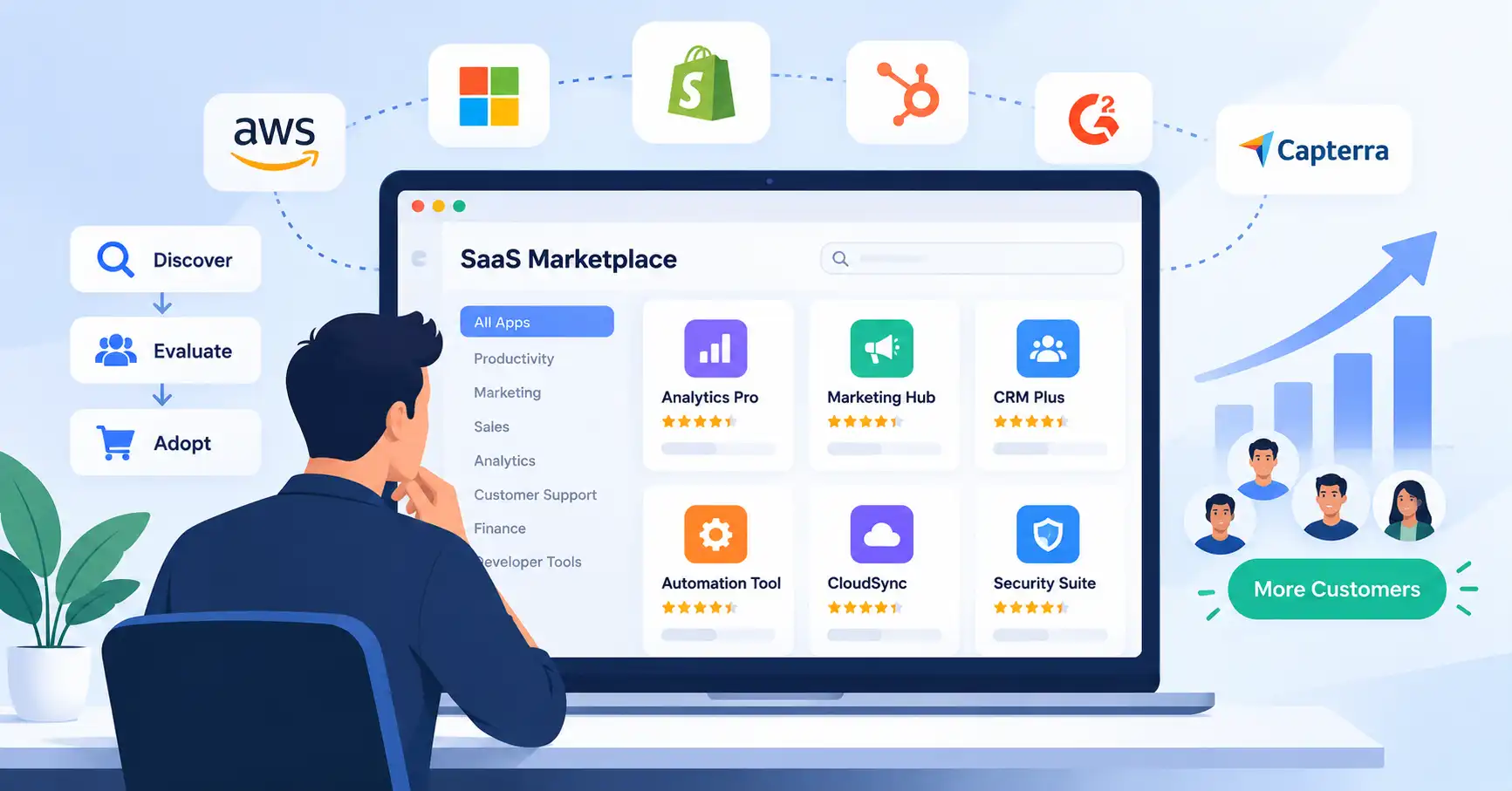
A SaaS marketplace gives software companies a way to reach buyers who are already looking for solutions or working within a familiar technology ecosystem. Still, publishing a listing alone won’t necessarily generate signups or sales.
An effective SaaS marketplace strategy brings together the right platform, a compelling value proposition, a well optimized listing, and consistent promotion. Just as importantly, it connects those activities to measurable business results.
For SaaS founders and growth teams, the goal isn’t to join every available marketplace. It’s to find where potential customers discover software, make the product easy to evaluate, and turn that visibility into sustainable revenue.
What Is a SaaS Marketplace Strategy?
A SaaS marketplace strategy is a plan for distributing software through third party platforms to reach potential buyers, generate qualified leads, and acquire customers.
Most platforms fall into three broad categories:
- Cloud marketplaces: AWS Marketplace and Microsoft Marketplace help customers discover and purchase software, including solutions used in cloud environments.
- App marketplaces: The Shopify App Store and HubSpot App Marketplace connect users with applications that extend the platforms they already use.
- Software review directories: G2 and Capterra help buyers research products, compare alternatives, and evaluate potential solutions.
Each category serves a different purpose. An integration focused SaaS product may gain traction through an app marketplace, while enterprise software may be better suited to a cloud marketplace that fits its customers’ procurement processes.
The right choice comes down to your audience, integrations, pricing model, and available resources.
Why SaaS Marketplaces Can Help You Acquire Customers
Marketplaces can complement outbound sales and paid advertising by putting your product in front of people who are already exploring software solutions.
Here are some potential benefits:
- Reach relevant audiences: Connect with buyers looking for products in a specific category or ecosystem.
- Make discovery easier: Give prospects a place to review features, integrations, use cases, and pricing.
- Support integration led growth: Help customers discover your product while searching for complementary tools.
- Simplify some purchasing processes: Certain cloud marketplaces fit into established enterprise procurement workflows.
- Create partnership opportunities: Use marketplace relationships to support referrals, co marketing, and ecosystem collaboration.
These benefits come with trade offs. Competition can be intense, some platforms require technical development or certification, and commercial fees or restrictions may apply.
Consider a SaaS company that attracts plenty of listing views but few paying customers. The problem might not be visibility. Unclear positioning or a complicated onboarding process could be preventing prospects from converting. Improving those areas may be more valuable than joining another marketplace.
Which SaaS Marketplace Should You Choose?
Popularity alone isn’t a good reason to select a marketplace. Start by considering where your ideal customers already work and how they prefer to discover and purchase software.
| Marketplace type | Examples | Best suited for |
| Cloud marketplaces | AWS Marketplace, Microsoft Marketplace | B2B software, cloud solutions, and enterprise procurement |
| App marketplaces | Shopify App Store, HubSpot App Marketplace | Integrations, extensions, and ecosystem specific applications |
| Review directories | G2, Capterra | Software discovery, comparison, and buyer research |
Before committing, assess five factors:
- Audience fit: Does the platform attract the customers you want to reach?
- Purchase intent: Are users actively looking for a solution like yours?
- Technical requirements: Can your product meet the platform’s integration and listing requirements?
- Economics: What will setup, maintenance, promotion, and transactions cost?
- Measurement: Can you connect marketplace activity to qualified leads, conversions, and revenue?
Start with one promising marketplace, measure the results, and expand only when the numbers and customer feedback justify the investment.
How to Build a SaaS Marketplace Strategy Step by Step
A structured approach makes it easier to set priorities and understand what’s working.
1. Define your target customer and goal
Identify the customers most likely to benefit from your product. Consider their industry, company size, existing software stack, and buying process.
Next, decide what success looks like. You might want to generate qualified sales opportunities, increase integration installs, or convert more free users into paid subscribers. Choose a measurable objective before launching.
2. Validate demand before investing
Study competing listings, customer reviews, category relevance, and the questions buyers ask. Look for unmet needs, weak product positioning, and recurring customer complaints your product can address.
Check eligibility and technical requirements before investing in development. Microsoft’s SaaS offer planning guide outlines considerations for publishing a SaaS offer, including listing options and technical requirements.
3. Create a listing that communicates value
A list of features won’t necessarily persuade buyers. Explain the problem your product solves, who benefits, and what customers can accomplish.
For example, rather than saying, “Automated reporting and dashboard integrations,” you could write, “Bring your sales data into one dashboard to reduce manual reporting.”
Include relevant keywords, clear screenshots, accurate pricing information, and a clear next step. Use genuine product visuals and specific benefits instead of unsupported performance claims.
4. Make evaluation and onboarding easier
Once prospects click your listing, help them understand what to do next. Offer an appropriate trial, demo, contact option, or purchase path.
Keep signup requirements manageable, explain integration steps, and provide useful setup documentation. Track where prospects abandon the process so you can identify and address friction.
5. Promote the listing beyond the marketplace
Don’t rely on marketplace discovery alone. Promote your listing through product documentation, relevant blog posts, customer newsletters, partner campaigns, and sales outreach where appropriate.
You can also explore SaaS channel partnerships to understand how partner relationships can support distribution beyond your own marketing channels.
6. Measure results and make improvements
Follow the customer journey from listing visits to qualified leads, product activation, paid subscriptions, and retention. Use the findings to improve your messaging, listing, and onboarding experience.
SaaS Marketplace Listing Optimization Best Practices
A few practical improvements can make your listing easier to understand and more persuasive.
- Write a clear title: Describe what your product does in language customers recognize.
- Lead with the problem: Explain the value before diving into technical features.
- Show the product in action: Use screenshots that demonstrate real workflows and useful capabilities.
- Clarify pricing: Explain plans, trial conditions, and relevant limitations.
- Build credibility: Keep documentation accurate, respond to customer questions, and invite honest reviews.
- Keep information current: Update screenshots, integrations, features, and product details as your software changes.
On review platforms, ask customers for feedback fairly rather than selectively requesting positive reviews. G2’s review and ranking policies explain restrictions on review and ranking manipulation.
SaaS Marketplace Strategy vs. Other Acquisition Channels
Marketplaces are one option within a broader customer acquisition strategy. Each channel has different strengths and resource requirements.
| Channel | Main advantage | Main trade off |
| SaaS marketplaces | Access to established software ecosystems | Platform dependency and competition |
| Direct sales | Greater control over qualification and customer relationships | Requires sales resources |
| Paid advertising | Control over targeting and campaign budgets | Costs can rise without efficient conversion |
| Referral partnerships | Recommendations from trusted partners | Depends on partner engagement |
| SEO and content | Can attract relevant visitors over time | Requires consistent effort |
These channels can work together. A marketplace listing may help capture existing demand, while SEO content introduces potential buyers to your product earlier in their research. Referral partnerships can bring in prospects through relevant business relationships.
Choose your channel mix based on customer acquisition cost, sales cycle, product maturity, and budget. For another complementary approach, explore SaaS referral partnerships.
How to Measure SaaS Marketplace Performance
Listing views and downloads provide useful context, but they don’t tell the whole story. Measure how effectively marketplace activity translates into paying, retained customers.
| Metric | What it tells you |
| Listing to lead conversion rate | How effectively the listing generates inquiries |
| Trial to paid conversion rate | How many trial users become paying customers |
| Customer acquisition cost (CAC) | How much you spend to acquire a customer |
| Marketplace attributed revenue | Revenue associated with marketplace acquisition |
| Retention rate | Whether acquired customers continue using your product |
Calculate marketplace CAC by dividing the channel’s relevant acquisition costs by the number of new customers acquired through that channel over the same period. Include listing preparation, promotion, partner fees, and attributable sales effort.
Also distinguish marketplace sourced revenue from marketplace influenced revenue. This helps prevent double counting customers who interacted with several marketing channels before purchasing.
A Practical 30 Day SaaS Marketplace Launch Plan
Use this schedule as an initial framework for getting your marketplace strategy moving.
- Week 1 : Research: Define your ideal customer, compare platforms, and validate demand.
- Week 2 : Prepare: Finalize your listing, screenshots, pricing, documentation, and technical requirements.
- Week 3 : Launch: Publish once approved, promote the listing, and enable lead tracking.
- Week 4 : Optimize: Review early engagement, investigate drop offs, and prioritize improvements.
Keep expectations realistic. Certification, integration development, and platform review processes may take longer than four weeks. The goal of the initial month is to establish a solid foundation and begin gathering useful performance data.
FAQ’s
What is a SaaS marketplace strategy?
It’s a plan for using software marketplaces to distribute a SaaS product, reach potential buyers, generate leads, and acquire customers. It covers platform selection, listing optimization, promotion, onboarding, and performance measurement.
Which marketplace is best for a SaaS startup?
The right choice depends on your product and audience. Integration led tools may benefit from app marketplaces, enterprise software may fit cloud marketplaces, and review directories can help reach buyers comparing alternatives. Validate customer demand before investing.
Are SaaS marketplaces free to join?
Costs depend on the platform and listing model. Some offer free profile options, while others may involve transaction fees, paid promotions, technical development, or ongoing maintenance. Review current platform terms before setting your budget.
How do you measure SaaS marketplace ROI?
Compare attributable revenue and customer value against marketplace related costs. Track qualified leads, paid conversions, CAC, retention, and payback period. Include relevant sales and technical expenses rather than judging performance by traffic alone.
Conclusion
A successful SaaS marketplace strategy starts with finding the right customers, not joining the largest number of platforms. Choose a marketplace that fits your product, explain your value clearly, and make it easy for prospects to evaluate and adopt your software.
Then follow the numbers. Measure which activities generate qualified leads, paying customers, and long term retention. Use those insights to improve your listing and decide whether to invest further or test another distribution channel.