

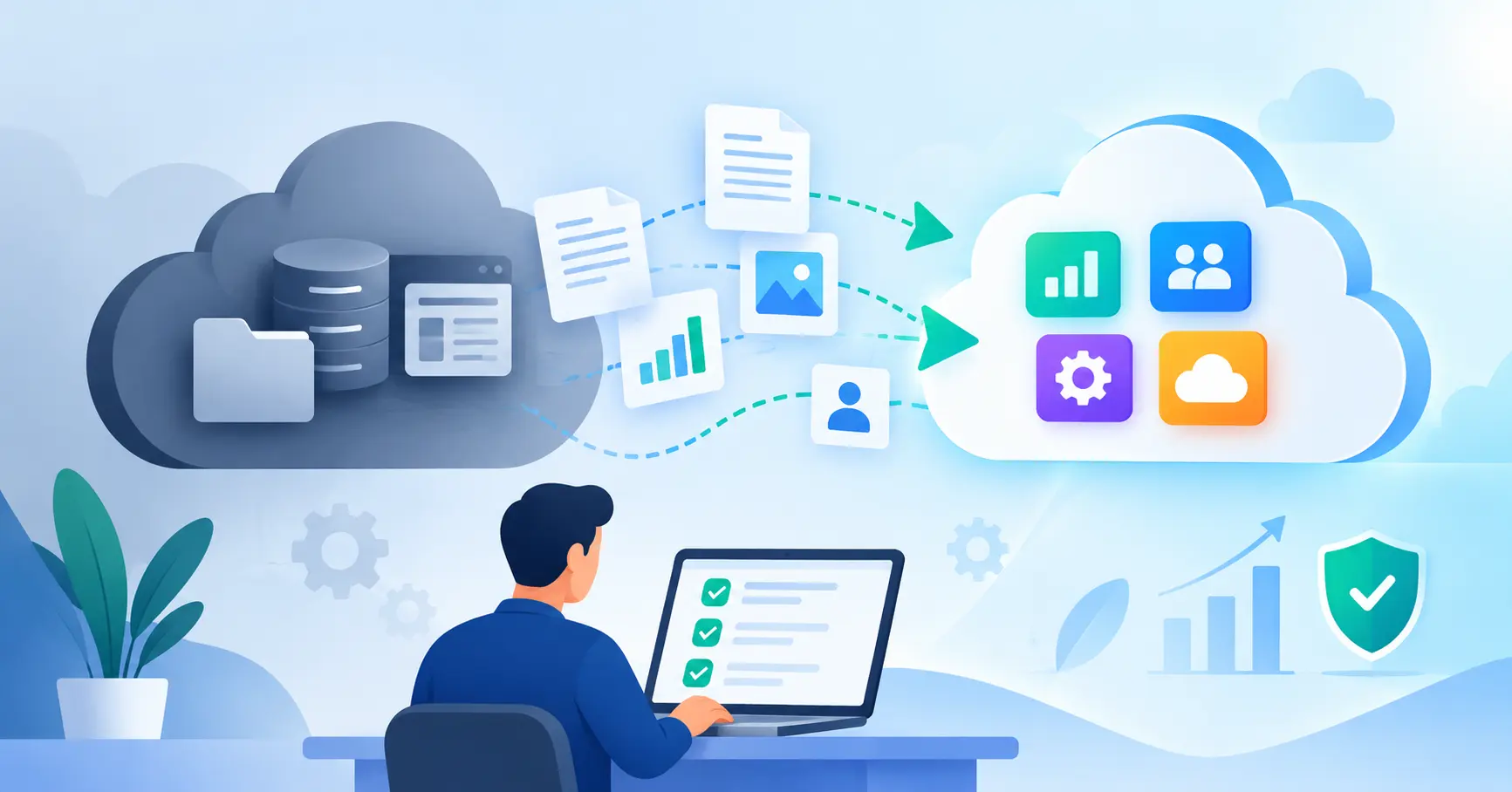
SaaS migration means moving core data, software, users, or workflows straight between environments. Organizations usually need this when swapping tired legacy apps, shifting vendors, or finally consolidating platforms. Why wait? Or leaping from self hosted systems to modern cloud setups.
Platform migration demands ruthless strategy, not basic file copying. Botch the timeline and sudden downtime hits, databases corrupt, integrations break, and you hemorrhage money fast.
Good roadmaps matter. They keep the wheels turning.
This guide untangles SaaS migration. We map planning, clever execution, smart tooling, and traps to dodge, Simple.
Table of Contents
- What Is SaaS Migration
- Why SaaS Migration Is Important
- Step by Step SaaS Migration Guide
- SaaS Migration Best Practices
- Common SaaS Migration Mistakes
- SaaS Migration Tools
- SaaS Migration Approaches Compared
- Frequently Asked Questions
- Conclusion
What Is SaaS Migration
Moving SaaS work from one cloud to another is basically a swap. You shift apps, data, users, settings, and day to day processes.
Say a business is expanding. It might stop using its current CRM because the reporting is not strong enough, or the automation and add ons do not fit. Then it has to move customer records, contact details, sales stages, role access, and the same workflow habits into the new CRM. All of this needs to keep running while the change happens.
Moving to SaaS changes everything completely now.
- Application migration swaps one software platform for another.
- Data migration shifts your records, files.
- And core business details over, while cloud migration simply drops your applications onto rented cloud infrastructure.
- Integration migration repairs broken workflows seamlessly. Meanwhile, subscription migration tackles the exceptionally messy headache of shifting billing accounts.
Goals, data volume, tech demands, downtime limits: migration depends entirely on these.. It varies completely.
Why SaaS Migration Is Important
Moving apps online cuts friction, accelerates velocity, and truly sparks growth.A brilliant move. This also helps teams finally untangle their messy software stacks.
Key benefits include:
- Better scalability. A platform with suitable capacity and features can support more customers, users, and transactions as the business grows.
- Lower operational costs. Dropping unused subscriptions eliminates excess licenses, slashes maintenance expenses, and stops tool sprawl dead.
- Improved productivity. Clever apps eliminate tedious errands, and genuinely unite teams.
- Stronger security and compliance. Pick the right platform. Security simplifies effortlessly via robust access controls, audits, and management.
- Better integration capabilities. Merging sales, marketing, finance, and support teams instantly slashes manual data entry while banishing messy records.
Merge billing, recover payments, and track analytics. All through one platform. Manual tracking vanishes. Finance crews finally gain absolute clarity on recurring revenue streams instead of simply guessing.
Step by Step SaaS Migration Guide
Solid blueprints, proper gear, and constant checks drive smooth migrations, Five steps build this framework. Success follows closely behind every careful effort you make.
Step 1: Define Migration Goals and Requirements
What exactly makes them migrate like this?Is it bloated software bills? Clogged integrations, Old security gaps? Or maybe the thing just won’t scale.
Map out what you expect to get out of it before looking at new tools. Take a marketing squad trying to stop manual lead swaps between their CRM and automation stack. They need contact history locked down, smart lead scoring, solid campaign tracking, and sync that doesn’t break.
Who gives the green light here? Track down those elusive approvers, exhausted leads, and everyday users.
Step 2: Audit Existing Applications and Data
Audit every app, user profile, workflow, and data pile before moving. Figure out what actually matters, discard the stale junk, and map which external tools rely on your setup. Do this first.
Check data health before you copy anything over. Duplicates, patchy records, sloppy field formats, or rotting access permissions will bite you down the line. Take a company switching help desk tools: do they actually need archived tickets, old file attachments, internal notes, SLA configs, and trigger rules? Ask hard questions.
This audit becomes your compass.The honest timeline and fair scope just clicked.
Step 3: Choose the Right Migration Strategy and Platform
Compare candidate platforms against the brutal reality of your daily grind. Ignore the cheapest or trendiest toy on the market. Look closely at features, security, integration hooks, export paths, scaling room, uptime, and lifetime cost. Most importantly, verify the new home handles every single record type and custom routine you plan on dragging over there. Don’t compromise.
Map out a switchover blueprint. Detail task orders, owners, bottlenecks, dry runs, and fallback triggers. SaaS implementation plan
When interconnected platforms dictate your daily tasks, audit those SaaS integration specifications immediately. Spotting a bad fit now prevents gridlock later.
Step 4: Migrate Data and Configure the New Platform
Clean source files first. Match them against target now. SaaS data migration that details from the legacy software actually land where they belong on the other side.
Say your old database logs a client’s business under Organization, but the new setup labels it Account Name. The shift has to bridge that gap, Correctly.
Prepare roles, permissions, alerts, third party links, and workflow rules next. Skip manual copy pasting entirely, Use built in import tools, supported APIs, or custom migration utilities instead.
Always run a tiny pilot batch before migrating the whole archive. Verify everything. Check record tallies, linked items, files, access tiers, and crucial daily processes first to avoid breaking things later. Do it early.
Step 5: Test, Launch, and Monitor
Execute standard workflows before flipping anything. Spin up a record, tweak the details, pull a report, and finally fire off an API call. Seriously, test your actual daily grind first.Don’t skip steps.
Cutover needs real forethought. You might call for scheduled downtime, one last push to sync the data, a freeze on legacy updates, or perhaps a slow rollout in stages.AWS migration strategies
Leave the old environment running. You will want it handy until every acceptance check passes and that rollback window shut completely.
Once you are live, watch the logs. Keep an eye out for broken connections, lagging speed, messy data, and what users are grumbling about. Train them, too, and knock out bugs fast.
Moving data over isn’t the finish line. A migration works only when the people relying on the system can do their jobs without it falling over.
SaaS Migration Best Practices
Less risk, smoother moves. The journey, much safer, flows on.
- You need one person to own the whole migration. She watches teams closely, spots roadblocks instantly, and sounds the alarm the very second trouble hits.
- Back up your vital files. Seriously, test those backups out first. Can you actually pull the data back when things break? Practice it.
- Find your absolute top priority. Then strike at it immediately.Get the essential stuff migrated and checked before you even think about the smaller features.
- It’s smart to run a pilot. Test with a chunk of data and some users that look like the rest of the group.
- This way, you find kinks before the big push. Talk to your team early, Often, too. Lay out the schedule, shift details, where help lives, and what gets locked down for a spell.
- Keep sensitive stuff safe. Use encryption. Lock down access, log every move, and shift data securely. No slip ups.
- Finally, measure everything. Keep tabs on errors and downtime. Check if the numbers check out and whether anyone actually logs in, Count the support tickets and tally total expenses. How does all of this stack up against your original budget?
Juggling all those SaaS apps is easy. And moving your critical business systems, that’s a big help too.
Common SaaS Migration Mistakes
Even the most brilliant schemes can falter, Dodge these everyday traps.
- You can mess up a platform migration in a few key ways.
- First, skipping the data audit is a bad move.
- Shipping bad or duplicate data tanks trust in whatever new system you’re putting in place.
- Then there’s underestimating how things need to connect.
- An app might work fine solo, but the workflows it’s part of could still crater.
- Watch adoption closely. When training fails, employees revert to archaic habits or messy workarounds, Moving everything in one massive leap remains a dangerous trap.
- That unproven switchover usually triggers endless downtime, transforming everyday troubleshooting into an absolute nightmare.
- Finally, killing the old system too soon.
- If you yank access before you’ve double checked everything and run recovery tests, fixing missing data or surprise failures becomes a real headache.
Phased steps, total buy in, and a tested recovery? That’ll truly dampen risks.
SaaS Migration Tools
Picking tools? It boils down to your apps, your data’s state, and current tech.
- Workato connects disparate business apps and automates complex workflows, gracefully handling unexpected integration shifts mid migration.
- Boomi offers solid data management alongside standard tools to tie different systems together, effortlessly guiding intricate data flows.
- Airbyte shuttles info seamlessly across endpoints via modular connectors, effortlessly tackling everything from daily syncs to massive data migrations.
- Fivetran automates data pipelines straight into diverse warehouses, engineered entirely for analytics.
- AWS delivers robust cloud migration tools, thriving specifically when your workloads transition directly onto their native infrastructure.
These things do different jobs. Don’t assume an integration platform covers a full application migration. Check that it supports your source system, destination system, and specific data types first. Pick carefully.
SaaS Migration Approaches Compared
Businesses pick from several migration paths. The right move? Essentially, it boils down to operational risk, technical hurdles, and precisely how much downtime the company can actually stomach.
| Migration approach | How it works | Main advantage | Main limitation |
| Big bang migration | Moves most or all required data and users in one planned cutover | Short transition period | Higher cutover risk |
| Phased migration | Moves teams, data, or functions in stages | Easier troubleshooting | Requires temporary coordination between systems |
| Parallel migration | Runs the old and new systems together for a defined period | Allows comparison and additional validation | Can increase costs and duplicate work |
| Hybrid migration | Keeps selected workloads in the existing environment while moving others | Supports complex requirements | Requires careful integration and governance |
| Pilot migration | Tests the process with a limited dataset or user group first | Identifies issues before a wider rollout | Adds an initial testing stage |
Pilot tests always save you. No matter your migration style, If a sudden cutover threatens everything, phase the rollout slowly. Keep that risk low.
FAQ’s
How long does SaaS migration take?
How long it takes depends on applications, data size, and how messy the integrations get. Simple moves might wrap up in days or weeks. Big enterprise projects? Those can drag on for several months.
How much does SaaS migration cost?
Software licenses are merely the starting line, Factor in messy data migrations, endless training, and hidden support fees. Seriously, budget for the true total expense instead of fixating solely on subscription tags.
How can businesses prevent data loss during migration?
Verify backups constantly, Test imports and exports, verify record counts, and leave recovery ready. For critical setups, map out who handles the fix and what triggers a rollback before you finally go live.
Should a business migrate all applications at once?
Not necessarily. A phased migration is usually more manageable with tangled app dependencies or mixed business priorities. But a single cutover works fine too, provided those dependencies are clear and downtime stays firmly under control.
How do businesses know whether migration was successful?
Watch accuracy, uptime, integrations, adoption, support load, speed, and cost. Measure real outcomes. Hit those targets. Keep watching things post launch. Normal workloads expose hidden bugs. You have to catch those early.
Conclusion
SaaS migration isn’t just moving files from one cloud to another. It’s a heavy technical lift. Companies have to map out goals, tear apart old systems, pick the right new home, run tests, and keep an eye on things post launch.
Do it right and you dodge chaos, you keep data safe. Your team could embrace this shift instead of fighting it.
Begin with a strict audit of your current apps and spell out what needs fixing. Build a checklist, Map out vital integrations. Run a small batch test before you pull the trigger on the full move.