
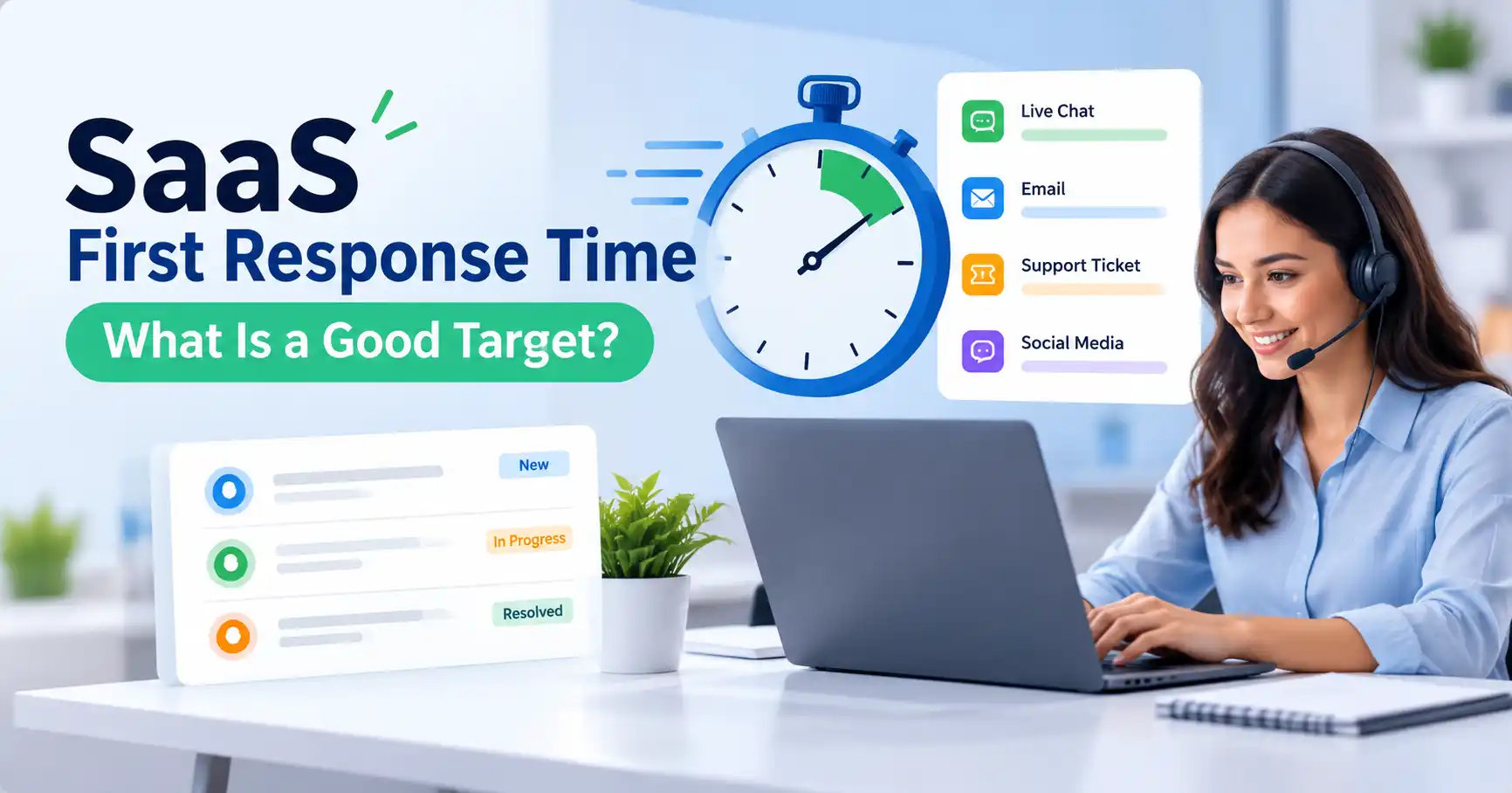
First response time in SaaS tracks how long a customer sits waiting for a real answer from support. Frankly, a slow reply turns a minor snag into a major headache and just kills customer happiness. What’s a decent target? It really hinges on your support channel, what folks expect, how urgent the ticket is. And what your team can actually handle. This guide dives into measuring that first response time, setting sensible goals, boosting your game, and sidestepping typical support fumbles.
Table of Contents
- What is SaaS First Response Time
- Why SaaS First Response Time is Important
- Step by Step Guide
- Best Practices and Tips
- Common Mistakes
- Tools
- FAQs
- Conclusion
What is SaaS First Response Time
First response time in SaaS? It’s simply how long a customer waits from sending in a support ticket to hearing back from a real person. Don’t count those automatic “We got your message” emails. They don’t actually help anyone. Zendesk agrees, saying it’s all about that first agent reply to the ticket.
Think about it: Someone sends a billing issue at 10 AM, A human agent gets back at 1 PM. Boom, three hours. They might get an auto reply at 10:01 AM, sure, but the real wait time, the one that matters, is still that whole three hours until someone actually helps.
Now, there’s no magic number that works for every single SaaS business. Email support can probably take a bit longer than live chat. And if you’ve got big enterprise clients paying extra for top tier support, they’ll rightly expect much quicker turnaround.
Why SaaS First Response Time is Important
That first ping from support? It’s crucial. It really shapes how people see your SaaS. Honestly, it can build or break customer trust.
- Frankly, it just makes things better for customers they feel heard, you know, when a real person’s tackling their issue.
- That gut punch frustration? Gone when tech glitches, billing snags, or account freezes unexpectedly crop up.
- SaaS teams can quickly pinpoint support logjams and staffing woes.
- Retention? Skyrockets.
- Speedy replies forge serious trust, and tracking SLAs becomes a breeze, Agents finally have a solid goal.
Zendesk’s take, Ditch the one size fits all first response goal. You’ve got to align those targets with what customers genuinely anticipate and, well, how they’re even contacting you.
Scaling up support? You could actually tether this metric to your wider SaaS customer support figures, then, you’ll spot whether faster answers truly make a difference for them.
Step by Step Guide
Step 1: Define exactly what counts as a first response
Set your start and finish lines before picking any target. It matters.
The clock usually starts ticking the second a user submits their ticket, and it doesn’t pause until someone on the team sends back a truly useful first answer. Those automated “got your message” acknowledgements? Keep them distinct from actual human replies, or your reports will unfairly inflate your team’s speed.
Imagine a ticket at 9 AM, an auto reply at 9:01 AM. No real person responds until 11 AM. That’s a two hour first response time, Nothing else.
Step 2: Segment response time by support channel
Don’t slap the same response time goal on everything, email, chat, social media, whatever. It just doesn’t work, Folks expect answers way faster on real time channels. Zendesk, for instance, says you’re good if you hit emails back in 12 hours, live chats in under a minute. And social media in five hours. Those are fine starting points. But honestly, a SaaS company needs to tweak those numbers to fit its own customers and how they deliver service.
| Support channel | Practical SaaS target | Faster target | Typical customer expectation |
| Live chat | Under 5 minutes | Under 1 minute | Immediate help |
| Under 8 hours | Under 2 hours | Same business day | |
| Support ticket | Under 12 hours | Under 4 hours | Prompt acknowledgement |
| Social media | Under 5 hours | Under 2 hours | Quick public response |
| Premium support | Under 2 hours | Under 30 minutes | High priority service |
The key takeaway is to set different response targets for different channels instead of forcing every support request into one SLA.
Step 3: Set targets based on ticket priority
Not every support ticket deserves the exact same response time. Payment failures, security holes, or total product outages demand much faster attention than some general feature question. You need priority levels. Assign a strict SLA to each one.
A critical outage might require action within fifteen minutes. A normal product question, though? That can happily wait four hours.
This smart strategy lets a small SaaS support crew protect urgent customers without ever needing to promise impossible response times across the board.
Step 4: Measure median as well as average response time
Average first response time is handy, sure, yet it often hides real problems. One weirdly slow ticket will drag that average right up.
Track median response time alongside the average for operational decisions, Zendesk actually suggests the median because it kills the noise from bizarre outliers.
Take this scenario. Most tickets get answered inside an hour, but a few sit there for two full days. That average looks terrible. Even though most customers had a fast experience, the median gives you a truer picture of everyday performance.
Step 5: Connect response time with customer outcomes
Don’t optimize first response time in isolation. Look at how it stacks up against CSAT, resolution time, ticket reopening rate, customer churn, and escalation volume. A squad answering in five minutes with half baked answers creates way more follow up mess than a team taking 30 minutes to drop a real solution.
Think about it. Sashing median first response time from six hours to two hours only matters if CSAT goes up too. If speed climbs while satisfaction tanks, dig in, Are your agents rushing?
Best Practices and Tips
- Set realistic SLA targets
Set realistic targets. Goals that look stunning on paper but fail constantly just breed exhausting workplace stress, helping nobody at all. - Prioritize urgent tickets
Fix payment snags, security threats, outages, and locked accounts instantly. Stop letting trivial tickets steal your focus. Critical emergencies demand it. - Use automation carefully
Automation speeds up routing, sorting, and alerts. But it ought to lift human support rather than hide slow replies behind a bot. - Staff around ticket volume
Watch ticket arrivals hour by hour. Suddenly buried at noon? Just shift staff right then, and response times plummet instantly, the best part of it all? Not even a single extra hire is needed to fix the rush. - Build a useful knowledge base
Self service content stops basic tickets. Write articles tackling nagging headaches, like stubborn password lockouts, tricky integrations, billing confusion, and account tweaks, before anyone even asks. - Track response time by segment
Measure initial reply speed by tier, channel, urgency, item, and operating hours. Plain averages hide real trouble. High value clients suffer silently while totals look remarkably fine. - Protect quality while improving speed
A hasty reply missing the mark fails buyers totally. Give staff true context, past history, and product details so that opening answer solves the issue.
Drowning in SaaS support tickets? Examine your customer workflow today, weaving it deeply into every single broader operational experience strategy.
Common Mistakes
- Treating every single channel the exact same way, Counting auto replies as real help.
- Looking at just the average wait.
- Chasing pure speed without checking if the answer even helps anyone, Pushing brutal SLAs while leaving shifts dangerously understaffed.
Flashy dashboards hide slow support. Real people are left to suffer in the end.
Tools
Help desks track early reply speeds meticulously, keeping those strict service agreements completely on track.
- Zendesk excels at ticket tracking, reporting, SLAs, and response times. Intercom, however, is a whole other beast, blending messaging, automation, a help center, and complex workflows seamlessly.
- Freshdesk provides fundamental help desk features, automation, reporting, and SLAs, Help Scout offers shared inboxes, workflows, reporting, and a knowledge base.
- HubSpot Service Hub conveniently combines ticketing, customer chats, reporting, and CRM data.
Don’t obsess over how many features a support tool boasts. What really counts is its ability to cleanly track response times. Can it segment tickets, manage SLAs, and link your team’s daily grind directly to what customers live through? That’s the stuff that matters.
FAQ’s
What is a good SaaS first response time?
For your SaaS company, shoot for email or ticket replies under four hours. That’s a good goal. Live chat needs minutes, though. What’s “right” hinges on your customers, how you run support, ticket urgency, and your Service Level Agreement.
Is a one hour first response time good for SaaS?
Hitting a one hour response time works well for SaaS support teams handling major issues. But let’s be real. That speed is overkill for slow email tickets, and way too sluggish for live chat. Match the pace to the problem.
Should SaaS companies measure average or median first response time?
Track both metrics, the median reveals a standard journey. Meanwhile, the mean distorts reality by lingering on those crawling, exceptionally painful tickets.
Does an automated email count as first response time?
Automated replies fail as real first contact. What truly matters is speed: how fast a human agent can deliver something actually useful, not just an empty bot ping.
Can faster response time reduce customer churn?
Speed pleases clients, yet it rarely locks down true loyalty alone. SaaS teams must constantly juggle fast answers right alongside resolution quality, CSAT, rock solid product stability. And all those deeper metrics that truly count.
Conclusion
SaaS first response time is basically a quick pulse check on your support team. How fast do they actually move, A solid baseline looks like under a minute for live chat. For urgent tickets, aim for two to four hours. Regular emails, Just hit reply within the same business day.
Chasing the absolute fastest clock is a trap. That is not the real win here. Instead, you need targets that fit what your customers expect, how hot the ticket is, your actual headcount, and your service level agreements.
Start by tracking your median response time across every single channel. Spot the bottlenecks. Set real SLAs that make sense, and check those numbers every month right alongside your CSAT and resolution scores.