
Building software forces a brutally tough choice early on. Do you push out a basic MVP first, or just build the entire thing right away? That vast gap between a bare minimum viable product and a fully loaded platform ultimately comes down to scope, cash, and sheer velocity of learning. Choose wisely. Pick the right path and you slash your risk instantly while stopping the hemorrhage of money on features nobody even wants. This guide breaks down how both approaches function, exactly when each makes sense, and how to successfully evolve that early prototype into an enduring SaaS titan.
Table of Contents
- What is SaaS MVP vs Full Product
- Why SaaS MVP vs Full Product is Important
- Step by Step Guide
- Best Practices and Tips
- Common Mistakes
- Tools
- FAQs
- Conclusion
What is SaaS MVP vs Full Product
A SaaS MVP is the barebones, first usable version of a software product, it packs just the core features required to fix one specific customer pain point. Founders use it to test if people actually want the thing and will open their wallets.
A full SaaS product is worlds apart. It brings a lot more to the table. Think deep automation, third party integrations, robust analytics, strict security controls, subscription billing, support tools. And an architecture built to handle heavy traffic.
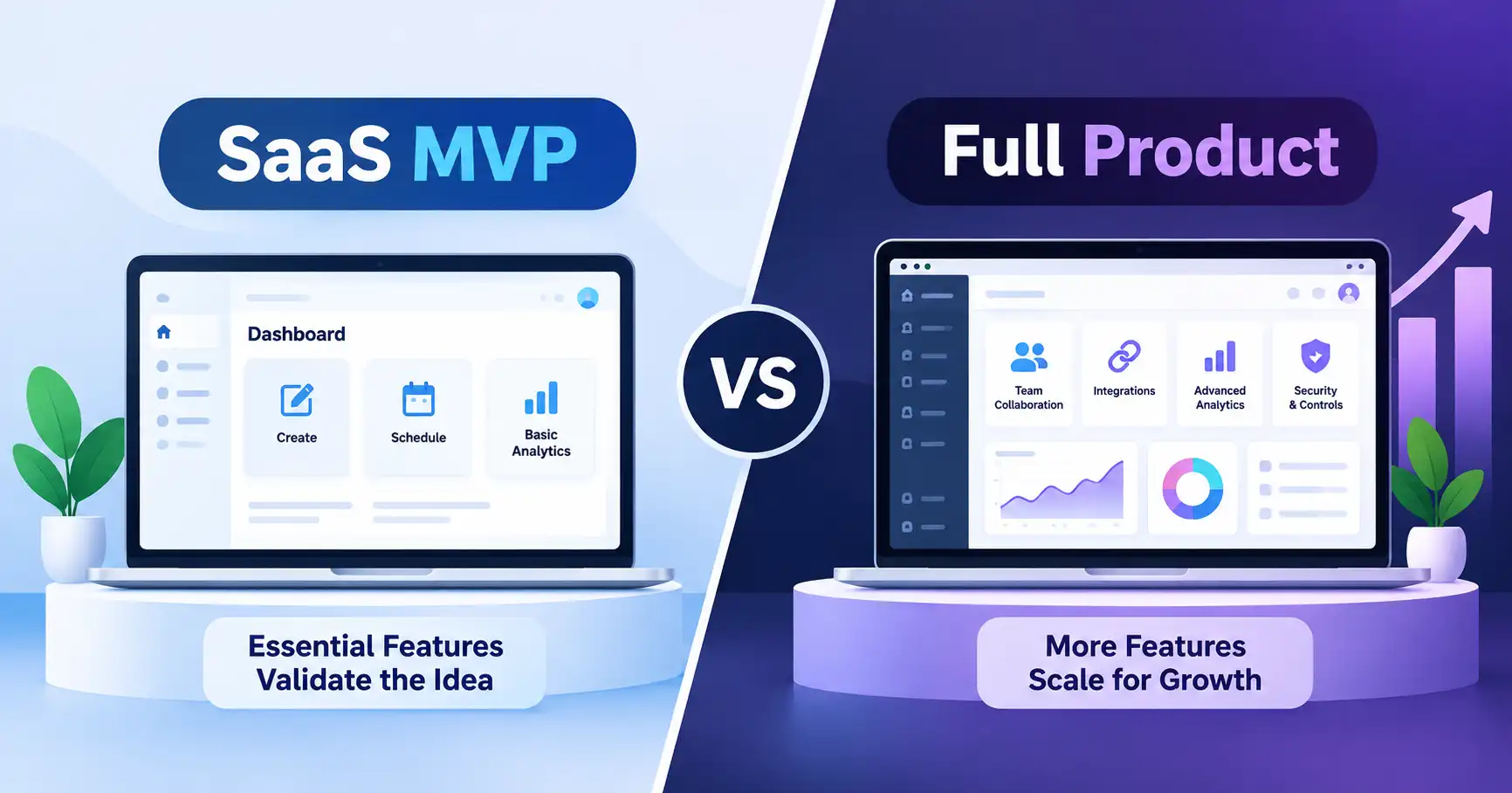
Picture building a platform for small businesses to run social media ads and posts. The MVP just lets users whip up content, schedule it, and check basic metrics. But the mature product? That expands later to add team workspaces, sign off chains, AI writers, social listening, fancy reports, CRM links, and enterprise grade security.
The real gap here isn’t just feature count, An MVP is built to test whether an idea holds water. A full product scales up to meet a much wider web of customer demands.For a deeper understanding of product validation, you can also explore the SaaS Product Discovery resources available on SaaSyntic.
Why SaaS MVP vs Full Product is Important
Once founders and product teams truly understand the chasm, they start making much smarter development choices overall.
• That cuts financial risk right down to size. You can actually test if anyone wants what you’re selling before throwing serious money at it.
• It helps teams figure out what real customers want, instead of just guessing.
• Builds a sharper product roadmap grounded in real user data and actual feedback.
• Your team won’t waste months building stuff customers don’t even want.
• You can finally figure out where to dump your money and effort, is it dev? Marketing? Sales? Or maybe customer support?
A well planned MVP can become the foundation of a larger SaaS product. The goal is not to keep the product small forever. The goal is to learn what deserves investment before expanding the product.
SaaS MVP vs Full Product Comparison
| Factor | SaaS MVP | Full Product |
| Main goal | Validate the core idea | Serve a mature market |
| Feature scope | Essential features only | Broad feature set |
| Development time | Usually shorter | Usually longer |
| Investment | Lower initial investment | Higher investment |
| Customer feedback | Critical for direction | Used for continuous improvement |
| Scalability | Basic foundation | Built for broader growth |
| Integrations | Limited or essential | Multiple integrations |
| Target users | Early adopters | Wider customer segments |
An MVP just hunts proof. Meanwhile, a full product targets massive customer value, chasing serious scale across the entire market without looking back.
Step by Step Guide
Step 1: Define the Core Customer Problem
Zero in on the precise agony your SaaS must soothe. Forget the endless feature parade, especially early on.
Imagine finance teams squandering entire afternoons wrestling with monthly expense reports. Your main gig? Drastically cutting the time they spend gathering and sorting that data, Seriously, go chat with potential customers. Dig for that one nagging grievance, that single pain point that gives your MVP its real purpose.
SaaS product discovery framework helps you log these buyer struggles, what users truly need, and your early hypotheses before a single line of code gets written.
Step 2: Separate Essential Features From Nice to Have Features
Create two lists. The first should contain features required to solve the core problem. The second should contain features that could improve the experience later.
Your expense SaaS MVP just requires basics like receipt uploads, simple entry, categorization, and reporting. Forget fancy custom dashboards, complex accounting integrations, heavy approval workflows, or clever AI tips. Why build those now, this approach halts feature creep completely, keeping that first release ruthlessly focused..
Step 3: Build the MVP Around One Clear Use Case
Your MVP needs a straight line from problem to fix. Take an expense app. A person signs up, drops in receipts, tags them, builds a report, and sends it out. Every single core feature must back that exact path up. No wandering.
Don’t strip out the basics just because it is a first version, Real users demand logins, locked down data, clean error messages, backups, and basic usability.
When you map out SaaS architecture, AWS has blueprints. They cover things like keeping tenants apart, handling IDs, onboarding, watching system health, and keeping AWS bills under control.
Step 4: Launch With a Small Customer Group
Skip the rush for thousands of users right out of the gate, Grab a small, tightly focused group of early adopters instead. Find people who actually fit your target profile.
Watch closely how they use the stuff. Keep tabs on activation rates, features they touch, stickiness, support tickets, and recurring headaches.
Take a dashboard people constantly skip while exporting reports left and right. That behavior speaks volumes. Real customer actions beat planning assumptions every single time.
Step 5: Use Feedback to Build the Full Product
Revisit your MVP numbers. Once data piles up, hunt for fixes, ruthlessly slash dead weight, and unearth hidden growth. Surprises lurk in integrations. Another feature that looked important during planning may turn out to have very little usage.
Build the full product around validated customer needs rather than simply adding every feature requested by individual users.
This SaaS product roadmap grows fierce, now, development funds relentlessly chase hard proof instead.
Best Practices and Tips
• Pick one specific group of buyers to focus on. Don’t try to appeal to the whole world at once.
• Pin down the actual problem first. Only then should you start building out that feature backlog.
• You want the MVP tight, sure, but don’t ever skimp on security or the basics of reliability.
• Pick hard numbers for your MVP, like how many people stick around, activate, pay, or keep coming back.
• Talk to your actual customers face to face. Don’t just stare at the analytics dashboards all day. Numbers only tell half the story.
• Sort your features by what actually moves the needle for customers, brings in business value, takes reasonable effort, and fits the big picture strategy.
• Design the technical foundation so successful MVP components can evolve without requiring a complete rebuild.
For more SaaS growth and product strategy resources, visit SaaSyntic and connect your MVP decisions with your wider SaaS business strategy.
Common Mistakes
Building the Full Product Too Early
One of the most common mistakes is investing heavily before validating whether customers actually need the solution. A large feature set does not automatically create product market fit.
Confusing an MVP With a Poor Quality Product
An MVP should have fewer features, not poor usability. Customers should still be able to complete the intended task reliably.
Adding Every Customer Request
Customer opinions matter, sure. But chasing every single whim wrecks your roadmap. Look for stubborn patterns across many users instead. That is the trick.
Ignoring SaaS Operations
Founders obsess over features early on, but billing, onboarding, monitoring, support, security, and data management get ignored. Big mistake. As users pile in, these blind spots catch up.
Rebuilding Everything After Validation
Your MVP needn’t be disposable. Choose your architecture and stack wisely. Let those winning foundational pieces organically mature alongside the product, provided you plan well.
Tools
Jira
Jira equips product teams to track MVP backlogs, crush annoying bugs, and plan tomorrow.
Figma
Figma plots user journeys, wireframes, and clickable prototypes long before code gets written.
PostHog
PostHog maps product paths. It reveals the exact features people actually touch every single day.
Stripe
Stripe can support subscription billing and payment workflows when you are ready to monetize the SaaS product.
AWS
AWS provides infrastructure and SaaS architecture resources that can support teams as they move from an early product toward a more scalable service.
FAQ’s
Is an MVP the same as a full SaaS product?
No. An MVP is just a stripped down first version meant to test an idea and fix one main headache. A full SaaS build tackles way more users, workflows, integrations, and operational demands than that.
How long should a SaaS MVP take to build?
Forget standard timelines. A basic MVP demands mere weeks. Conversely, an intricate digital product stretches into endless months, because scope dictates absolute control. Always remember this truth: the genuine weight of your core problem crushes arbitrary calendar deadlines.
Should every SaaS startup build an MVP?
Not necessarily. Certain products carry heavy regulatory or technical demands that make building a quick MVP tough. Still, teams usually find clever ways to test critical assumptions before writing mountains of code.
When should an MVP become a full product?
Only broaden your main services when you have solid proof people want them. Know exactly which improvements truly boost lasting customer worth, loyalty, or revenue. No guesswork.
Can an MVP become the final product?
Some products win just because bloat is universally despised. An MVP should never mutate into an endless, bloated ecosystem simply because modern software engineering makes cramming in useless extras so tempting.
Conclusion
A SaaS MVP and a full product split apart on purpose, scope, money spent, and maturity. An MVP is built strictly to test one core fix with actual buyers, whereas a full product stretches wider to tackle bigger demands and years of growth.
Smart builders start small. Really small. You drop the leanest version that actually solves a problem, watch how people react, and let their feedback steer the wheel. Before writing code on your next SaaS project, pin down the main headache, pick the absolute fewest features needed, and sketch out what comes after the trial run.
For extra product strategy help, check out SaaSyntic and other guides before locking down your roadmap.External resources that can support this process include Atlassian’s guide to minimum viable products and AWS’s SaaS architecture guidance.