

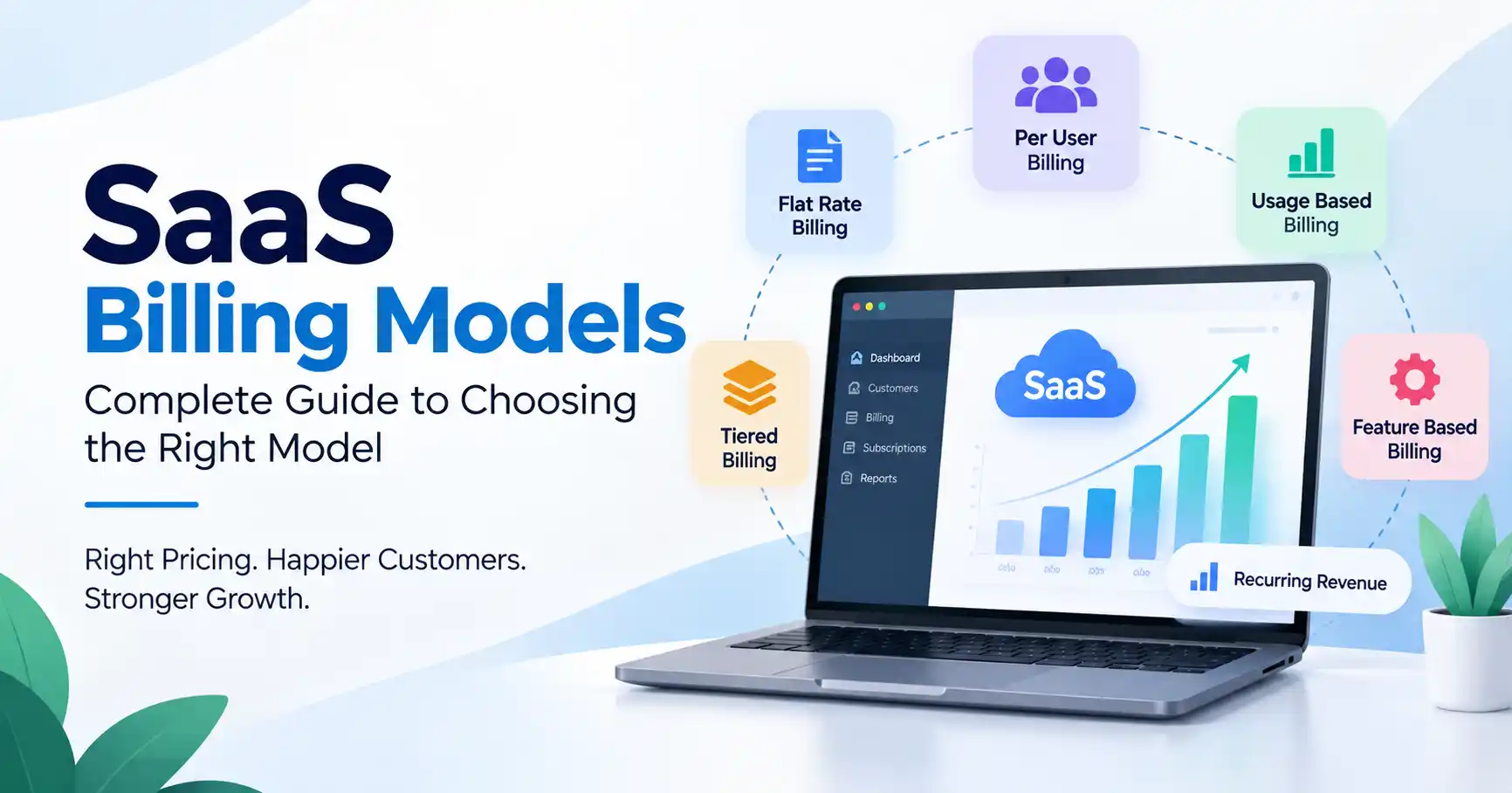
SaaS billing models are the ways a software company charges people for using the product. That can be based on features, seats, usage, or time. Picking the wrong setup often causes pricing confusion. It can also slow down growth and lead to higher churn.
A good plan ties the price to the value customers actually get. At the same time, it helps the business forecast revenue. This overview covers the major SaaS billing models. It also shows how to decide which one fits, what to do during setup, and the main best practices. You will also see frequent missteps and the tools that can help run billing more smoothly.
Table of Contents
- What is SaaS Billing Models
- Why SaaS Billing Models are Important
- Step by Step Guide
- SaaS Billing Model Comparison
- Best Practices and Tips
- Common Mistakes
- Tools
- FAQs
- Conclusion
What is SaaS Billing Models
SaaS billing models are simply how software companies charge their customers. The structure decides if people pay a flat subscription, per seat, by usage, tier by tier, or some mix of these.
Take a project management tool, they might bill ten bucks a month per user. A developer API tool? They charge per call. An AI startup often mixes a monthly fee with token consumption.
We see flat rate, per user, tiered, usage based, feature based, and hybrid models out there. The right pick depends entirely on where your customers actually get their value.
If you want a deeper look at SaaS growth and strategy, check out the SaaS billing.
Why SaaS Billing Models are Important
That billing model extends far past finance. It actually pulls every single lever, completely reshaping acquisition, conversion, retention, expansion, and experience.
- It creates predictable revenue by establishing a consistent payment structure.
- It gives customers a clear connection between price and product value.
- It creates expansion opportunities as customers add users, features, or usage.
- It influences conversion by making pricing easier or harder to understand.
- It affects operational complexity across finance, sales, product, and engineering.
Clients need utter clarity on your billing structure, while the whole system simultaneously scales up effortlessly alongside your rapidly expanding enterprise.
Step by Step Guide
Step 1: Identify Your Core Value Metric
Start by identifying what customers actually value. This could be users, transactions, storage, projects, contacts, API calls, or another measurable outcome.
For example, a collaboration platform may create more value as more employees use it, making seats a logical billing metric. A cloud storage product may be better aligned with gigabytes stored.
Avoid choosing a metric simply because it is easy to track. It should increase when customer value increases.
Step 2: Select the Right Billing Model
Once you lock onto your value metric, choose a pricing model matching actual buyer habits. Flat rates work fine when everyone gets identical worth, but per user billing clicks only when value scales with growing teams. Consumption fluctuates, Go usage based. Tiered packages serve distinct segments well. Hybrid setups blend steady subscriptions with variable charges. Simply put: match the mechanism to the market.
Step 3: Design Your Pricing Structure
Create plans that make the buying decision simple. Most SaaS companies use a small number of clearly differentiated SaaS pricing strategy.
For example:
Starter: 29 dollars per month for small teams
Growth: 99 dollars per month with advanced automation
Business: 299 dollars per month with additional controls and support
Enterprise: Custom pricing based on requirements
Subscription tiers require real differences. Never build fake walls just to nudge buyers into expensive upgrades.
Step 4: Build Billing and Usage Logic
You need a billing setup that can manage subscriptions. It should also cover plan changes like upgrades and downgrades. The same system must deal with invoices, payment failures, and tax rules. It also needs to support discount codes, free trials, and cancellations.
If you use usage based billing, metering accuracy matters a lot. The platform must log what the customer actually uses. Then it must turn that usage into the charges that go on the bill. Stripe describes this kind of billing as a flow that starts with usage collection, then price setup, then billing the customer. It also includes checking the usage over time.
Stripe usage based billing documentation provides additional implementation guidance.
For complex products, involve engineering and finance before launching the model. A pricing change that looks simple on the pricing page can create significant backend complexity.
Step 5: Test and Optimize
Do not assume the first billing setup will stay. Keep an eye on how well signups convert, the average money made per account, how much comes from upsells or add ons, and how many accounts leave. Also watch for downgrades and for what kinds of help tickets people file.
For instance, if many users quit a plan that charges by use because they cannot guess what the bill will be each month, you can change the offer. Add a spending cap, offer prepaid credits, send usage alerts, or include a small monthly base fee.
Run controlled pricing experiments instead of changing everything at once. New customers can often be tested first before existing customers are migrated.
SaaS Billing Model Comparison
The following table compares six common approaches.
| Billing Model | How It Works | Best For | Main Advantage |
| Flat Rate | One price for all customers | Simple products | Easy to understand |
| Per User | Price increases with seats | Collaboration software | Revenue grows with adoption |
| Tiered | Customers choose feature or usage tiers | Different customer segments | Supports segmentation |
| Usage Based | Customers pay for consumption | APIs and infrastructure | Strong value alignment |
| Feature Based | Customers pay for selected capabilities | Products with distinct features | Monetizes functionality |
| Hybrid | Combines subscription and usage charges | Complex or scalable SaaS | Balances predictability and expansion |
Finding the right model hits your metrics, but more importantly, it finally locks down predictable costs so procurement can sign off without hesitation.
Software firms, Stripe notes, juggle recurring, tiered, usage, and hybrid pricing. It all boils down to the value. Stripe SaaS pricing models guide offers additional examples.
Best Practices and Tips
- Make the value metric obvious
Customers should understand what causes their bill to increase. If they cannot predict pricing, they may hesitate to adopt the product. - Keep pricing simple
Complex pricing can increase sales friction. Start with a structure customers can understand without a sales call. - Provide usage visibility
If customers pay based on consumption, show current usage, projected charges, and relevant limits inside the product. - Use annual plans strategically
Annual billing can improve cash flow and reduce renewal frequency, but provide a meaningful reason for customers to commit annually. - Design for expansion
Your billing model should provide a natural path from small accounts to larger accounts. Seats, usage, features, and add ons can all support expansion. - Plan for failed payments
Invoices are not the end. Automated retries, stern reminders, and recovery workflows actually stop involuntary customer churn completely.
Customer behavior, infrastructure costs, competitors, and product value change over time. Review your billing model using actual customer and revenue data.
For broader SaaS strategy and operational guidance, you can also explore SaaSyntic and SaaSyntic SaaS strategy resources.
Common Mistakes
- Choosing a metric customers do not value
A metric may be convenient internally but meaningless to buyers. This creates resistance and makes pricing difficult to justify. - Making usage based pricing unpredictable
Customers should not receive unexpected bills. Usage alerts, limits, estimates, and transparent dashboards can reduce bill shock. - Creating too many plans
Ten pricing tiers rarely make the buying process easier. Most businesses can serve their market with fewer, clearly differentiated options. - Ignoring billing operations
Pricing changes can affect invoices, taxes, accounting, sales commissions, customer portals, and product access. Treat billing as a cross functional system. - Copying competitor pricing
Market context matters. Still, your pricing structure has to reflect true product economics and what buyers actually value.
Tools
Several platforms manage billing for SaaS businesses.
Stripe handles subscriptions, usage charges, tiered pricing, invoices, payment recovery, and recurring revenue workflows smoothly. It just works.
Paddle brings subscription tools alongside merchant of record features, effortlessly tackling recurring billing, usage fees, plan swaps, and global tax handling.
Chargebee focuses heavily on subscription management, recurring bills, and rev ops, fitting complex pricing models quite well.
Recurly hones in on subscription billing, automatic payments, recovering lost revenue, and tracking the customer lifecycle from start to finish.
Then you have Zuora, which massive subscription companies rely on whenever they desperately need deep monetization and advanced revenue tracking.
FAQ’s
What is the best SaaS billing model?
No single model wins for everyone. What you pick depends on how you measure value, what users do, how the product makes money, and how you plan to grow. If you charge per user, it can work well for team oriented products. If you charge by usage, it often fits things like infrastructure or API offerings.
What is usage based billing in SaaS?
Hybrid billing, you know, it just works sometimes. SaaS firms want that steady cash flow, absolutely. But when user consumption fluctuates, those variable charges are a lifesaver.
Is hybrid billing better than subscription billing?
Hybrid billing can be better when a SaaS product needs predictable recurring revenue while also capturing additional revenue from usage. It is particularly useful when customer consumption varies significantly.
How many SaaS pricing tiers should a company have?
No fixed number exists, but starting with three self service tiers plus an enterprise option works well for most SaaS companies. The real key here isn’t how many plans you build. It is making sure each one actually stands apart.
Should SaaS companies offer monthly and annual billing?
Usually, offering both can work well. Monthly billing reduces the initial commitment while annual billing can improve retention and cash flow. The annual option should provide a clear benefit without making monthly customers feel penalized.
Conclusion
SaaS billing models dictate how your company captures value and how customers experience your pricing. Flat rate, per user, tiered, usage based, feature based, and hybrid setups. Each structure tackles a completely different business problem.
First, pinpoint your strongest customer value metric. Then lock in a billing setup that makes that value dead simple to understand. It needs to support effortless expansion while remaining operationally manageable for your team.
Next up, dig into your current customer metrics. Look at usage, conversion, churn, and expansion data, Does your billing model scale right along with the value you deliver? If not, switch it up.