

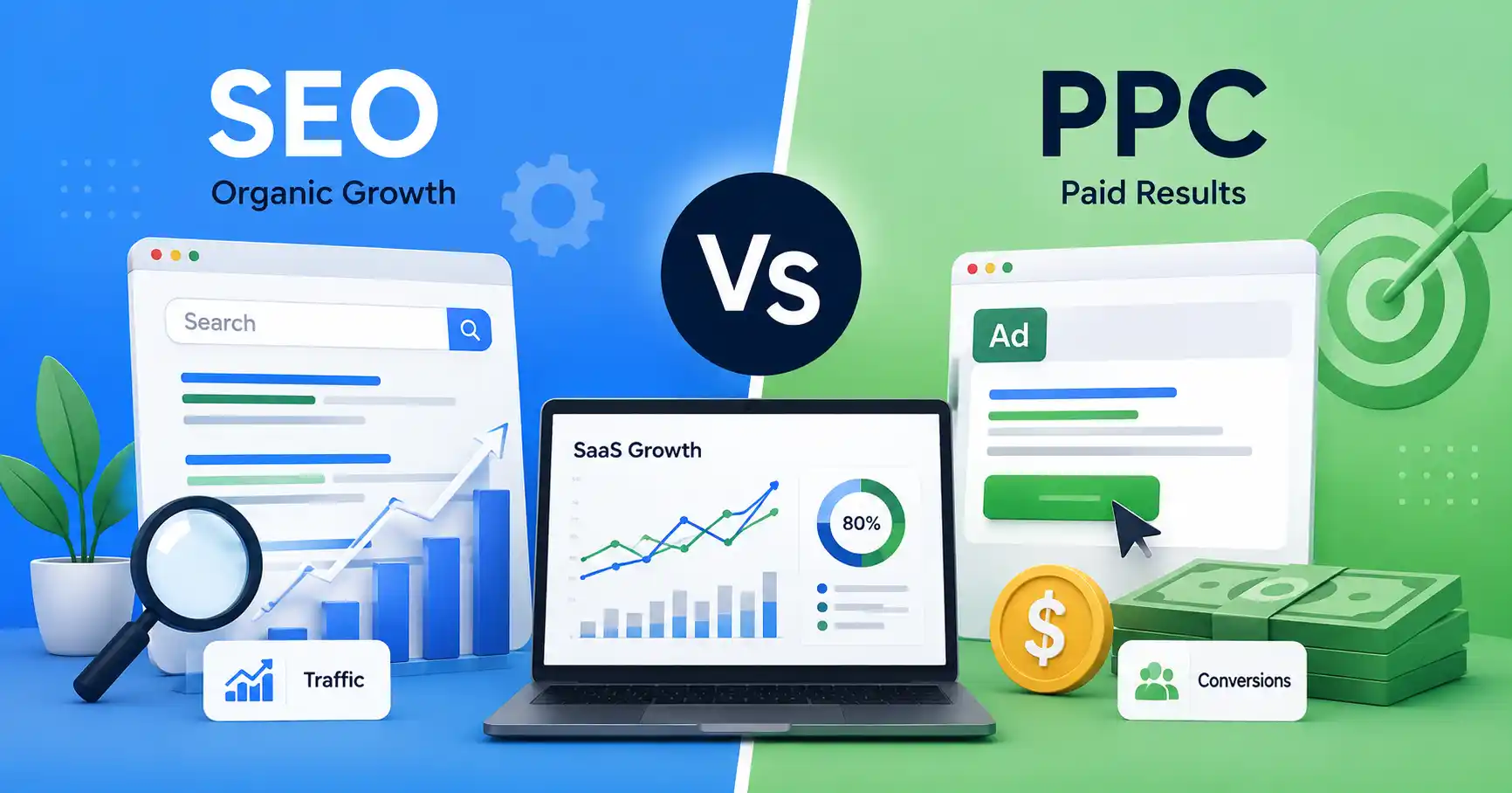
Deciding between SEO and PPC can be a bit tricky for SaaS teams, because both channels can bring leads in, but they behave in a very different way. SEO is all about building organic presence and pulling in people via search intent , while PPC leans on paid ads to meet potential customers faster. Which one you should pick really depends on your objectives, your runway budget, your sales cycle, and how quickly you need outcomes. In this piece, you’ll see how SEO and PPC line up for SaaS, when you should rely on each, and why mixing them often builds a more dependable acquisition system.
Table of Contents
- What is SEO vs PPC for SaaS
- Why SEO vs PPC for SaaS is Important
- Step by Step Guide
- Best Practices and Tips
- Common Mistakes
- Tools
- FAQs
- Conclusion
What is SEO vs PPC for SaaS
SEO vs PPC for SaaS is basically a comparison between two different search acquisition methods. SEO helps a SaaS website gain unpaid visibility in search results by tuning up content, technical performance , authority, and making sure the pages match real search intent. PPC uses paid advertising to get a SaaS offer in front of people who are actively searching for relevant terms, this is the quick route.
For example, picture a SaaS company that sells project management software. With SEO, it might publish materials around phrases like project management software for startups and ways to manage remote teams, these topics can pull in organic visitors over time. With PPC, it could instead pay to show up right when someone types project management software into a search engine.
In general, SEO takes longer to build. but it can keep sending visitors after the first work is done. PPC brings traffic far faster, yet the company must keep paying for every click and for every conversion that results.
Why SEO vs PPC for SaaS is Important
Getting the difference between these channels helps SaaS marketers put money where it actually matters based on business goals, not just picking the one that looks easier at first.
• SEO can create longer run organic traffic, and it reduces dependence on paid acquisition.
• It can also help build authority by publishing useful material and covering topics broadly.
• Meanwhile PPC can deliver immediate visibility for high intent searches.
• It makes it easier to test offers, messaging, and landing pages much faster than waiting on rankings.
• When you use both, you also get sharper signals. that can improve the whole acquisition strategy over time.
A strong SaaS marketing strategy usually goes beyond traffic alone. The real aim is qualified trials, demos, users who activate, and ultimately paying customers.
SEO vs PPC for SaaS Comparison
| Factor | SEO | PPC |
|---|---|---|
| Speed | More time, usually slower | More quick, usually faster |
| Cost model | Mostly investment in content and tuning | Paying for ads, and clicks |
| Long term value | Can keep generating organic traffic | Web traffic usually ends when the campaigns end |
| Best use | Sustainable demand generation | Fast tests and high intent grabbing |
| Main challenge | Competition and how long it takes to rank | Higher costs and wasteful campaigns |
| Measurement | Site visits, search positions, leads, conversions | Clicks, conversions, acquisition cost |
| Ideal for | Longer term growth | Right now demand plus testing |
Key takeaway: SEO builds a long run acquisition asset, while PPC is good when you need targeted traffic and quicker signal.
Step by Step Guide
Step 1: Define Your SaaS Growth Goal
Start with the business outcome first, rather than the channel itself. Decide if you need more free trials, demo requests, sales qualified leads, or direct subscriptions.
For instance, a fresh SaaS product preparing for launch may require immediate reach and customer input. PPC can help drive that first wave of demand, while the team builds the organic search base.
A more established SaaS company with solid content resources might be better with heavier SEO commitment.
Step 2: Understand Search Intent
Not every keyword deserves the same treatment. See what the searcher is actually chasing, before you choose between SEO and PPC.
High intent searches, like CRM software for small businesses or accounting software pricing , can be good candidates to test with PPC. Meanwhile informational searches, such as how to manage customer onboarding may fit better with SEO content.
For a deeper approach, use your SaaS keyword research routine to bucket keywords by the main problem, the practical scenario, and where the buyer is in the journey.
Step 3: Calculate Customer Acquisition Economics
Don’t judge SEO and PPC by traffic alone. Instead, compare them using business metrics.
For PPC, you should measure cost per click, conversion rate, cost per lead, customer acquisition cost, and customer lifetime value.
For SEO, check the cost of content production, organic conversions, assisted conversions, and the longer term worth of what the traffic ends up doing.
For example, a PPC campaign could pull in 20 customers but at a rather steep acquisition cost . An SEO article might take a few months to climb into the rankings, yet once it does, it can keep generating capable leads each month without having to pay for each individual visit.
Step 4: Test PPC While Building SEO
SaaS companies do not always need to pick just one path. PPC can be useful to validate commercial keywords before you put more money into a bigger SEO push.
Let’s say your PPC campaign proves that people searching for employee onboarding software are converting with solid results. That signal can guide your SEO work. You might build a dedicated landing page, write comparison content, create a use case page, and add supporting articles around the same theme.
In this way, paid search becomes a kind of market intelligence that feeds organic search too, not just traffic.
Step 5: Build an Integrated Search Strategy
Once you have enough numbers and proof, link SEO and PPC together, rather than treating them as separate chores.
Use SEO to capture wider demand, and the long term pipeline. Use PPC for higher intent commercial queries, fresh offers, competitive testing, and the campaigns that matter most.
You can also make landing pages better by using insights from both channels, and yes, it helps to tie everything together even when the details feel messy. Your SaaS SEO content strategy should connect the search intent with the actual product pages, but also with educational articles, comparison-style pages, and clear conversion routes.
Best Practices and Tips
• Rank keywords by buying intent first, and don’t over focus on search volume alone.
• Use PPC to test messaging before you sink a lot into long form content.
• Build your SEO structure around customer pain points, use cases, and product categories.
• Send paid traffic to specific landing pages, not generic ones, because those usually leak conversions.
• Track trials, demos, pipeline, and revenue, rather than relying on clicks only.
• Rework SEO content that already performs well when search intent shifts, or when competitors get louder.
• Compare SEO and PPC performance side by side, to spot search themes that look profitable.
Google Ads offers campaign options that reach people who are actively searching for products and services, so it is handy for validating high intent demand quickly.
Common Mistakes
1. Picking PPC just because SEO takes time
Speed helps, but paying for traffic doesn’t automatically make it profitable, ya know. If targeting is off, and the landing page is weak, acquisition costs can rise fast, like immediately.
2. Choosing SEO Because It Feels Like Free
“Organic” does not mean zero cost. SaaS SEO needs keyword research, content production, technical fixes, internal linking, and continued optimization, every month.
3. Chasing High Volume Keywords With No Real Intent
One keyword can bring in thousands of visits, yet still lead to almost zero customers. SaaS teams should tie keyword ideas to real product use cases and the buying stage people are in.
4. Measuring Only Visits
Traffic is just an early signal. The really important numbers are qualified leads, trial engagement, sales opportunities, customer acquisition cost, and revenue.
5. Treating SEO and PPC Like They Never Touch
Paid search insights can show which keywords and messages actually work. SEO can then build landing pages and content that lowers the need for paid acquisition, over time.
Tools
Google Search Console
Useful for monitoring organic search performance, indexing , queries and pages that get search visibility, it helps you see what’s happening under the hood.
Google Ads
Useful for testing commercial terms, offers, audience targeting and landing pages through paid search campaigns, you can validate demand faster.
Google Analytics
Useful for understanding traffic sources, what people do on the site, conversion paths, and customer journeys, it can feel a bit like detective work.
Ahrefs
Useful for keyword research, competitor analysis, backlink research, and tracking organic search chances, it also supports deeper audits.
Semrush
Useful for SEO research, competitor analysis, keyword tracking, and broader search marketing evaluation, it gives multiple angles.
FAQ’s
Is SEO or PPC better for SaaS?
Neither is automatically better, SEO often turns out to be stronger for sustainable organic growth , while PPC helps a lot for instant visibility, testing small things, and pulling in high intent demand.
Should a SaaS startup start with SEO or PPC?
A startup can use both methods, but the balance depends on the budget and the urgency a bit, and also how fast you need leads. In practice PPC tends to give swifter customer feedback , while SEO is more of that longer term customer acquisition rhythm.
How long does SaaS SEO take to work?
SEO results depend on the competition level, the authority of the site, the content quality, and also the real search intent behind that query. Sometimes a page starts appearing earlier than you’d think, even if it was not ready, but in many cases the more jammed commercial phrases can take quite a while longer to mature.
Is PPC expensive for SaaS companies?
It can be quite pricey when you target high competition keywords that signal serious purchase intent. The real question is not only the cost per click , it is whether those clicks turn into customers whose lifetime value comfortably covers the acquisition expenses.
Can SEO and PPC work together?
Yes, absolutely. For many SaaS setups the best play is to mix them in the same period, because PPC captures near term demand and at the same time feeds keyword insights. At the same time SEO builds longer lasting organic traction, and that also helps reduce the dependence on paid traffic, which is usually what people forget.
Conclusion
Picking between SEO and PPC for SaaS really should come from where you are in your growth cycle, what your budget looks like, how customer acquisition economics actually shake out, and how urgent you need results to be. SEO tends to help you establish a durable organic pipeline, while PPC shines when you need quick exposure and tight, measurable experiments.
For most SaaS teams the more useful question usually is not “SEO vs PPC, which one wins?” but rather how both channels can work toward the same revenue objectives at the same time. Start by pinpointing your highest value search opportunities. Then run PPC tests on the key commercial terms, and in parallel publish SEO content that matches the themes where real customer demand is showing up.
The next step, practically speaking is straightforward. Look at your top customer problems, connect each one to search intent, list the most valuable keywords, and decide which terms deserve immediate paid validation, and which should turn into long term SEO assets.