


Introduction:
- To attain better decision-making and accelerate growth, knowing of the crucial SaaS marketing metrics is essential.
- Although finding out about CAC (Customer Acquisition Cost) and CLTV (Customer Lifetime Value) is helpful, knowing that these metrics are pathways leading to profits is more beneficial.
- User Conversion and Churn Analysis are also important for small SaaS businesses seeking to achieve a sustainable scale.
Why is it Essential to Learn: Then Proper SaaS Marketing Metrics?
Whilst a lot of what has been mentioned concerning the marketing metrics utilized in SaaS services might appear to be more related to mere numbers, the reality is that these measurements can lead to decisions that help grow their businesses and make an impact on a higher revenue stream. According to ProfitWBritishers, more than 80% of SaaS-based organizations that track key metrics have experienced added growth faster than those who are not.
Often, many SaaS businesses, particularly the smaller ones, seem to get distracted by vanity metrics like website traffic or social media followers. While they also matter, they may not sufficiently provide a clear picture of health or growth of the business. The following post will provide good insight into better metrics to follow, like Customer Acquisition Cost (CAC), churn rate, and Customer Lifetime Value (CLTV), that will solidify measures into the desired strategy for the SaaS growth.
Critical Metrics to Track: But what you want to be able to see is how much your marketing efforts are going to contribute to improving the ROI.
What Are the Most Important SaaS Marketing Metrics to Track?
These metrics need to be on the list for any SaaS business for its marketing execution:
- Customer Acquisition Cost (CAC)
- Customer Lifetime Value (CLTV)
- Churn Rate
- Conversion Rate
- Monthly Recurring Revenue (MRR)
Now for some insights on these metrics.
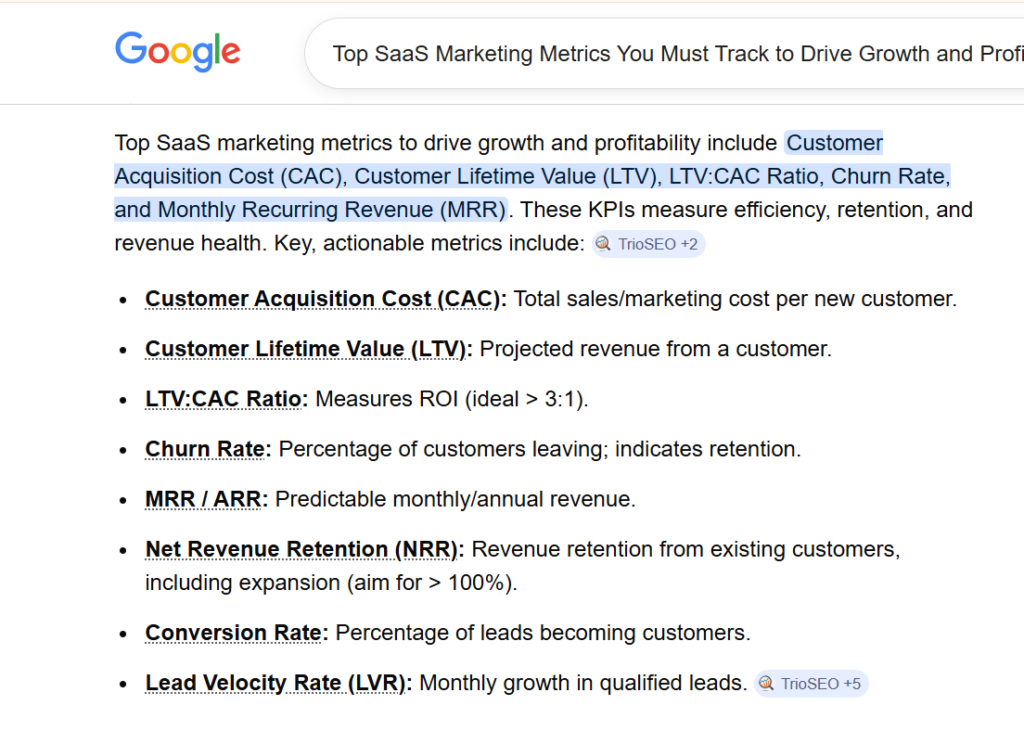
Customer Acquisition Cost (CAC)
Customer Acquisition Cost (CAC) is one of the most critical statistical indicators of a SaaS organization, measuring the expenses occurring for acquiring a new customer. The CAC then provides a means to understand and monitor the efficiency of various acquisition techniques.
For example, if it takes $500 to purchase a customer, but people only pay on average $100 monthly, you’re in a soup.
| Metric | Why It Matters |
|---|---|
| Customer Acquisition Cost (CAC) | Helps assess if you’re spending efficiently to gain customers. |
| Customer Lifetime Value (CLTV) | Shows how much revenue a customer brings over time. |
| Churn Rate | Indicates if customers are leaving and how to improve retention. |
| Conversion Rate | Measures how effectively website visitors are turning into customers. |
| Monthly Recurring Revenue (MRR) | Helps predict future revenue and plan for growth. |
Customer Lifetime Value (CLTV)
CLTV calculates the quantity of revenue the customer contributes during the expected period of business association between the company and the customer. So good is the sense of having this particular metric, here clearly placed for checking if your CAC is debt-accurate. If CLTV equals a great deal of CAC, you are totally up the right path.
Quick Tip: A ratio of 3:1 for CLTV:CAC is considered good with most SaaS companies. Anything less than that should send off signals for change in the approach towards customer acquisition.
Key Metric to Track: Just ensure that the CLTV is consistently greater than the CAC in order to ensure profits.
How Can Conversion Rate Optimization (CRO) ImproveMarketing?
Conversion Rate Optimization (CRO) measures how well your marketing turns visitors into paying customers. It is crucial in figuring out which channels and strategies are working well and how to improve the poorly-performing ones. Your rate of optimization could be the fine nuances that prevent you from scaling at all versus a rapid scaling up.
Using a hypothetical example in the real world, you could have $10,000 worth of ads driving a crowd totaling up to 10,000 visitors to your website, but if you witness a dismal 1% conversion rate, (consider it a blind spot.) Nevertheless, increasing the conversion rate from 1% to 3% gives you 300 customers for those dollars instead of 100.
Now, you have much more marketing dollars that you can leverage to scale if supported by due attention to CRO. This is where A/B testing and constant fine-tuning of landing pages, forms, and CTAs set in.
CRO focuses on amplifying the value of the present traffic and effectively providing better customers out from the same amount of expense.
Let us consider your churn rate to be the Sin Killer.
The most important indicator of a customer’s satisfaction is how many customers stop using a SaaS product within a given period. Certainly, high churn rates are catastrophic to SaaS companies, particularly when they start getting bigger. When this stage comes up, you should realize that high churn rates are basically biting into your revenue stream, and your customer experience is just not up to the mark.
Real-World Example: A SaaS company focusing on reducing churn by just 5% can see a massive increase in profitability. A business with 10,000 customers and a 10% churn rate stands to lose 1,000 customers a year: honing that down by 5% can give you an extra 500 customers and increase lifetime revenue.
Quick Tip: Shooting thus seems acceptable annually, aiming to decrease churn rates to under 5%, even though it is not very accurate depending on industry.
Key Takeaway: Monitoring churn at all times will help you identify any red flags that lower customer satisfaction and fixing them will elevate your customer retention.
Using Monthly Recurring Revenue (MRR) to Predict Growth
MRR is one of the most significant numbers for a SaaS company as it calculates the consistent annual revenue anticipated from the subscription on a monthly basis. MRR helps in anticipation of the revenue, hence allowing the SaaS organization to make appropriate financial decisions. Also, if you keep a keen eye on this KPI, you will be able to verify its functionality.
In this case: by regularly growing MRR from quarter-to-quarter; you will slowly see growth in a much clearer trend. That further enables better long term planning and budgeting.
MRR ends up reflecting the actual financial effects when customers upgrade, I downgrade, or new customers join for revenue, thus telling the story about the health metrics of the revenue mechanism.
Revenue An MRR tool does not only help in forecasting a business but also supports keeping the business stable-an importance that extends more to small SaaS business.
How Do These Metrics Affect Small SaaS Companies?
Small SaaS businesses are haunted with marketing data. However, such measurements make the decision-making process much easier for a business. A good understanding of metrics like CAC, CLTV, churn, conversion rates, MRR, et cetera, safeguards startups from certain doom such overspending for non working advertising or underestimation of the importance of customer retention.
Counter-Argument: The brief idea is that these smaller SaaS companies rely on less quantifiable metrics (basically leading me to believe that in enhancing branding, product-market fit, and such), but without tracking the main metrics such arguments seem to be somewhat oxymoronic. Data is the groundwork behind these companies’ elevation.
Conclusion
Tracking right SaaS marketing metrics helps you to make smarter decisions and showcase how profitable you have been. By concentrating on CAC, CLTV, churn rate, conversion rates, and MRR, you can better align marketing strategy with business growth. This is a model that will provide scalability for some SMEs by effectively using the said metrics to reduce the costs of customer acquisition and maximize retention that goes in the best interest of the business. However, remember that measuring vanity metrics is all fun and games. Traffic may be of very little worth in any stage of meaningful growth. Real metrics are somehow related to real customer value and long-term sustainability.
One last reminder: Don’t get caught up with vanity metrics-track metrics that affect real business progress and watch your stay in the marathon.