


The Problem: B2B SaaS Content Marketing presents proposal for which standard strategies are not perfect.
- We all know the critical role of content marketing on behalf of SaaS companies.
- But one significant point to note is that the same sterilized strategies that work for consumer brands don’t always fit the B2B SaaS space.
- Traditional marketing techniques fall short in illuminating the pain points that businesses confront whilst sifting through software solutions.
- Your target market needs no flashiness or offers simply defining them as “catchy.”
- They would rather gather information regarding how your SaaS platform solves real, measurable challenges.
This transition in mindset became, and will remain, a major marketing struggle. Content marketing, in relation to B2B SaaS firms, is no longer about generic strategies; it is now about giving insight, authority, and answering the questions your prospects ask.
How is B2B SaaS Content Marketing Unique?
At the heart of any argument in favor of a B2B SaaS content marketing strategy must lie the simple fact of long-term needs driving business decisions: those are not impulse decisions (which would “order now”). Very much removed from B2C’s emotional appeal and strong branding driving transactions, B2B decisions typically come at the end of extensive research, discussion by several stakeholder groups, and significant considerations for the expected ROI.
What makes this significant?
- The sales cycle is long: Since repeated consideration, even over several months, is crucial for a final sale, bringing in certain groups from each area is extremely likely.
- One can acknowledge that there is diversity in stakeholders: This one is a little more complicated, but B2B purchasers are fairly opposite in terms of financial decisions that carry weight, given its ranks of decision-making authorities driven by different sets of priorities.
- Thus making your content to answer some challenging questions about every nook and cranny of your solution, from incorporating it into existing systems to demonstrating the ROI it turns out over time before it is thought well because while working on a complex, multifaceted task, you need to provide the client with all parameters of information which is countering the risk.
How Do You Create Content that Resonates with B2B ?
Empathy lies at the heart of effective B2B SaaS content marketing: understanding the pain points, hopes, and urgent needs of your audience. Below is what you need to do and how to align your content strategy with them.
- Talk About Problems, Not the Product
Instead of excitedly presenting those features, address the problems the target audience has. Sell your SaaS solution as a path to counteract those very formidable challenges.
For Example:
Assume that you are into project management software. Instead of calling out features such as task management or Gantt charts, just frame how your product will contribute to making the team collaborations more efficient, fewer bottlenecks, and smoothed out delivery in projects.
Why It Works
You are selling to consumers who want to know how their lives will get better if they use your services. If you emphasize features without customer pain point relevance, you may not make the sale.
- Create Educational Content for Thought Leadership
Before reaching the point of being spoken to by a sales rep, prospects are comparing different solutions for their business problems. Educational content is what can win the race. A company that creates detailed resources such as case studies, whitepapers, and industry reports gains authority and you will see an increase in organic traffic.
Example:
HubSpot is NOT ANY LONGER JUST about pimping its CRM. The brand acts like a university or library to train users about effective shortcuts, marketing and lifecycle nurturing. Thence their positioning as thought leaders in their industry.
Does it work?
Provide value to educate your audience and build trust, but make sure it’s informative and, most importantly, actionable, so readers leave with steps to effect change in their business.
| Content Type | Top-of-the-Funnel (TOFU)-Awareness Stage | Middle-of-the-Funnel (MOFU)-Consideration Stage | Bottom-of-the-Funnel (BOFU)-Decision Stage |
|---|---|---|---|
| Blog Posts & Articles | Draws awareness and educates on general industry pain points | – | Assists in comparing solutions, introduces your product as a solution |
| Guides & eBooks | Offer an in-depth educational perspective on problems your prospects may be examining | In-depth education on how your solution works supporting with real examples | Provides real examples of your solution working |
| Case Studies | N/A | Shows how your product actually works against real-world challenges | Provides another confirmation that your solution works and offers confidence to go ahead buying |
| Product Demos | Their effectiveness could be questioned; N/A | Provides a deeper dive into how your product solves exact needs | A final demonstration of your product functionalities closes the deal |
| Customer Testimonials | N/C | Offers social proof as other subscribers gained value from the solution | Eases concerns of excited shoppers by the very account that shows experience from other satisfied customers |
| Free Trials/Offers | N/A | N/A | Provides firsthand experience to the prospects, thus pushing them closer to conversion |
What kinds of content types are B2B SaaS Marketing?
In B2B SaaS content marketing, the differences in the content formats make them good for different stages of the buyer journey. Here are the types of content aligned with each stage:
Top of the Funnel (TOFU) – Awareness Stage
Audience(s) at this stage are newly recognizing issues that ail them; thus draw them in and inform them.
- Blog Posts & Articles: Concentrating primarily on long-form content that discusses major queries while also aims at other numerous inquiries in relation to the industry challenges and suggests the solutions provided
- Guides and eBooks: Deeper insights and briefings are included in causes to provide a more detailed partner for solving complex problems.
- Infographics and Visual Content: Visual content could aid a great deal for the more complex problem after being simplified using such methods.
Once the prospects reach the middle of the funnel, consideration has formally stepped in.
At this stage, they have reached the level where these different solutions, including yours, are side by side for comparison. You need your solution to be represented as the best fit.
- Case Studies: This is a very big stage group of how the solution helped one business after another; that could refer real-world cases.
- Product Demos: The product demos come here, helping prospects think of how their specific challenges can be addressed from a software demonstration.
- Customer Testimonials: Into this stage, social proof can do most of lifting. Prospects must obtain a reassurance through existing customers.
Bottom of the Funnel (BOFU) – Decision Stage
Now that your prospects are familiar with your offering, leaving them in no doubt which decision to make is paramount. You want to admit in every second word why your SaaS product is the only solution for their needs.
- Free Trials/Offers: Offer them any peculiar opportunity to test the software with their own hands.
- Comparison Guides: Help the prospects understand the difference between your product and a competitor’s.
Pro Tip: Fill out your content with lead magnets for example, downloadable templates or trial offers at crucial points to obtain prospects’ information and nurture them.
Should I Cash on SEO for B2B SaaS Content Marketing?
The answer is a giant yes. However, never spare a moment looking back at assets like keyword rankings or organic traffic volume. The B2B SaaS domain rather entails targeting very relevant long-tail keywords, which are but the Holy Grail of terms-which will fetch companies that ask to sign up for products or services similar to yours.
How to do it:
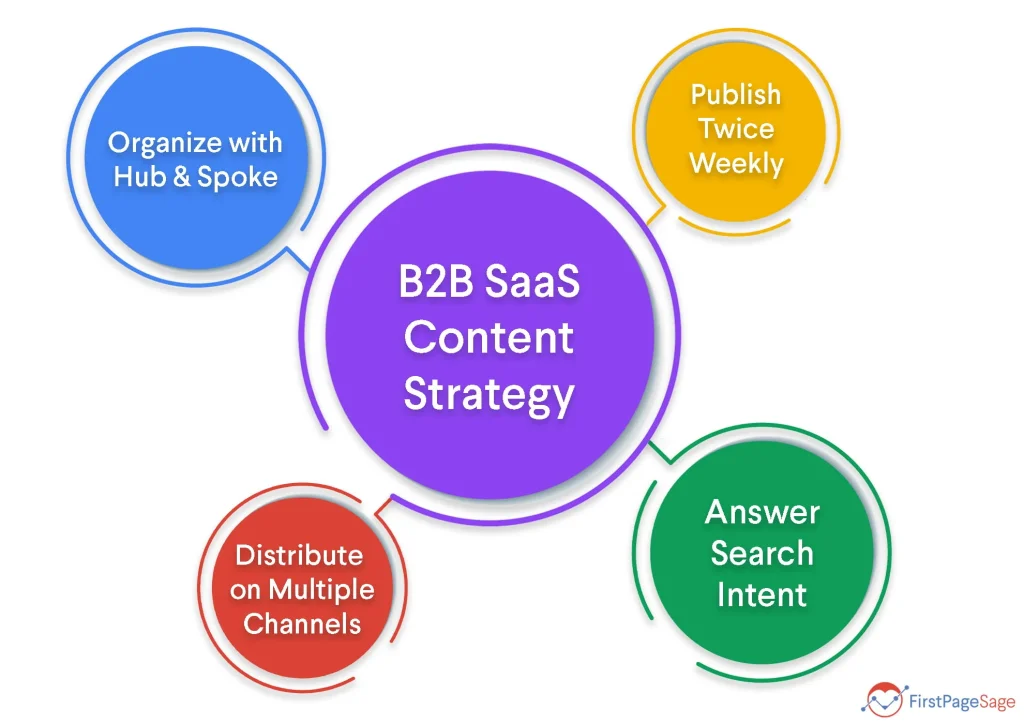
- Recommended: Focus on Search Intent: You need to find out what your target audience is searching for and create content that answers these queries. To find relevant terms, use tools such as Google Keyword Planner or SEMrush.
- Recommended: Optimize for Featured Snippets: Look at what queries your audience is posing and try to optimize that content to dismiss the notion of disappearing from the “position zero” featured snippet.
The Real World Application: A SaaS Content Marketing Example
Now let’s dive a little deeper and take a closer look at how a SaaS company actually used content marketing.
Case Study: Unbounce
- Unbounce, a provider of landing page building and conversion rate optimization solutions, grew its traffic by 17% and conversions by 35% when it turned its focus from feature selling to content-driven delivery.
- Gone are the days when they sold their product.
- When they realized that providing valuable content about conversion rate optimization (CRO) was more beneficial to their customers, they got that in motion.
- Unbounce’s blog became a place for learning what marketers could do right and, over time, an understanding that the way an A/B test is set up and executed is very important, landing page design is paramount, and anything a company spins impacts user experience.
- All the time, Unbounce, subtly, weaved its own tool in as the possible answer.
Insight:
While pushing the product as a symptom reliever for an urgent issue when following an educational approach, Unbounce managed to successfully drip leads through the entire process and established itself as a CRO resource.
Conclusion
- Empathy is key: Your content should solve the real problems your audience faces not just talk about your features.
It is not lost on many experts that: More often than not, specific, humanized content simply offers the customer some kind of contribution. An FAQ page as an easily navigable, concise interactive step in the lead nurturing process simply eases the load on your sales and marketing team.
What makes the difference in SEO is your long-tail keywords. These with low intent are crucial to most enterprise software application company needs as those can be used for relevant queries while high intent, long-tail keywords target search results.
The truth is undoubtedly that inbound marketing efforts for long-term success breeds continuous improvement and evolution. For companies that have in some instances specifically used knowledge-based, value-driven content in developing trust and fostering an improved relationship with customers, sustainability is a well-grounded reality.
Tip: Consistent feedbacks: Consistently update your content according to market trends, customers’ requirements, including SEO, to keep your materials valid and ensure consistently good service.