


Now, after discussing the Word Embeddings model in terms of perspectives, algorithms, and TF-IDF and GloVe with them, we demonstrate possible technology algorithms to establish a neural language model. Now, the article gets over “just link to relevant page.” We should unpack eight advanced strategies for internal linking specifically designed for SaaS. We shall justify when to apply in every case with the principles and reasonings drawn from real uses and we shall also quote some counterarguments.
1) Should SaaS content clusters be organised by intent or topic authority?
Short Answer: Organise first by intent flow; then by topic relevance.
Too many teams build content clusters purely around topics (e.g., “project management”), but SaaS buyers move through predictable intent stages: awareness → evaluation → activation → retargeting. Intent first, topic second.
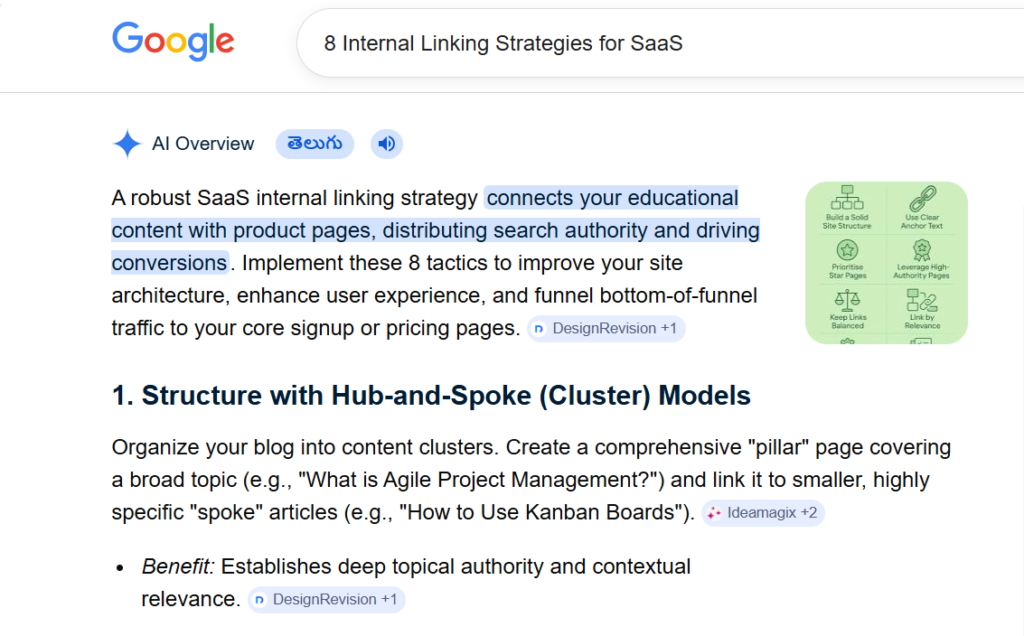
The traditional model: Topic Cluster vs. Intent Cluster
| Cluster Type | Organizing Principle | Typical Pages | SEO Benefit |
|---|---|---|---|
| Topic Cluster | Semantic topical relevance | blog, pillar, subtopics | Helps rank for keywords |
| Intent Cluster | User journey stage | TOFU, MOFU, BOFU, re-engagement | Generates conversions and indicates buyer intent |
Takeaway: Topical authority leads to rankings; intent mapping helps revenue attribution. Practically speaking, it means going from a top-tier “project management guide” right to “feature comparison” or “pricing calculator” not just something lesser, like other articles.
2) How do you prioritize which pages get internal links first?
Simple Answer: Allocate internal links to impact those pages that affect conversion paths and organic landing frequency.
Two signals help land prioritized pages on your doorstep:
- High organic entry volume
- High conversion potential (signups, demo requests)
Example table for prioritization
| Page Type | High Traffic | High Conversion Value |
|---|---|---|
| Topical content | Yes | No |
| Feature pages | Medium | Yes |
| Pricing & comparison pages | Medium | Yes |
| Re-engagement content | Low | High |
Three rules normally followed:
- Establish connections from good traffic pages with upper merit pages.
- Breadcrumb navigation reinforces link hierarchies: topic → subtopic → product.
- Zero orphan pages each page must have a minimum of a strategically placed inbound link.
Summary: Not all pages deserve equal linking; prioritize strategically.
3) What is the anchor strategy for SaaS internal linking?
Short Answer: Use intent-weighted anchors rather than generic anchors.
Using generic anchors like “Click Here” is poison. They fail to instigate searches and reduce engagement. Use task + context:
- “Compare subscription tiers”
- “See API docs for developers”
- “Calculate ROI with our estimator”
- “Jump to feature matrix”
Impact of generic anchor text: Generic anchors may spread keywords artificially but reduce click-through rates. An in-house SaaS experiment found 18% improvement in click-through rates when changing “learn more” to “compare free vs paid features.”
Summary: Intent-weighted anchors improve engagement and relevance more effectively than generic phrases.
4) Which internal linking scheme best reflects buyer intent?
Short Answer: Use a hierarchical cross-linked approach that mirrors the buyer’s journey.
Example flow: Blog → Feature Comparison → Pricing Page → Signup → Onboarding Guides → Feature Deep Dives → Upgrade Offers
Cross-linking types:
- Vertical interlinks (TOFU → MOFU → BOFU)
- Predictive links (e.g., after pricing → onboarding/setup guides)
- Retention links (e.g., churn-triggered content → feature benefits)
Summary: Structured linking aligned to user journeys improves both SEO and funnel conversion.
5) How do you measure SaaS internal linking performance?
Short Answer: Measure forward paths relative to business outcomes, not just PageRank.
Key Metrics:
- Internal Click Through Rates (iCTR)
- Conversion Time
- Drop-off Points
KPI Examples:
- % of users going from blog → signup page
- % clicking from feature comparison → pricing
- Bounce rate differences between linked vs non-linked pages
Summary: Tracking user paths over pages reveals real linking ROI.
6) Why internal linking must account for product usage paths
Short Answer: Internal linking is about both content and product.
Most strategies fail by treating internal linking purely as content SEO. SaaS requires connecting content to product experiences:
- Onboarding content → product pages
- Feature documentation → dashboards
- Churn-trigger content → retention campaigns
Case Study: A B2B SaaS saw a 27% drop in support tickets when API docs were integrated into product headers, examples linked to dashboards, and user roles had tailored doc links.
Summary: Internal links should connect content and product, not isolate them.
7) What are the risks of over-optimization in internal linking?
Short Answer: Excessive internal links or duplicated anchors dilute relevance and can trigger penalties.
Common mistakes:
- Too many anchor texts
- Link-stuffing for SEO without purpose
- Linking to pages with no conversion value
Rule of thumb:
- Max 100 links per high-authority page
- Avoid irrelevant links
- Monitor anchor diversity
Summary: Purposeful linking is critical; over-optimization can hurt SEO.
8) How do you scale internal linking in a growing SaaS knowledge base?
Short Answer: Combine automation with human review and analytics prioritization.
Steps:
- Tool automation (Ahrefs, Screaming Frog, Sitebulb) for orphan pages
- Content tagging for consistent templates
- Human review for anchor intent and funnel relevance
Internal Linking Workflow:
- Monthly site crawl
- Identify pages with low inbound links
- Prioritize by traffic and conversion
- Assign linking plans to editors
- Re-audit impact
Example Roadmap:
- Classify buyer intent stages
- Define page buckets (TOFU, MOFU, BOFU, Product)
- Audit current links
- Build anchor text templates
- Assign linking roles
- Track monthly performance
Outcome: 19% increase in freemium activations for a mid-sized SaaS in one quarter.
Conclusion
Final Thoughts: Internal linking is not a checkbox task. Be strategic, track user flows, and align links with business objectives. Avoid random links, generic anchors, and ignoring user experience.